
Local Ecosystems Regulate Climate Change
How Local Ecosystems Regulate Climate Change — Through the Lens of Understanding Living Systems
Integrating climate science with Raymond & Denis Noble’s Understanding Living Systems (Cambridge University Press, 2023). Why protecting local nature is about restoring agency, not just storing carbon.
Beyond the Machine: a systems view of climate change
Politics today often abandons climate targets. The gungho enthusiasts for fossil fuels cry “Drill baby drill!” calling for more oil and gas exploration. It is as if we are turning towards palliative care of our environment rather than saving it. It is a simplistic remedy for the energy crisis. Yet net zero isn’t the cause of the cost-of-living crisis. There is also a growing sense of throwing caution to the wind, with the argument that what we do as individual nations or communities is outweighed by others’ pollution, and that we can’t make a difference locally. It has become a major issue dividing politics, left and right. However, it is false, because local action matters.
Local action provides hope by protecting habitats
Some still argue that mankind is not the significant cause of global warming. It is a politically convenient concept. A strong lobby favours fossil fuels. At best, politicians are backsliding on renewable energy targets; at worst, they are withdrawing from global agreements to cut carbon emissions. Yet, climate change and armed conflict are major drivers of a cost-of-living crisis. Heatwaves, severe droughts, and unpredictable rainfall destroy crop yields and stress livestock. Just a few days of temperatures over 30°C can heavily damage staples like wheat and maize. This is why we need local action: local ecosystems regulate climate in ways that can help counter the systemic effects of global change. Local action provides hope and a sense of community.
A systems view of climate change is necessary
In the final chapter of our book, under the heading “ The Responsibility of the Human Species,” we said this:
There is just one species that can understand the great responsibility that now lies on its shoulders. That is us humans. We are both responsible for the Anthropocene, the current era of great extinctions of life forms on earth, and for the hope that we can as a matter of deliberate purpose, seek to limit the damage we have done to our environment and ultimately to ourselves.
Raymond Noble and Denis Noble, Understanding Living Systems.
Denis and I discuss this further here as The Awakening Earth.
How does a systems view alter our understanding of climate change? Ecosystems are not regulatory machines with a simple CO2 in → biomass out. We don’t have a thermostat we can turn with a switch. In Understanding Living Systems, we argue this mechanistic view is flawed. In living systems, function is nested within causation, without a privileged level of causality.
Organisms generate the driving forces of the self-regulating living system. It is robust in adapting to circumstances, yet often delicate. Climate change is driving species migration, which can upset conservation efforts and requires judgement. So, conservation isn’t about keeping the system static or choosing species, but about building resilience, which itself involves and fosters change. Organism behaviour may change in response to ecosystem shifts. A changing climate is a disruptor of the natural cues—such as temperature, snowmelt, and rainfall—that wildlife rely on for survival..
The UN’s State of the World’s Migratory Species Report warns that climate change is fundamentally redrawing the map of animal behaviour and migration, shifting migration routes and ranges. Nearly half of the world’s migratory species are declining. Key threats to migratory bird species include habitat loss, climate change, pollution, and illegal hunting.
Rising global temperatures and habitat loss
The evidence of the impact of rising global temperatures is broad and compelling. Let’s consider just a few.
As rising ocean temperatures melt Arctic ice and shift krill and fish distributions, whales are altering their traditional migratory paths. Grey whales and humpbacks are spending more time in unfamiliar waters. Strikingly, tracking data from major marine reports shows grey whales increasingly pushing into highly congested areas like the San Francisco Bay in search of food.
Sharks are migrating farther north and south into historically cooler latitudes, and as they shift locations, they trigger a domino effect for sea turtles in new regions, allowing underwater seagrass meadows (vital carbon sinks) to recover and absorb more CO2.
Warmer spring temperatures are causing insects to hatch weeks earlier than usual. This has knock-on consequences for songbirds such as the yellow warbler, which have advanced their spring migration schedules by up to 15 days over the past two decades to avoid missing peak food availability. Milder winters mean birds delay their departure, thereby extending the autumn migration window. Many other examples show measured changes in migration and feeding behaviour.
Human activity has a major impact on biodiversity
The 2026 interim update to the State of the World’s Migratory Species report confirms that human activities continue to drive the global decline of migratory species and that these species are particularly vulnerable because they depend on connected habitats across large geographic areas.
A Systems Perspective
- Active agency: Living organisms are purposive agents whose behaviour shapes evolution, development and ecosystems.
- Ecological Intelligence. The ecosystem is a kaleidoscope of signs through which organisms actively anticipate and engage.
- Multi-level causation: Causation runs upward and downward — from molecules to organisms to ecosystems and culture. Organisms use heritage in creative adaptations to change.
1. The Carbon Keepers: Forests, Peatlands and Blue Carbon
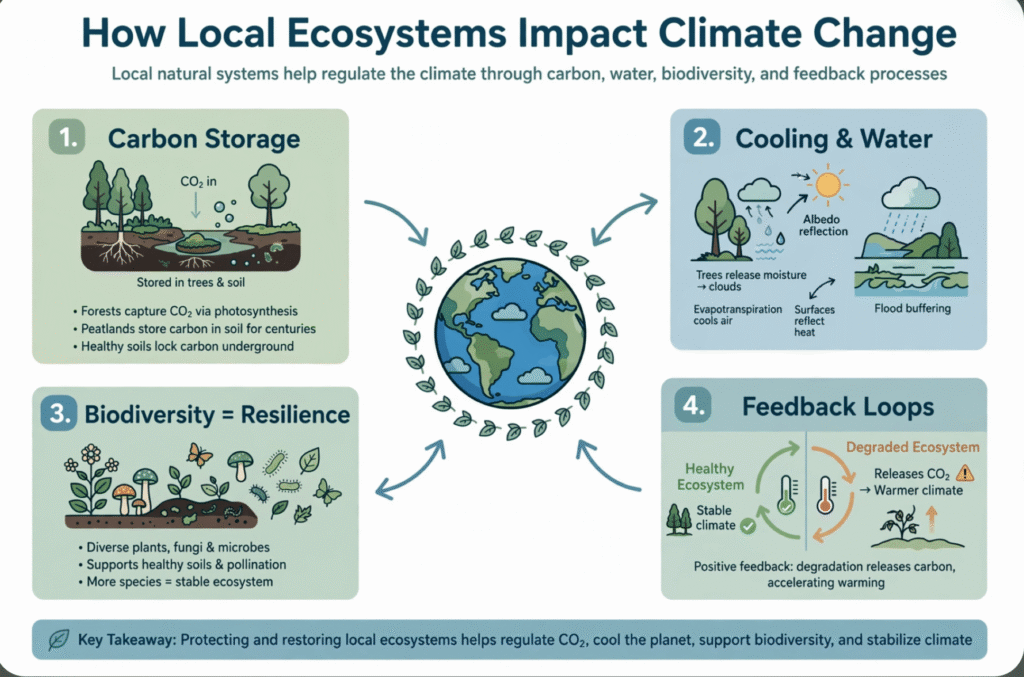
Forests capture CO2 via photosynthesis, but most carbon lives in soils, roots and deadwood. Peatlands — such as Dartmoor and the Flow Country — store carbon in waterlogged soil for centuries. Healthy soils lock carbon underground; drained or ploughed soils oxidise it back to CO2.
Coastal blue carbon — saltmarshes around the Thames, seagrass meadows off Cornwall — can sequester carbon up to ten times faster per hectare than forests. This storage is a property of the whole system, not of a single chemical process. Coastal blue carbon refers to the carbon captured and stored by living marine and coastal organisms, specifically within vegetated coastal ecosystems like mangroves, tidal salt marshes, and seagrass meadows. Although they cover less than 0.2% of the ocean’s surface, these highly productive habitats are powerful carbon sinks, responsible for up to 50% of the carbon sequestered in marine sediments.
2. Nature’s Air Conditioning: Cooling, Water and Reflection
Trees release moisture through evapotranspiration, cooling air and seeding clouds. Different surfaces reflect heat differently— a property called albedo. Albedo measures how much sunlight a surface reflects rather than absorbs. Healthy woodlands, wetlands and grasslands soak up heavy rain and release it slowly, buffering floods and droughts.
“We cannot fully understand the forest by simply looking at the trees”
Noble and Noble, Understanding Living Systems
These are examples of downward causation: the ecosystem level regulating molecular processes, organisms actively creating the conditions for their own persistence. This is why habitats matter. Organisms don’t simply live in an ecosystem like toys in a box; they embody the system and, over time, create the complex organic material needed for its ongoing balance. When the system is damaged, organisms repair it. This is why understanding the significance of any given species is vital in conservation. We can ask a simple question: what do we do locally that denies this repair system the resources it needs?
3. Why Diversity Means Stability
A monoculture has one score to play. A mixed hedgerow, species-rich grassland or diverse woodland has many. Diverse plants, fungi and microbes support healthy soils and pollination. When heritage is inadequate, organisms can innovate — even to the point of altering their genetic heritage under stress. The ecosystem is an adaptive process with population ebbs and flows;; it consists of dynamic, interactive organisms. An ecosystem isn’t a static picture; it breathes and moves. Living with it, organisms use ‘ecological intelligence’, they read, leave, and act on signs, and are actively involved in niche creation.
4. Feedback: The Loops That Help or Hurt
This diagram illustrates the stark contrast between a self-stabilising natural system and a runaway positive feedback loop. While healthy ecosystems buffer the planet against warming, degradation triggers a vicious cycle in which climate impacts cause ecosystems to release even more carbon, further accelerating global warming. Let’s be honest: who has not seen signs of degradation?
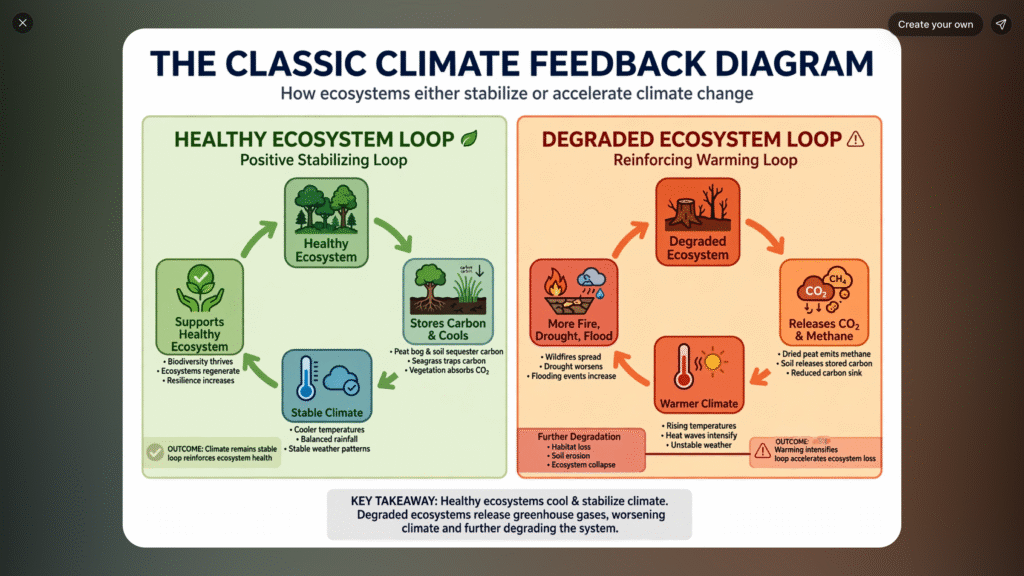
Healthy ecosystem → stores carbon → stable, cooler climate → ecosystem stays healthy. Degraded ecosystem → releases CO2 and methane → warmer climate → more fire, peat drying, permafrost thaw → releases more carbon. This is the positive feedback that concerns climate scientists.
Governments and their leaders need to support local strategies more consistently. Much can be done, and evidence shows local communities are willing to act.
What Can We Do Locally? Restoring Agency
- Rewet peat: Keep bogs waterlogged to keep carbon locked.
- Diversify hedges and woods: Plant mixed natives, allow deadwood and mycorrhizae to build.
- Protect saltmarsh and seagrass: Support restoration projects on coasts.
- Build living soils: Avoid bare soil, add organic matter, support microbes and fungi.
As a biologist, I marvel at the extraordinary resilience of living systems. But we must not take it for granted. We are stretching it to its limits. Restoration is not just adding carbon credits, and certainly not allowing global corporations to trade off their carbon footprints. It means restoring the self-regulating agency of living systems — allowing local nature to once again orchestrate its own climate regulation. But we need coherent strategies from national governments and a clear understanding that local ecosystems regulate climate. But scale matters too. We can all do a bit, but government can do more. We mustn’t give up on the global scale; yet, we can and must act locally.
Glossary
- Agency: Capacity of living systems to act purposively.
- Downward causation: Higher-level system influencing lower-level processes.
- Self-regulation: System maintaining itself within bounds.
- Blue carbon: Carbon stored in coastal and marine ecosystems.
- Sequestration: Long-term capture and storage of carbon.
- Albedo: Reflectivity of a surface.
Reference: Raymond Noble & Denis Noble (2023) Understanding Living Systems. Cambridge University Press. Based on teaching aid ‘How Local Ecosystems Impact Climate Change’.
Key Takeaways
- Local ecosystems regulate climate and play a vital role in mitigating climate change effects.
- Individual actions on a local scale can significantly impact climate outcomes despite political narratives suggesting otherwise.
- A systems view highlights the complex interactions within ecosystems, emphasizing the importance of resilience and diversity.
- Human activity drives declines in migratory species and disrupts ecological balance, necessitating local conservation efforts.
- Restorative actions, such as rewetting peat and protecting coastal habitats, help restore the natural regulatory functions of ecosystems.