
The Importance of Biodiversity for Ecosystem Resilience
What is Biodiversity?
Estimated reading time: 13 minutes
Key Takeaways
- Biodiversity signifies the variety of life forms in ecosystems, impacting their resilience and sustainability.
- Key indicators of biodiversity include genetic diversity, species diversity, and ecosystem diversity.
- Niche partitioning enhances biodiversity by allowing different species to share resources and adapt to changes.
- Human activities, such as deforestation and urban expansion, threaten biodiversity and disrupt ecosystems.
- Restoring ecosystems, like the River Thames, shows the potential for recovery through targeted actions and regulations.
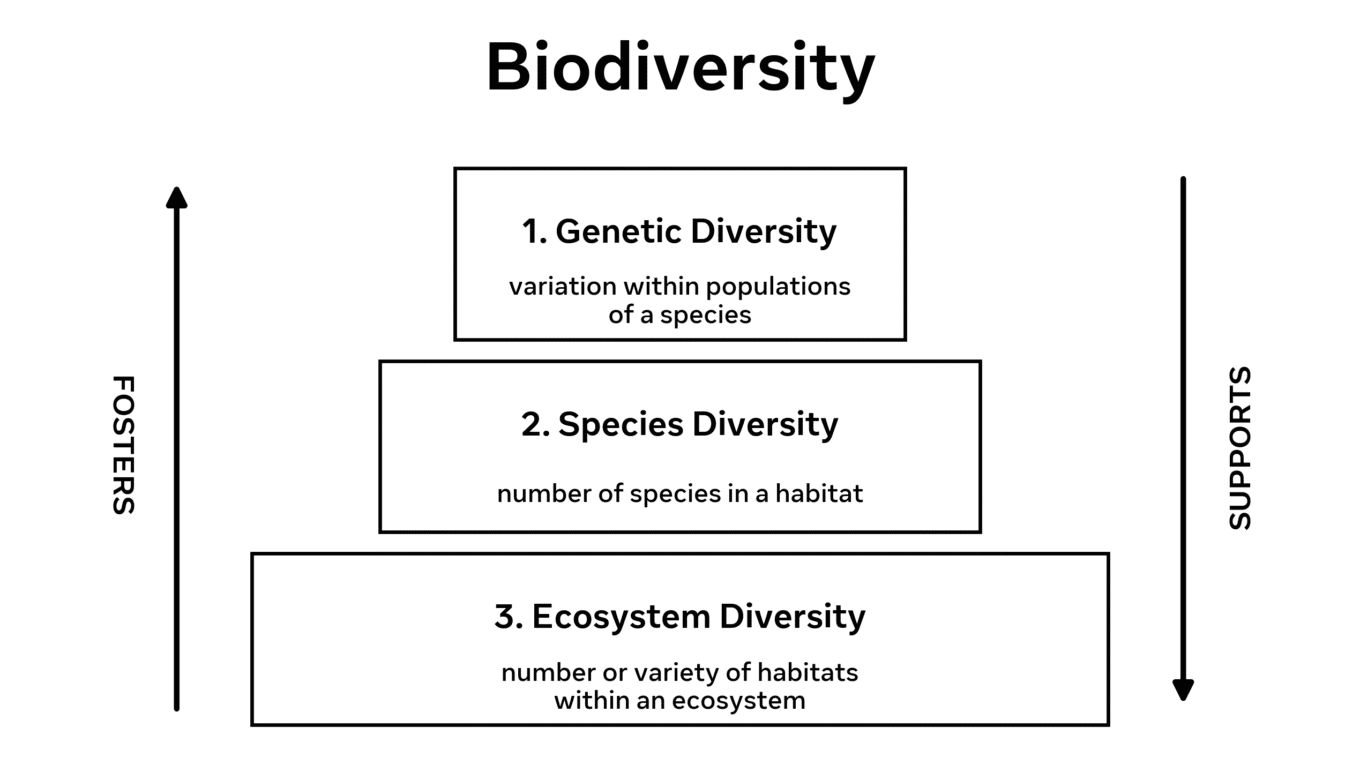
Biodiversity refers to the variety of organisms living in different habitats and ecosystems. For example, researchers commonly assess biodiversity using three key indicators: 1) genetic diversity within populations of a given species, 2) the number of species in a given habitat, and 3) the number or variety of habitats within an ecosystem (Figure 1). It is crucial to understand the importance of biodiversity, as it demonstrates the vitality and resilience of a habitat or ecosystem and shows its ability to sustain life. In addition, it signals an ecosystem’s capacity to adjust to change, that is, its resilience. For this reason, ecosystems rely on biodiversity. Overall, biodiversity both measures and contributes to ecosystem resilience.
Biodiversity reflects the vitality and resilience of a habitat or ecosystem, as well as its ability to sustain life.
The 3 layers of biodiversity
Three layers underpin biodiversity’s importance.
1 Genetic diversity — variation within a species
This is the difference between individuals in the same population. A woodland with oaks that have slightly different drought tolerance, disease resistance, or flowering times has higher genetic diversity. It gives the population raw material to adapt when conditions change.
2 Species diversity — variation between species
This is what most people think of first: how many different species share a habitat, and how evenly balanced they are. More species usually means more overlapping jobs — pollinators, decomposers, predators — so if one species declines, another can partly cover its role.
3 Ecosystem diversity — variation between habitats
This is the variety of habitats themselves within a larger landscape: ponds, hedgerows, grassland, old woodland, marsh. Each habitat supports different communities, and the mosaic creates corridors, buffers, and refuges that help species move and recover after disturbance.
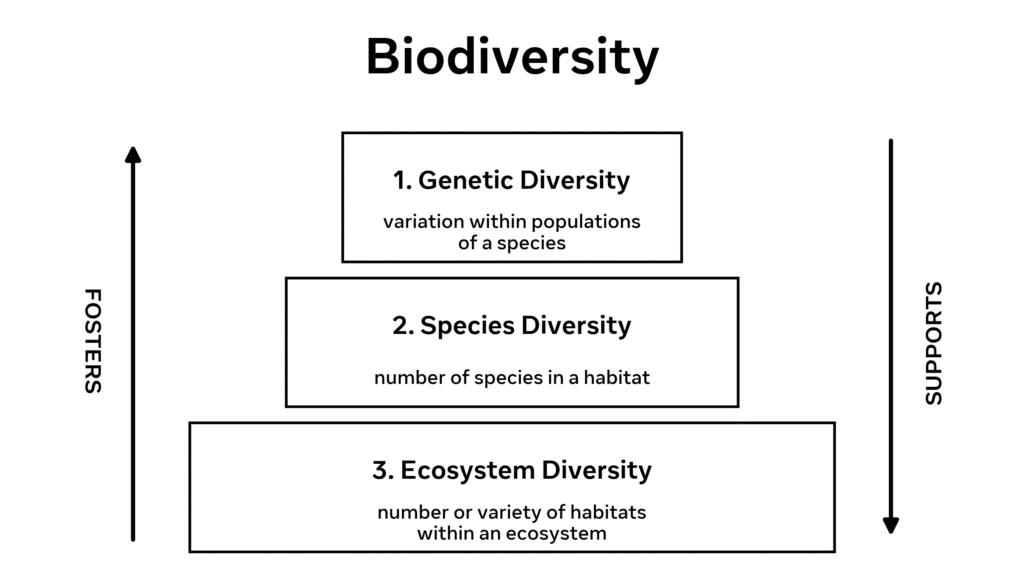
Left arrow up — FOSTERS: Genetic diversity fosters species diversity, which fosters ecosystem diversity — showing how resilience builds upward, too.
The importance of Biodiversity in Ecosystem Resilience
Niche diversity across time and space reflects biodiversity. This reduces competition for resources and creates and sustains habitats that support cooperation among species. For example, different damselfly species lay eggs at different times, in different ways, and in different locations. Such niche partitioning creates and fosters diversity.
Ecosystems are webs of interacting species. Both habitats and the niches within them change dynamically, shifting across seasons and within them. The eco-architecture changes and, in turn, influences how organisms behave. The two-way arrows in Figure 1 illustrate this dynamic.
As we argued in our book, Understanding Living Systems, the genome is not a rigid blueprint for life. Organisms regulate gene expression, which supports their adaptability. This regulation may initially be epigenetic, reflecting changes in resource availability, temperature, or other environmental constraints. Species can also shift gene regulation as their habitats change. Passing adaptations from one generation to the next is vital for long-term sustainability. In this way, physiological and behavioural changes can be passed through the germline or via cultural transmission.
Species diversity and adaptability
Ecosystems aren’t fixed boxes in which organisms exist. Organisms create ecosystems as much as they inhabit them. Nevertheless, the greater the species diversity and adaptability, the more resilient the ecosystem is in sustaining itself. This is the importance of biodiversity. Individual organisms or groups come and go, but the ecosystem adapts. Change is crucial to sustainability. Ultimately, life always solves the problems of existence by changing.
Niche Partioning
Niche partitioning underpins biodiversity’s importance. Over long periods, evolution moulds this adaptability, enabling organisms to survive the ecosystem’s ‘give and take.’ In this way, species occupy niche opportunities. Niche partitioning can initially foster this change by separating groups of closely related organisms, which then diverge genetically. These species then develop unique ways of existing in the ecosystem. Over time, these changes can alter the balance of species within the ecosystem.
Finding ways to survive
Both Lamarck and Darwin saw evolution operating in this way. Fitness isn’t so much about ‘fighting for survival’ as it is about finding ways to survive. Species diversity reflects this health over long periods of geological time. However, if ecosystem change occurs too rapidly, this adaptability is challenged; species diversity falls as niche opportunities shrink. As a result, the system’s resilience declines further. Habitats may become increasingly fragmented. In turn, migrations are disrupted, further altering vital seasonal regrowth and population numbers. Ultimately, these factors reflect the impacts of human-induced global warming.
Adaptation and Resilience Cycle
Epigenetic, physiological, behavioural, and cultural adaptations continue to shape ecosystems. Each adaptation strengthens the system’s resilience and fosters further natural change. For example, in mammals, when maternal nutrition changes, offspring adapt their metabolic strategies in anticipation of their environment. This adaptation can pass across generations, enhancing survival. If environmental pressure persists, these epigenetic changes may become more deeply embedded in the genome. The advantage of such epigenetic change is that it is more readily reversible if circumstances change (Figure 2).
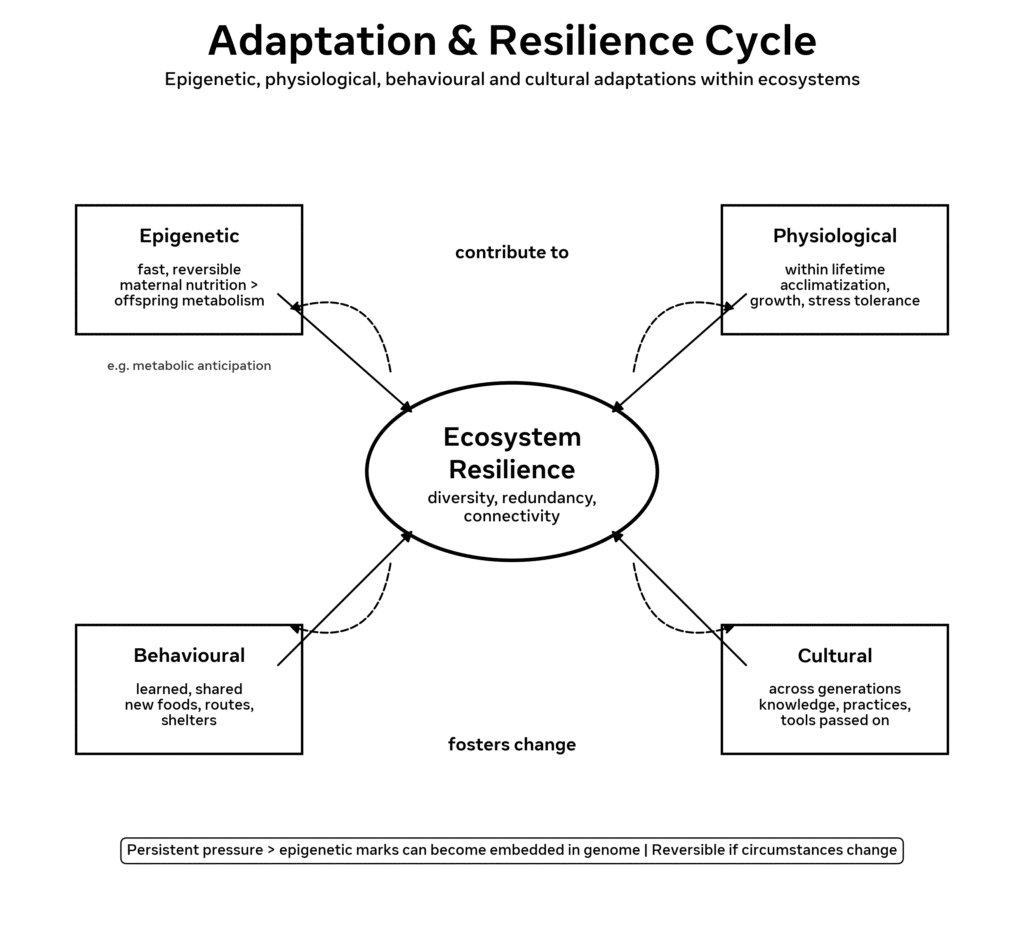
The diagram (Figure 2) shows the four adaptation pathways in ecological resilience— the advantage of these pathways is that organisms are not locked into them. Each has importance for biodiversity as a process.
- Epigenetic — maternal nutrition → offspring metabolism: Fast, reversible,
- Physiological — acclimatisation within a lifetime.
- Behavioural — learned and shared quickly between individuals.
- Cultural — knowledge and practices passed across generations.
- Solid arrows in — each pathway contributes to Ecosystem Resilience at the centre (diversity, redundancy, connectivity).
- Dashed arrows out — resilience then fosters further change, creating more conditions for those adaptations to arise.
- Bottom note — persistent pressure can embed epigenetic marks more deeply into the genome, but the advantage is reversibility if circumstances change.
Threats to Biodiversity
The demand for human economic growth
Organisms can adapt immediately to short- to medium-term changes and to longer-term evolutionary changes. However, some human-driven changes are so sudden that they outpace ecosystems’ capacity to respond. These include the acute effects of global warming and the wholesale destruction of crucial habitats for human economic growth. These changes are reshaping the environment on a global scale, for example, by altering ocean currents and affecting animal migrations, by droughts and floods, and by forest fires. Rainforest destruction has been accelerating. Major roads and other transport infrastructure disrupt or fragment local habitats. Airport runway expansion increases demand for ‘better’ rail and road access.
Human economic migration and rising global conflicts are increasing demand for housing and driving urban expansion. These developments create conflicting political demands that often undermine the importance of biodiversity in policy decisions. This is why biodiversity must be prioritised in action.
Deforrestation
According to the latest Global Forest Resources Assessment by the UN Food and Agriculture Organisation (FAO), gross global deforestation slowed to an average of 10.9 million hectares per year between 2015 and 2025, down from 17.6 million hectares annually in the 1990s. This may sound like good news, but the devil is in the details.
Total Forest Extent
Forests cover 4.14 billion hectares globally, about 32% of Earth’s land area. Net Forest Loss: The annual rate of net forest loss (accounting for regrowth and expansion) fell to 4.12 million hectares per year for 2015–2025, down from 7.8 million in the 1990s.
Tropical Primary Rainforests: According to Global Forest Watch, the world lost 4.3 million hectares of tropical primary forest in 2025—a 36% decrease from the extreme fire-driven losses seen in 2024, though still 46% higher than levels a decade earlier.
The world lost 4.3 million hectares of tropical primary forest in 2025, 46% higher than levels a decade earlier.
Global demand for food
The demand for cheap food in the face of a ‘cost of living’ crisis is also a major pressure subverting the importance of biodiversity. Agriculture remains the leading historical cause of permanent forest conversion, while wildfires have emerged as an increasingly severe and volatile short-term driver of canopy loss. These consequences are important for biodiversity.
Regional Trends:
South America continues to have the highest absolute annual forest loss (despite rates halving since 1990), while Europe is the only region to record a slight increase in forest loss over the last three decades.
Airport expansion
Airport expansion directly destroys local habitats through construction and harms surrounding wildlife via pollution, noise, and light. In addition, aviation contributes roughly 3.5% to 4% of global warming, and non-CO2 effects like contrails can double that warming impact.
In the UK, aviation accounts for around 7% of total greenhouse gas emissions, a share projected to rise to 16% by 2035 as other sectors decarbonise. Recent Climate Change Committee reports warn that unchecked airport expansion could push this even higher. But the impact on local habitats is also grim. Yet, once again, the conflicting political decisions subvert the importance of biodiversity.
Permanent Habitat Loss and Fragmentation.
Airport expansion compromises local biodiversity in several distinct ways. For instance, new runways require vast expanses of cleared land. Expanded boundaries pave over ancient woodlands, wetlands, and grasslands. Furthermore, habitat loss cuts off wildlife corridors. Animals become trapped in smaller, isolated pockets of nature, restricting their foraging grounds and limiting genetic diversity by preventing interbreeding between populations. In addition, clearing part of a forest exposes the remaining interior habitat to more wind, sunlight, and invasive species, altering the microclimate and degrading the quality of what remains.
Severe Hydrological Disruptions of water table
Runway and terminal construction adds large, impermeable surfaces that disrupt natural water flow. Altered Water Tables: Rainwater is diverted into drains instead of replenishing aquifers, drying wetlands and soils. Polluted Runoff: Chemicals like de-icing fluids, fuel, and heavy metals are washed into streams, harming aquatic life.
Noise and Light Pollution
Increased flights and ground activity disrupt wildlife cycles. Jet engine noise interferes with animal communication, forcing birds to change their songs or leave, and hinders nocturnal predators like owls. Constant floodlighting alters nocturnal animal behaviour, confuses migrating birds, and affects insects.
To prevent bird collisions with aircraft, airports aggressively manage nearby wildlife. They intentionally drain nearby ponds, net wetlands, and remove specific trees to make the environment hostile to large flocks of birds. As a result, local wetland birds and birds of prey are driven out of their native habitats.
How to Protect Biodiversity
To illustrate the importance of biodiversity, consider a forest. In the forest ecosystem, the wood mouse helps disperse seeds but also serves as prey for birds, reptiles, and other mammals. Although these roles are incidental to the mouse’s life, they are integral to the ecosystem it shares with other organisms. Trees produce leaves, which fall to create leaf litter, which in turn provides cover for wood mice and other species. As a result, wood-mouse abundance depends critically on seasonal factors. One such factor is summer droughts. Similarly, as with other small rodents, high reproductive rates allow a rapid population recovery, and populations will fluctuate from season to season. Furthermore, female numbers depend on acorn abundance. This creates interdependent relationships in the ecosystem. Owls, for example, eat mice and other small mammals, and their numbers in turn depend on the mouse population.
We can find such dependency cycles for any species we choose. Ideally, we would create and foster systems with such inherent interdependencies and allow them to ‘regulate’ themselves through these cycles. The problem is that our incidental interference, through the way we live- our economic growth, our consumption, our noise or light production, our roads and railways, our aircraft, and other ways to travel has both global and local impacts on biodiversity and ecosystems. Depending on location, it affects some species more than others or disrupts these webs of interdependency.
In our book, Understanding Living Systems, we pointed out that the wood mouse is unaware of how its behaviour affects the forest’s ecological health. But we humans are. We know our impact, and we are learning more about the need for biodiversity. It is as important to our survival as a species as is the oxygen in the air we breathe. For all our fancy and expensive telescopes, ours is the only living planet we know. Planning for a doomsday scenario of life on Mars isn’t a strategy. Our planet is a jewel in our immediate cosmic neighbourhood. It is precious…to and for us.
Let’s put that into perspective. In 2011, the EU adopted the EU Biodiversity Strategy to 2020, which aimed to halt the loss of biodiversity and ecosystem services in the EU and help stop global biodiversity loss by 2020. A recent review of progress concluded that
“Biodiversity loss and ecosystem collapse is considered one of the top five threats humanity faces in the next ten years”
“Biodiversity loss and ecosystem collapse is considered one of the top five threats humanity faces in the next ten years”
It also noted that several recent reports have warned of massive, accelerating worldwide biodiversity loss.
The European Environment Agency’s 2020 report found that 60% of species and 77% of habitats are in unfavourable conservation status, with continued declines in common birds, butterflies (farmland birds 32%, grassland butterflies 39%), and pollinators (bees). This led the Commission to initiate the first EU pollinator initiative in 2018.
The UK government’s strategy centres on the UK National Biodiversity Strategy and Action Plan (NBSAP), published in February 2025, which commits the UK to meeting the 23 global targets of the UN Kunming-Montreal Global Biodiversity Framework to halt and reverse biodiversity loss by 2030.
Restoring biodiversity in the River Thames
A prime example of reducing pollution to protect ecosystems is the River Thames in the UK. Declared “biologically dead” in the 1950s due to industrial waste and sewage, it has since become one of the world’s cleanest urban rivers.
The Strategy & Pollution Reduction involved targeted, long-term actions: 1. Tightened Regulations to enforce strict waste standards. 2. Infrastructure Upgrades to modernise sewage plants and cut pollution. 3. Continuous Monitoring with groups like the Zoological Society of London to use data-driven management.
The Zoological Society of London (ZSL) released its second State of the Thames Report in January 2026, noting the tidal river has recovered since being declared “biologically dead” in 1957. Improvements include cleaner water, higher oxygen, lower toxic metals like copper and zinc, and thriving wildlife such as harbour porpoises, seals, eels, seahorses, and sharks. Litter has decreased, with nearly no plastic cotton-bud sticks on shores. The Tidal Thames hosts over 115 fish species, 92 bird species, and nearly 600 hectares of saltmarsh vital for wildlife. For nine million residents, it offers drinking water, food, livelihoods, and flood protection.
Nevertheless, summer water temperatures and sea levels in central London are rising, while runoff, nitrate levels, and plastic waste such as wet wipes threaten the fragile estuarine ecosystem. Recent figures have shown that the utility company Thames Water was responsible for almost a third of the water sector’s most harmful pollution incidents in 2025. As Thames21 has said
“Water companies must be held accountable when performance falls short. Cleaner, healthier rivers will only come through sustained investment, practical action and long-term commitment from companies, regulators, government and environmental organisations.”
The UK government is now set to hand over regulatory powers of the water sector to the elected mayors.