
The Interconnectedness of Ecosystems
Interconnectedness of Ecosystems
Estimated reading time: 8 minutes
We Rethink Nature: Moving Beyond Competition
Ecology is the scientific study of how living organisms interact with one another and their physical environment. It considers the interconnectedness of ecosystems. Ecosystems are not simply the sum of the activities of the organisms within them; the totality of living things actively shapes these dynamic components. Living organisms drive the ecosystem. For example, forest plants communicate and share resources through the underground mycorrhizal network and above ground through plant and animal interactions, such as pollination and seed dispersal.
Nature is often described as a battleground of survival, where only the fittest survive. This narrative emphasises competition, painting a picture of organisms locked in constant struggle.
However, cooperation is just as vital. Throughout ecosystems, species depend on each other in complex webs of mutual benefit.
Species in Ecosystems Cooperate
Cooperation exists not merely between members of the same family group, but also between members of different species. Nature is, in many ways, cooperative. That is the nature of an ecosystem. What one part puts in, another may take out. Of course, competition for resources exists, especially where they are scarce, and predators hunt and kill prey, often in brutal ways. Nonetheless, many interactions exist between hunters and their prey. Cooperation is a key ingredient of the interconnectedness of ecosystems.
Ecosystems Balance Cooperation and Survival
For a species or population to survive, it is not in a predator’s best interest to consume all its potential prey. A viable, or sustainable, ecosystem is one of balance, or checks and balances, crucial ingredient of ecosystem interconnectedness. Much of this balance comes from degrees of cooperation between species, or within population groups. Thus, organisms may alter their behaviour in relation to population size, or to the presence of other or the same or different species. While we can understand ecosystem function at one level by considering, say, the carbon cycle or other minerals, we should not see organisms as simply passive players.
Understanding Ecosystem Components
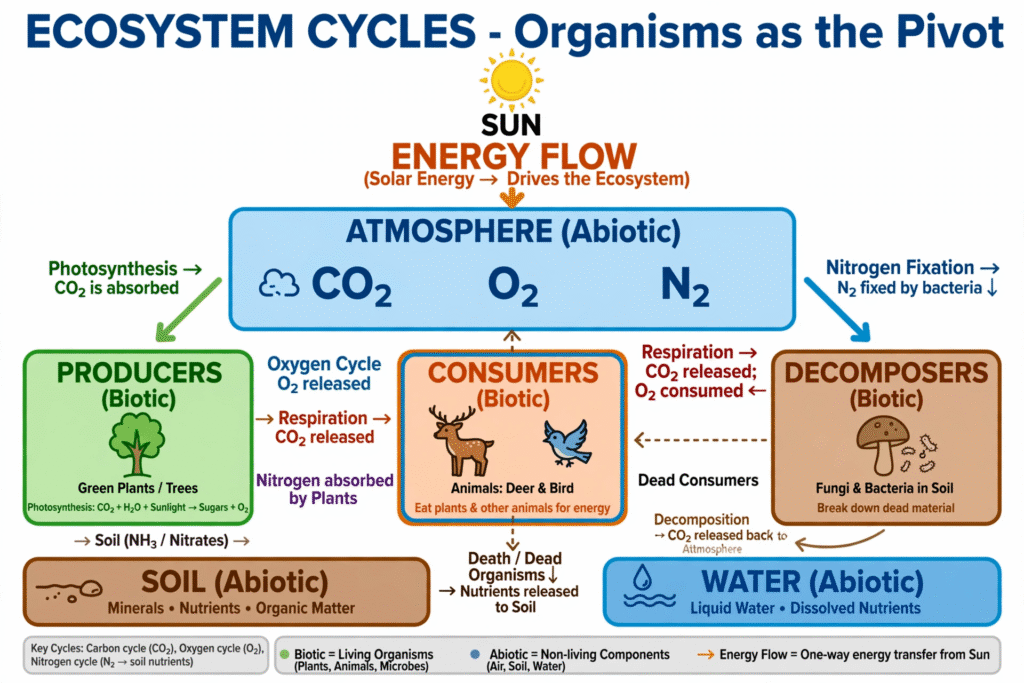
Ecosystems consist of living and non-living components. Biotic factors are the living parts of an environment, such as plants, animals, and bacteria. Abiotic factors are the ‘nonliving’ parts of an environment, such as water, soil, weather, and temperature. We must also consider energy and matter: how nutrients and energy flow through the interconnectedness of living communities in ecosystems. .
How Plants and Bacteria Drive Nutrient Cycles
We can express this in another way. Green plants take CO2 from the air, plus sunlight and water, and make sugars and oxygen. Without plants, CO2 would build up, and O2 would run out. Both plants and animals breathe in oxygen and release CO2. This creates a loop back into the atmosphere.
Animals cannot get nitrogen directly; special soil bacteria take nitrogen from the air and convert it into nitrates. Plants absorb those nitrates; animals eat the plants, so atmospheric nitrogen enters the food chain only because of bacteria.
Decomposition and the Importance of Biotic Activity
When plants and animals die, fungi and bacteria break them down. This releases CO2 back to the atmosphere and returns nutrients to the soil, which plants reuse. In short, the atmosphere stores gases and the Sun provides energy, but biotic activity moves carbon, oxygen, and nitrogen in a continuous loop. Remove organisms and the cycles stop. The organisms are the engines of this system.
The Role of Biodiversity in Ecosystem Health
Organisms build ecological resilience
Organisms drive self-regulating ecosystems by adapting to change. Climate change forces species migration and disrupts natural cues, challenging conservation efforts. Building resilience—not preserving static systems—ensures ecosystems can adapt and thrive. Species diversity increases adaptability and ecosystem stability. Ecosystem interconnectedness builds resilience.
Damselflies: A Case Study in Adaptive Strategies
Damselflies exemplify adaptation. Female damselflies use specialised ovipositors to lay eggs in various substrates, with species evolving distinct sites and timings to avoid competition and predation. Oviposition strategies include releasing eggs into water (exophytic), inserting them into plant tissue or wood (endophytic), or placing them on plant surfaces (epiphytic). These choices reflect behavioural and evolutionary differences. This diversity in behaviour and survival strategies strengthens ecosystem resilience by providing a range of survival options. (My first introduction to practical ecology was as a zoology student in the 1970s, doing a study of niche partitioning in damselflies).
Ecological Niche Partitioning
Diversity in egg-laying sites, microhabitats, and active hours among damselflies is a classic example of ecological niche partitioning. By dividing up resources in space and time, different species avoid direct, destructive competition with one another.
High species diversity signals a healthy, structurally complex wetland. If pollution or climate change alters the ecosystem, the loss of specific damselfly species serves as an early warning of environmental degradation.
Niche partitioning shapes all major ecosystems and occurs in four main forms: spatial, temporal, dietary, and conditional.
Spatial Partitioning
Species occupy different microhabitats within the same area. For example, five warbler species feed in the same spruce trees but hunt insects at different heights. Caribbean Anolis lizards avoid competition by living on leaf litter, twigs, or in the canopy. Shorebirds forage along the same beaches but target different water depths based on leg and beak length.
Temporal Partitioning
Species use the same resource at different times. Swallows hunt flying insects by day, while bats do so at night. Hawks hunt mice during the day; owls take over at night. In subtropical yards, green anoles feed by day and Mediterranean geckos by night.
Dietary (Trophic) Partitioning
Species living together evolve to eat different foods. On the African savannah, zebras eat tall grass stems, wildebeest eat new leaves, and gazelles eat short shoots. Darwin’s finches in the Galapagos specialize in different seeds: large-beaked finches crack woody seeds, slender-beaked ones eat small seeds or probe flowers.
Conditional Partitioning
Species shift dominance as environmental conditions change. In the Sonoran Desert, some annual plants thrive in wet years, while others thrive in dry years, allowing multiple species to persist for decades without outcompeting one another.
Symbiotic Relationships
In contrast, species in symbiotic relationships enable them to acquire and share resources.
We emphasised the significance of symbiosis in ecology and evolution in our book, Understanding Living Systems. Symbiotic relationships underpin ecosystem survival, productivity, and resilience. While competition determines how species divide resources, symbiosis governs how they cooperate to maximise them. This shows that cooperation in nature is just as important as competition for survival. It is a key ingredient of the interconnectedness of ecosystems.
1. Symbiosis lets organisms overcome their biochemical limitations by outsourcing tasks to other species.
Nitrogen Fixation: Most plants cannot absorb nitrogen directly from the air. Legumes form mutualistic bonds with Rhizobium bacteria in their roots; the bacteria absorb atmospheric nitrogen and fix it in the soil, fueling plant growth and enriching the surrounding soil.
Cellulose Digestion: Herbivores like cows and deer cannot digest tough plant cellulose on their own. They rely on mutualistic gut flora to break down plant matter. Without these microbes, major grazing food webs would collapse.
2. Symbiosis drives evolutionary innovation and colonisation, rapidly opening new biomes for life.
Conquering Land: Over 400 million years ago, symbiosis between plants and fungi enabled plants to move from water to land. Mycorrhizal bonds allowed the first land plants to extract water and minerals from barren rock.
Origin of Complex Life: All animals, plants, and fungi descend from symbiogenesis—an ancient union where simple bacteria merged with other cells, evolving into mitochondria and chloroplasts.
3. Symbiotic partnerships create highly structured microhabitats that support thousands of species, enhancing biodiversity.
Coral Reef Ecosystems: Hard corals result from mutualism between animal polyps and microscopic algae (zooxanthellae). This partnership builds massive reef structures that shelter 25% of all marine life.
Enhanced Environmental Stability: Ecosystems rich in symbiotic links resist shocks like disease or extreme weather because species share the burdens of defence, waste cleanup, and nutrition.
4. Symbiosis maximizes reproductive and defensive efficiency by allowing species to trade specialized skills.
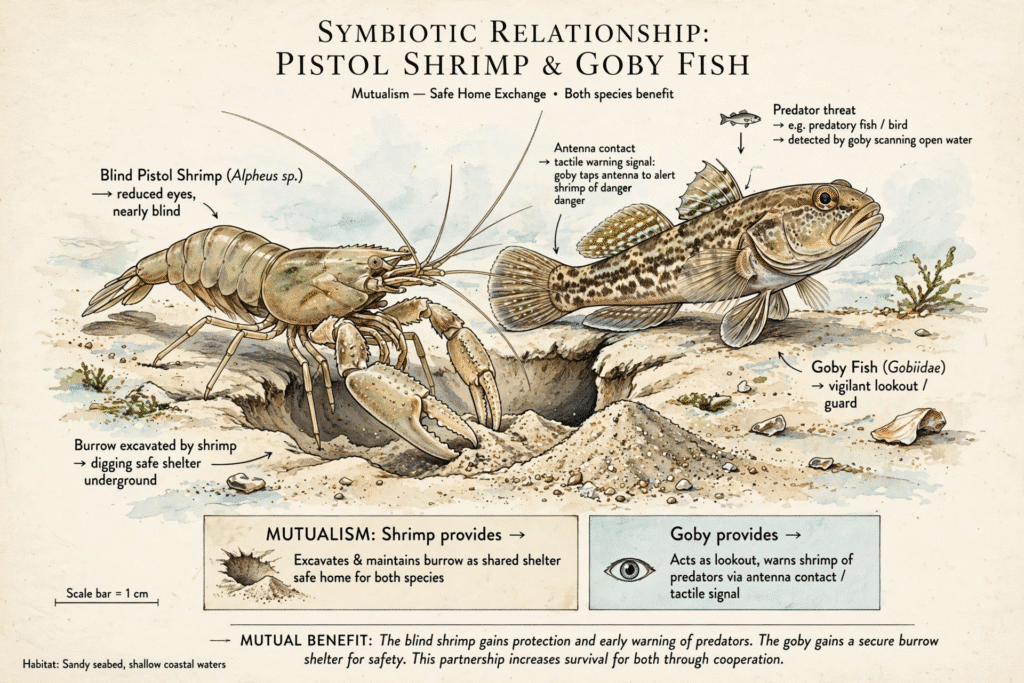
The Goby and the Shrimp: A blind shrimp digs a safe burrow but cannot detect threats. Meanwhile, a goby fish stands guard, warning the shrimp of predators by touch, and receives a safe home in return (Figure 2)
Pollination Services: Plants offer nectar to insects in exchange for precise pollination, a method far more efficient than wind dispersal.
Human Impact on Ecosystem Interconnectedness
Threats to biodiversity
Human activity now shapes every major ecosystem on Earth. As a result, we alter landscapes, fragment habitats, and introduce pollutants, invasive species, and new diseases. Urbanisation, agriculture, and industry not only drive habitat loss and climate change but also threaten biodiversity and ecosystem stability.
Humans as ecosystem stewards
Nevertheless, humans can also act as ecosystem stewards. Through conservation, restoration, and sustainable management, we can protect species, restore degraded habitats, and support ecosystem resilience. For example, rewilding initiatives, wetland restoration, and policies that reduce pollution and overexploitation all contribute to healthier ecosystems.
Prioritising ecological balance
Ultimately, our choices—what we consume, how we build, and how we govern natural resources—determine the fate of countless species and the health of the planet. By understanding our impact and prioritising ecological balance, we can foster a future where humans and nature thrive together.
Human activity, by contributing to global warming and driving increased encroachment by invasive species, is a major disruptor of interactions among these ‘native’ species. We significantly disrupt the ecosystem’s interconnectedness through sprawling suburbs, roads, and railways, as well as by creating noise, light and chemical pollution in rivers and waterways.
Ocean noise pollution profoundly affects whale communication and navigation. Whale interconnectedness profoundly affects the ocean ecosystem.
Key Takeaways
- Ecology studies the interconnectedness of ecosystems, highlighting cooperation alongside competition among species.
- Cooperation between organisms, such as mutualistic relationships, plays a crucial role in ecosystem stability and resilience.
- Biodiversity enhances ecosystem adaptability and health, exemplified by damselfly adaptations and ecological niche partitioning.
- Human activities threaten biodiversity and disrupt the interconnectedness of ecosystems, but sustainable practices can foster resilience.
- Prioritising ecological balance in our choices is essential for the health of both humans and nature.