
Case Studies in Ecological Intelligence: Nature’s Problem Solvers
Understanding Ecological Intelligence
Key Takeaways
- Ecological intelligence involves both material and immaterial dimensions, as organisms create and interpret signs of their existence.
- Niche creation is essential; organisms define roles within ecosystems while facing challenges that require adaptive problem-solving.
- Beavers exemplify niche builders by shaping habitats through dam construction and employing ecological intelligence to thrive.
- Human influence has altered ecosystems significantly, marking the Anthropocene and necessitating a deeper understanding of reintroduction efforts.
- Successful species reintroductions require ecological knowledge to balance species’ needs with environmental impacts, underscoring the importance of case studies that demonstrate ecological intelligence.
Estimated reading time: 14 minutes
Ecological Intelligence and Niche Creation
In a previous article, we defined ecological intelligence as the signs of meaning and purpose that organisms create and interpret. To further illustrate ecological intelligence in action, we’ll explore several case studies; ecological intelligence has both material and immaterial dimensions. The material dimension includes habitat change—what changes, where, and when. The immaterial dimension reflects why something changes: the intention, reason, or purpose behind it.
Organisms leave or create signs of their presence, whether intentionally or not. Together, they form ecosystems and create niches within them. A niche is the specific function, position, and role a plant or animal occupies in its natural environment and community. Yet organisms do more than occupy niches; they also create them.
How Organisms Solve Problems
The philosopher Karl Popper made an astute observation: “All life is problem solving.” Every living thing strives to survive and, in the process, faces challenges. To overcome them, organisms rely on ecological intelligence. As a biologist, I am interested in how organisms solve problems, what strategies they use, when they use them, and why. What fascinates me most about biology is the many different answers to these questions.
Each organism creates and occupies a niche. In one sense, that niche brings together the solutions, or ecological intelligence, an organism has developed to meet life’s challenges. It shapes how the organism finds the nourishment it needs for growth and maintenance, and the energy to carry out its activities. It also influences how the organism moves and feeds, senses its environment, interacts with other organisms, reproduces, and communicates. This is why studies of ecological intelligence are significant.
How Ecosystems Shape Natural Selection
Organisms shape their niches, even as those niches shape them. Their habitats, in turn, shape their niches, while interactions with other species help shape the ecosystems they create. Within every ecosystem, nested functions unfold through multidirectional causal—or creative—flows. This active process drives natural selection and explains why evolution proceeds directionally. This is what we mean by ‘fitness’, and one crucial ingredient runs through it all: ecological intelligence. Studies of ecological intelligence provide clues for understanding specific adaptations and their significance in evolution.
How Organisms Adapt Within Constraints
A nested function explains why things happen and how a system addresses a problem. In Understanding Living Systems, we call this ‘contextual’ or ‘situational’ logic. Within the constraints they face, organisms are both adapted and adaptable. They can adjust their behaviour in the short term to achieve specific objectives.
Over longer periods, evolution develops the faculties that make this adaptability possible, including systems for movement, nutrition, cognition, awareness, communication, and reproduction. However, this does not mean the future is predictable. As biologists, we can understand the circumstances that may influence evolution, but we cannot know precisely whether, when, or how an adaptation will occur. Moreover, constraints or rapid change may prevent a species from adapting quickly enough. Evolution has direction in a general sense, but it is not directed. To understand evolution, we need to study the abundance and significance of ecological intelligence as a driver and selective ingredient of adaptability.
Exploring New Possibilities Across Generations
Organisms create variability to explore new ways to achieve their goals. In turn, epigenetic and paragenetic transfer across generations plays an important role because it offers a fast, flexible way to explore new functional possibilities. These possibilities can also emerge within a particular community, where cultural practices adapt to local circumstances. As described in a previous article, if a group’s niche becomes sufficiently separated, it could eventually lead to the formation of new species over longer time periods.
From Simple Responses to Sensory Integration
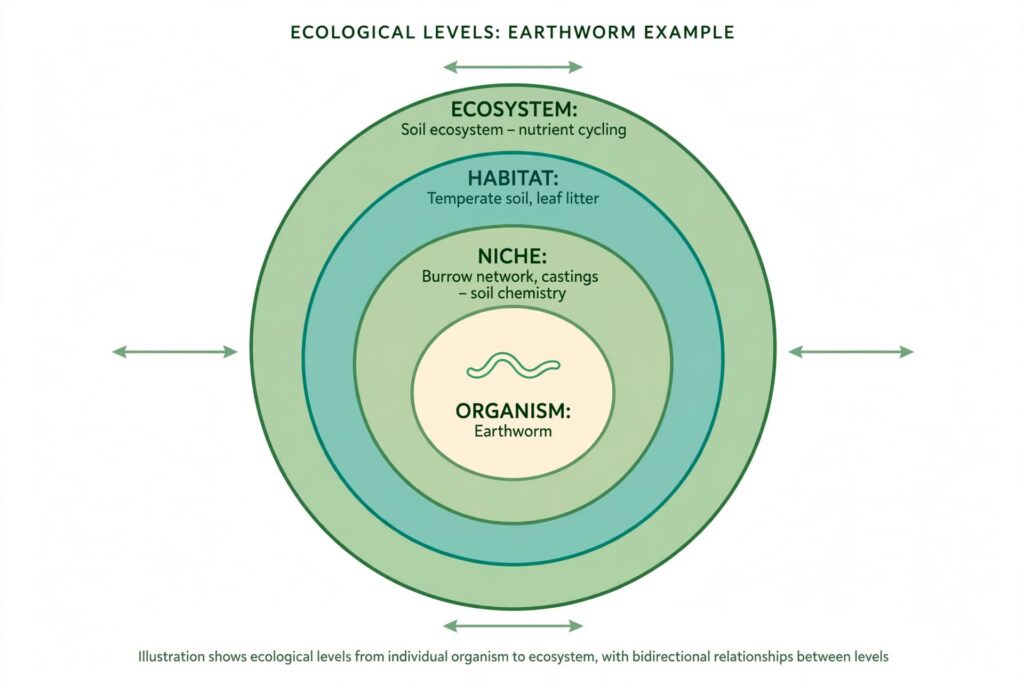
Consider the earthworm as an example of this sensory environment. Across worm species, sensory systems evolved from simple, diffuse cellular responses into centralised nervous systems capable of advanced multimodal integration. Over time, even earless, eyeless ancestors developed sophisticated ways to map the physical and chemical features of their surroundings. We cannot understand such evolution without studying ecological intelligence.
Studies of Ecological Intelligence in Annelids
Studies of ecological intelligence show how earthworms use specialised receptors to sense their environment. Inside the mouth cavity, buccal receptors act like rudimentary taste buds, allowing earthworms to sample organic matter and distinguish among vegetable foods before they ingest them. Meanwhile, photoreceptors—often called “little eyes”—embedded in the skin detect light intensity. A small, transparent internal lens, known as a phaosome, focuses the light. As a result, earthworms burrow deep into the soil to avoid surface predators and UV exposure. Nematodes, in turn, use unexpected molecular building blocks, including cyclic nucleotide-gated channels that mirror components found in human rod and cone cells.
A Worm That Senses Sound
The free-living, transparent roundworm Caenorhabditis elegans (C. elegans) is about 1 mm long and is a widely used model organism in biological research. Remarkably, it can “listen” through its skin. Its fluid-filled, cylindrical body acts as a soft acoustic sensor: when airborne sound waves reach the worm, they create a localised pressure gradient. In turn, the gradient makes the skin vibrate and shifts the internal fluid, activating auditory sensory neurons. This process offers a striking example of convergent evolution, as it echoes the fluid-and-gradient physics that operate in the human inner-ear cochlea.
In contrast, Earthworms have epidermal receptors concentrated on their sides and bellies. These hair-like cuticular projections act as highly sensitive “tangle receptors,” detecting microscopic acoustic vibrations travelling through the surrounding soil.
Evolution as an Ongoing Search
Perhaps we should see evolution as an ongoing search for new possibilities. In Understanding Living Systems, we compare it to a jigsaw puzzle: the picture keeps changing, so organisms must continually find new pieces that fit. As a result, living systems adapt in many ways, drawing on processes built into the system. This perspective also revives a form of teleology that modern science has sidelined and invites the study of ecological intelligence.
Real-World Case Studies
The Beaver: A Niche Builder
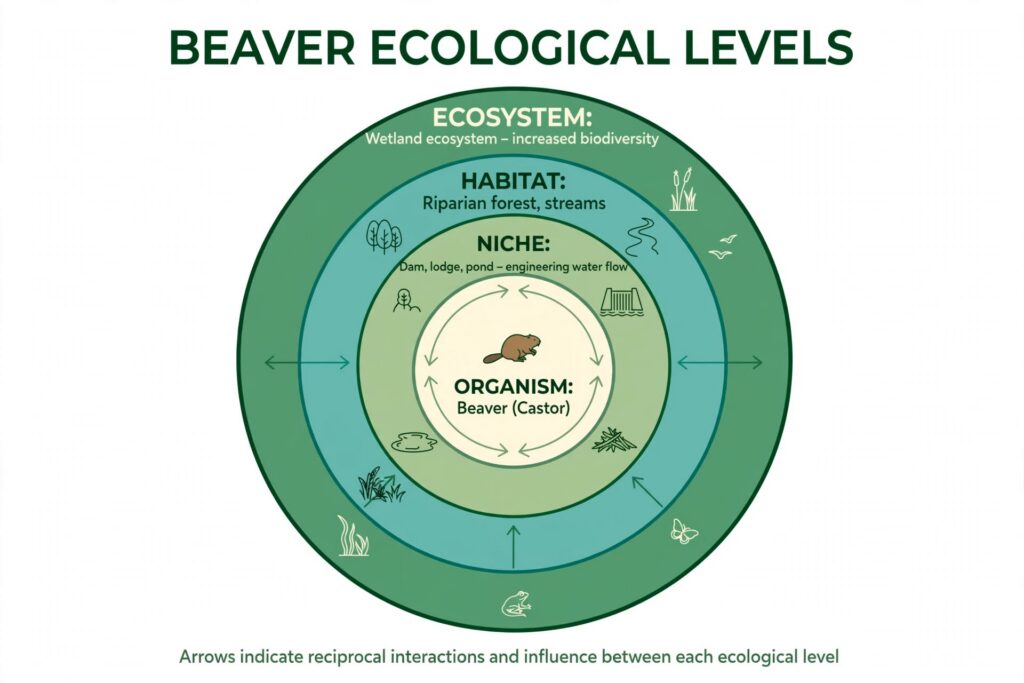
The beaver (Castor fiber) offers another example of a niche builder (Figure 2)—and perhaps the most visible one. To create a safe haven and protect themselves from predators, beavers build dams that raise the water level and form deep, moat-like ponds. They then construct dome-shaped homes, called lodges, within these ponds. Hidden underwater tunnels allow them to enter and exit safely. In addition, beavers store favorite foods, such as willow and aspen branches, underwater at the bottom of the pond. This way, they can eat throughout the winter without going outside.
Beavers Shape Their Habitat
Beavers also build small canals that connect to ponds, creating a transport network. As a result, they can float heavy logs and branches from the forest to their building and feeding sites. In turn, these activities reshape their habitat and support diverse wildlife, including fish and birds. To understand this process, researchers need ecological knowledge of which organisms are present, where they live, and when they are active. This ecological intelligence is especially important when studying reintroduced beavers. By reshaping the habitat’s jigsaw puzzle, beavers may also change how effectively other species use its different pieces.
Learning to Build Better Dams
Beavers seem to know instinctively how to build dams. Still, they improve with experience. Young beavers, for example, learn by observing others. They live with their parents for up to two years, and during that time, they watch their parents and older siblings at work. As a result, these young beavers become apprentice builders, refining their techniques as they learn. When beavers are reintroduced to habitats, it can take several generations to hone the necessary skills. This indicates cultural (or cross-generational) transfer of skill.
This illustrates the distinction between “adapted” and “adaptable”. Beavers demonstrate both. They are adapted to their environment but also adaptable, shaping it to suit their purposes.
Nature’s Lumberjacks
Beavers act like lumberjacks, using their metal-reinforced teeth, powerful jaw muscles, and strategic chewing to cut down trees.
Marking Territory with Scent
Building and maintaining dams takes enormous effort, so beavers have a way to mark their territory for others. After placing a mound of mud, a beaver squats and forcefully sprays it with castoreum—a molasses-like substance produced by its castor sacs—along with anal gland secretions and urine. The mud anchors the scent, helping it linger. This behaviour reflects the beaver’s niche intelligence: the scent carries specific information. When another beaver swims by and sniffs the mound, its chemical composition can reveal who lives there, including the resident’s sex, approximate age, health, and genetic identity. In this way, the mound offers a vivid example of the who, what, when, where, and how of ecological intelligence.
An entente cordiale
The demarcation serves to reduce potential conflict and to spread their impact geographically. Beavers can easily differentiate between the scent of their immediate, established neighbours and the scent of complete strangers. Because neighbours already have their own stable homes, they rarely pose a threat. Resident beavers will remain relatively calm if they smell a familiar neighbour near the border. This has the effect of producing a form of cooperation in maintaining the integrity of the beavers’ home range.
This ecological intelligence produces a form of entente cordiale. If a colony detects the scent of an unknown stranger (usually a nomadic two-year-old looking to take over a territory), it reacts with immediate aggression, increasing patrols, chattering its teeth, and rapidly adding new mud to its scent fences to reinforce the border.
Humans – A Niche Beyond Place and Time
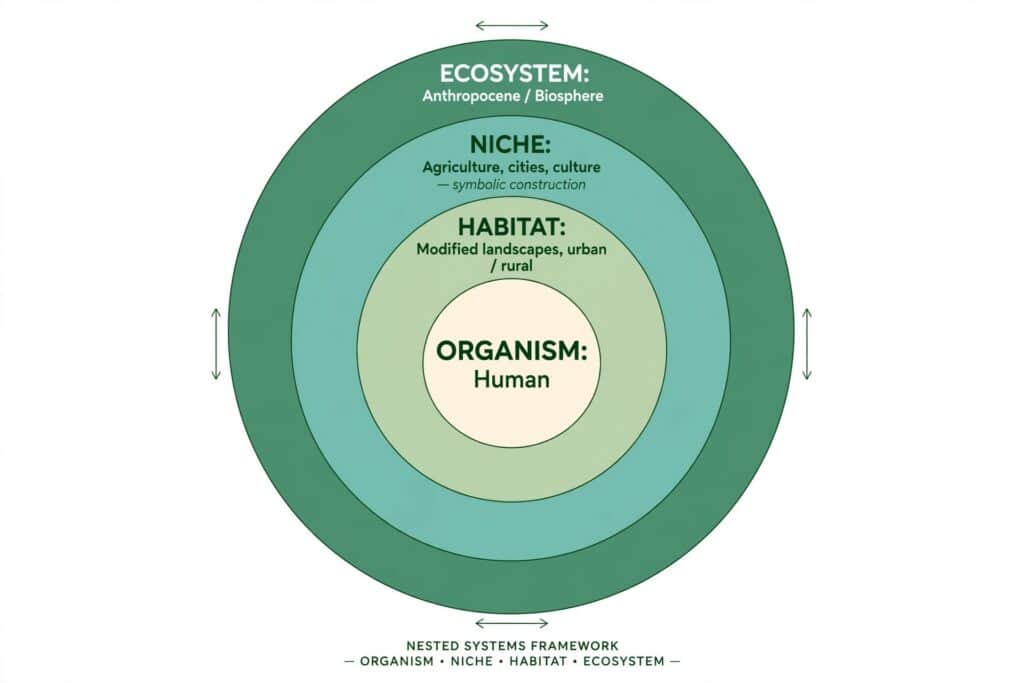
We humans have extended our niche across time and place. As sociologists put it, we now live in a society of distance, and our habitat is less tightly nested. Consequently, our niche is no longer easily defined by a particular time or place. Our home range has expanded, freeing us from dependence on any one habitat.
In the past, village and tribal elders passed knowledge down through stories, mythological explanations, and personal experience. Today, however, scholarship specialises and carries much of that knowledge. As a result, our niche no longer fits within a single habitat. Instead, our influence on habitats can nearly usurp them, as we commandeer them for our purposes (Figure 3). Some have regarded this as a new epoch, the Anthropocene.
How Human Activity Shaped the Anthropocene
The Anthropocene is an unofficial term for a proposed new epoch in Earth’s history. It describes the profound and rapid ways human activity has transformed the planet’s climate, ecosystems, and geology. In 2000, Nobel Prize-winning chemist Paul Crutzen and biologist Eugene Stoermer popularised the term. Since then, it has come to mark a period when human actions—including greenhouse gas emissions, industrial pollution, widespread plastic use, intensive agriculture, and habitat destruction—became a dominant global force shaping Earth’s systems.
A Landscape Changing Too Quickly
Returning to our jigsaw analogy, we are reshaping the landscape so quickly that other species struggle to fit their pieces into it. Our built environment and our demands for mass food production, housing, and fuel rapidly transform the land. As a result, we distance ourselves from the ecological intelligence embedded in its contours. In addition, noise and light pollution disrupt daily cycles and distort the signals other species rely on to communicate and respond. Meanwhile, our devastating global impact has altered the seasons.
Our impact on birds from noise is a good example.
How Noise Disrupts Bird Communication
Traffic, aircraft, and machinery produce low-frequency sounds that overlap with bird vocalisations. As a result, birds may struggle to hear danger signals or attract mates. To make their calls stand out, some species—including the Himalayan Monal and urban songbirds—raise their calls’ minimum frequency or pitch to overcome low-frequency noise from cities and tourists.
However, noise can also mask the intricate details of birdsong. Males use these details to signal aggression and defend their territories. Loud noise also masks hungry chicks’ begging calls, making it harder for parents to feed them effectively. In addition, when ambient noise blocks anti-predator warnings, birds may fail to react, leaving them more vulnerable to hawks and cats. Ultimately, these communication problems can reduce mate attraction, contribute to mismatched territories, and lower overall breeding numbers worldwide.
Reintroduction and Ecological Responsibility
Reintroducing species to habitats where they have disappeared has become an important part of nature conservation. Yet humans have not only disrupted ecosystems and habitats; we have also begun deliberately reshaping them. To get the balance right, we must draw on ecological knowledge and consider the potential consequences of every intervention. It is easy to focus on the species that capture our attention. However, successful reintroduction requires a deeper understanding of ecosystems than emotional attachment alone can provide. This is why studies of ecological intelligence are vital in such projects.
How Species Respond to Changing Habitats
Each habitat supports a different set of interacting functions, so what works in one set of circumstances may be less effective in another. As a species’ population grows—or other species’ populations shift—its behaviour may change substantially. To understand these changes, we need to know what a species responds to and how it responds. In other words, we need to understand its ecological intelligence.
The beaver is a good example of this. Scent marking plays a significant, indirect role in the Eurasian beaver’s territorial defence. As beaver populations grow and density increases, resource competition and space limitations shift their social, territorial, and settlement behaviours. As prime territories fill up, new family groups and younger beavers are pushed into marginal or suboptimal sites (e.g., fast-running streams, shallow banks, or areas with fewer preferred trees). In high-density populations, young beavers often delay leaving their natal (birth) family groups or stay to replace their parents.
Population Growth and Its Effects on Other Species
As beaver populations grow, they can disrupt other species’ habitats. In crowded areas, beavers are more likely to cause localised flooding on roads, agricultural fields, and private properties. As a result, communities may increase trapping, relocation, or other management interventions. These impacts can also trigger cascading effects by altering the predator-prey balance.
From Near-Extinction to Recovery
Overhunting initially threatened the Eurasian beaver. In pursuit of fur, castoreum, and meat, hunters reduced the species to just eight small, isolated populations—about 1,200 animals in total—by the start of the 20th century. Hunting bans and translocation programmes across Europe and Asia later reversed the decline, and beaver numbers have since grown. However, much of this recovery came through translocations that mixed geographically distinct populations. Authorities first banned hunting and, much later, began reintroductions—a process that continues today.
Early reintroductions for harvesting
Norway first banned beaver hunting in 1845, offering the earliest protection. Other countries with surviving beaver populations followed, but Finland and Sweden acted too late to save their native stocks. Sweden then led the first reintroduction effort, releasing about 80 Scandinavian beavers at 19 sites between 1922 and 1939. Over time, extensive programmes moved beavers across vast areas. From 1946 to 1964 alone, they translocated more than 10,000, most from Belarus. However, these early reintroductions were not driven by ecological motives.
From Harvest to Conservation
Earlier releases aimed to restore game species for harvest. Since the 1970s, however, people have increasingly reintroduced animals to support ecological goals, recognising, for example, how beavers fell trees and reshape water levels. Yet because they paid little attention to the founders’ origins, many translocations mixed distinct geographical forms. This ignored the adapted state of the founding populations. As a result, the few remaining unmixed populations now hold exceptional conservation value. Accordingly, the conservationists argue that reintroductions should use only the nearest geographical form.
Healthy riparian forests with a natural flood regime support the most fecund beavers and cause the least conflict with people, so they both strengthen fragile populations and reduce the friction that thriving ones create.
Beaver Reintroductions need studies of ecological intelligence
A recent review by the Freshwater Biology Association outlines recommendations for maximising the benefits of beaver reintroduction for biodiversity, ecosystems, and people. It highlights Scotland’s Beaver Strategy 2022-2045, developed by more than 40 organisations, as an important foundation. The review also stresses that ongoing stakeholder engagement is essential to identifying effective management principles.
To guide decisions about future releases, the review calls for comprehensive assessments of beaver impacts that draw on the expertise of scientists, policymakers, land managers, and others. Although scientific understanding continues to advance, important knowledge gaps remain. Therefore, collaborative research and coordinated data sharing are vital. In England, the newly established National Beaver Forum aims to support the development of best practices.
Because beavers’ effects vary across contexts, systematically gathering studies from diverse environments can help managers tailor their approach and prioritise restoration efforts. This work is especially important amid the wider global freshwater biodiversity crisis. Ultimately, the goal is to maximise the benefits of reintroduction and strengthen the evidence base for future management strategies.
We should not underestimate the importance of ecological intelligence in any species reintroduction.