
From Stochasticity to Ecological Intelligence and the Nature of Choice
From Stochasticity to Ecological Intelligence and the Nature of Choice
Raymond Noble & Denis Noble — Chapter 4 in Towards a Biosemiotic Theoretical Biology: Sign Processes and Meaning-Making in Living Systems (Kull & Favareau, eds., MIT Press, Vienna Series, 2026, pp.65-76)
Estimated reading time: 15 minutes
Key Takeaways
- Organisms use stochasticity to make choices and maintain fluidity, allowing for creative problem-solving.
- They create purpose through self-modifiable behaviour, distinguishing living systems from rigid machines.
- A four-part model outlines crucial concepts: stochasticity, nested integration, causality, and open systems.
- Ecological intelligence involves understanding and interacting with the environment, facilitating communication and adaptation.
- Free will in organisms includes making choices driven by motivation and rational objectives, influenced by situational logic.
Harnessing stochasticity
Organisms harness stochastic processes when making choices. Furthermore, in our book, Understanding Living Systems, and our recent semiotics chapter, we outlined a model with four key pillars: 1. stochasticity, 2. nested integration, 3. causal relativity—meaning no single level of causation is privileged—and 4. an open system. Moreover, living systems use stochasticity, or variability, throughout their processes to maintain integrity and interact with their environment. This variability, in turn, introduces the necessary fluidity or plasticity, enabling creative responses—reacting moment by moment in ways that serve specific purposes. Importantly, unlike machines, we should not view living systems as identical to mechanical constructs—a fundamentally flawed misconception.
Organisms create purpose
We make machines for a purpose: to do work. Organisms create purpose and solve the problems that come with fulfilling it. Machines are rigid designs; organisms are self-modifiable in achieving objectives, and not least the preservation of life itself; they are fluid and self-malleable. The self bit is significant. Organisms are impressionable, self-guided, and open to change and influence, and to influencing others. This is the nature of self-awareness. This malleability comes from harnessing stochasticity. Let’s turn to a bit of ancient philosophy.
“Open Systems” describes living organisms as continuous, interactive networks that freely exchange energy, matter, and information with their environment, rather than acting as closed, gene-controlled machines.
The mechanistic view of organisms led to René Descartes’ dualism of body and mind, and, consequently, has bedevilled our understanding of free will and conscious intentions ever since. To clarify, a machine is a physical device or apparatus with moving parts that uses power (such as electricity, fuel, or human effort) to perform work or complete specific tasks. Similarly, organisms definitely contain moving parts; they also have systems of pulleys and levers that use power to move these parts, shaped to support their functions. However, there is something more: inherent motivation and an awareness of their integrative self.
Life is problem-solving with creativity, which is the origin of purpose. Organisms do not function like machines driven by genes as master programs; instead, they use genes as tools. Organisms can switch genes on or off, modify them, and repurpose them. Meaning, reason and anticipation emerge from nested, stochastic processes integrated at psychosocial and ecological levels, making biosemiotics central to biology.
From Aristotle to Descartes
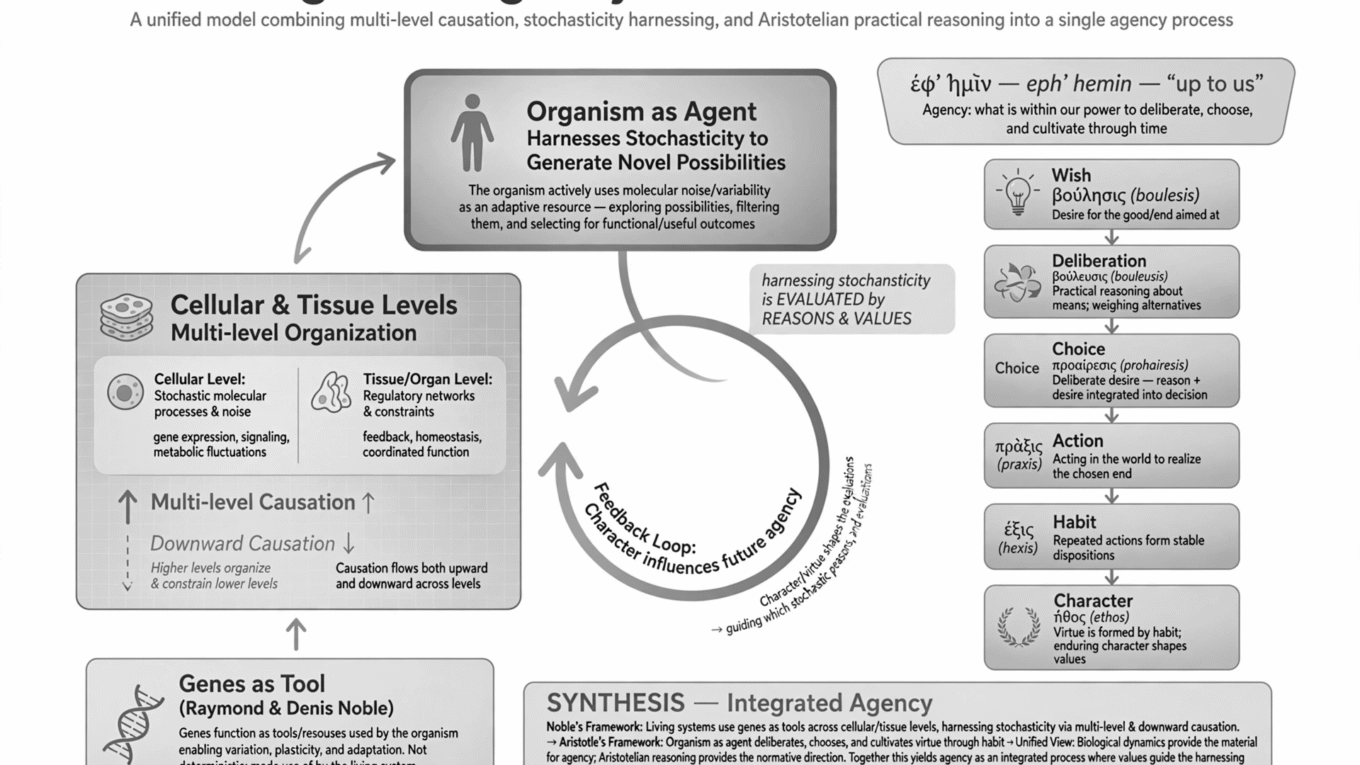
Plato saw that the world was in continuous flux. For Plato, this was a problem; Aristotle (in his De Anima), by contrast, saw it as a solution necessary for motivation and action in living organisms. Without it, nothing can happen. Yet, despite the materialism and objectivity of modern science, Cartesian dualism still plagues us. Moreover, many scientists continue to treat organisms as machines, recognising only humans as conscious and purposeful. Figure 1 contrasts the Cartesian and Aristotelian views.
Cartesian Dualism is the separation of mind from body. In modern science it has been replaced by a materialist dualism in, for example, the concept of vehicle (body) and gene (controller).
Our view in Understanding Living Systems owes more to Aristotle than to Descartes. Furthermore, semiotics helps us better understand the ‘immaterial’ aspects of life, since it draws on logic and meaning in ecological intelligence. In this sense, reason has driven evolution, honing the faculties of perception and cognition for this kind of engagement. Moreover, it helps us understand the role of teleological interpretations of events by better explaining why something happens.

Teleology explains or understands things in terms of their end purpose, goal, or final result rather than their material cause alone,
Key Concepts
a) Intelligence and Choice
Organisms directly communicate intelligence about their mood, emotional states, intentions, whereabouts, and foraging success. For example, Herring Gulls can communicate over several kilometres (Frings et al. 1955). Organisms anticipate the behaviour of others. Survival requires continuous adaptation and identity recognition — essential for creativity; many factors are semiotic (the way organisms create, share, and understand messages using signs and symbols). Assessment of others contributes to self-identity (Yorzinski 2017).
b) Signs Have Material and Immaterial Association
We cannot reduce or even understand signs by considering only their physical manifestations; signals convey contextual meaning and purpose. In physiology, discussions about signalling often overlook this distinction. Science tends to dislike teleological explanation (Noble and Noble 2023); reason, purpose, motive are difficult to weigh. This sidelining arises partly from Descartes’ dualism — body as thing that does not think, mind as thing that thinks. One aim of the semiotics chapter was to explain why dualism fails to address how physical processes align with non-material interpretations of value and meaning. This is why the residues of dualism matter; wrapped in a hardened materialist box, they deny organisms purpose and intentional agency.
c) Organisms Are Not Machines
We are not machines with fixed cogs and wheels. Machines operate as rigid objects with linear functionality: A causes B, which produces C. Living organisms involve continuous ebb and flow that conditions and predisposes potential actions — experienced as emotions, desires, hopes, fears, heart rate, blood pressure. Inputs and processes are flexible; outputs evolve as we go. We learn to use situational awareness, make logical and sometimes irrational decisions, and to collaborate. Organisms purposefully shape and finely tune their behaviour to achieve goals (Ginsburg and Jablonka 2007, 2019). But behaviour isn’t strictly ‘deterministic’; for example, we use A to create or do B, C, or D, or many other possible choices. We can put much that we produce to many purposes, as we can with our faculties of touch and manipulation, or speech and the written word.
Active Agency: because organisms are open systems, they possess intrinsic purpose, intelligence, and autonomy to shape their environment (“niche creation”) rather than merely reacting as passive genetic automata. (Noble and Noble, Understanding Living Systems, CUP, 2023).
Nested Organisation: Every biological level (from molecules and cells to organs, whole bodies, and human societies) is embedded within and interacts dynamically with adjacent levels. (Noble and Noble, Understanding Living Systems, CUP, 2023).

d) Nested Function With No Privileged Level of Causation – The 4-Part Model
Functionality is nested: organelles function within cells; cells within tissues; tissues within organs; organs within systems; systems within organisms, all interconnected through social and ecological interactions (Noble and Noble, 2023). Let’s now compare this with Aristotle’s model.

What is it to be free?
If we claim organisms have free will, what makes them free? The system that generates meaning and purpose feeds back, changing our state of being. In one sense, it is a partial freedom. We may never be totally free of our needs and desires, our hopes, fears and wishes; but we can be sufficiently free to not always pander to them, and not always allow their physiological manifestations to dictate our actions
Reasons are causal
We can manage our desires, or our anger, for example. The hopes, wishes, desires, loves, hates are ours. I am characteristically me, as you are characteristically you. Furthermore, we recognise such individuality in other animals, not solely by their features but also by their behaviour. That this freedom is relative doesn’t make it less precious; it makes it more so. When we say an animal does something for a reason, we are saying that reason is causal, but it is not deterministic in the sense that the organism had no choice. Teleological explanations are often necessary to fully understand events.
Summary of the 4 pillars
| Pillar | Explanation |
|---|---|
| 1. Stochasticity Everywhere | Living systems use stochasticity (variability) at all functional levels (Noble and Noble 2018) |
| 2. Nested Integration | Functionality is nested: organelles within cells; cells within tissues; tissues part of organs; organs integrated into systems; systems within organisms, all interconnected through social and ecological interactions (Noble and Noble 2023) |
| 3. No Single Direction | There is no single direction for causality in what is an open system (D. Noble and R. Noble 2021; R. Noble and D. Noble 2021) |
| 4. Open System | If preferred level, it lies at more integrative and psychosocial levels (Noble et al 2019) including readiness, anticipation, integrative awareness (consciousness) essential for intentional agency / free will. |
Evidence for harnessing stochasticity
Stochasticity is harnessed functionally at every level of the system from molecules through to social and ecological engagement. The keyword is harnessed. We use the term to mean control and make use of something. The system harnesses the power that can come from variability. For example, the cell and its semipermeable membrane ‘harnesses’ the random movement of solutes in diffusion gradients to create voltage differences across the membrane; changes in voltage can selectively open channel gates, which can create changes in voltage that lead to signalling within the cell or outside it.
Another example is that with each breath we take, we gain oxygen from the air by simple diffusion down a concentration gradient. It isn’t magic; it is physics: the random movement of oxygen molecules, harnessed for purpose and facilitated by the physiological arrangements of our cardiovascular and respiratory systems and the oxygen-carrying capacity of the molecule haemoglobin.
Water, water, everywhere
Whether we run, walk, or talk, every level of our system relies on constraining or moulding stochastic processes, shaping what we do and why. This is why water is such an important ingredient for life on Earth; it provides the fluidity needed for creative change. No surprise, then, that we are 70 per cent water.
Some more examples of stochastic functionality
.
Neurons at edge of stochasticity:
Nerve cells work by harnessing voltage changes across the cell membrane. These postsynaptic potentials occur with variable but continuous waffling (oscillations). When they reach a threshold the membrane generates discrete impulses (Action potentials) that are propagated from the cell along its axon. This is the basis of neuronal signalling in our brains. Networks control impulse threshold through continuous analogue modulation, not on/off switches (e.g. see Brown et al. 1987; Noble and Short 1989).
Nested Neuronal functionality:
neurons are organised within networks and within layers in processing nuclei and systems. This further illustrates the power of nested functionality to create integrative processing of inputs and outputs. Each layer modulates or constrains the inputs and outputs of other layers. A typical example of this is the ‘gate control theory’ of pain (Melzac and Wall, 1965). My own work in the 1970s and 80s also showed the function of such gates in the somatosensory system, and it was a privilege to have my thesis examined by Pat Wall.
The gate control theory proposed by Ronald Melzack and Patrick Wall in 1965 explains how non-painful sensory input can close a neural “gate” in the spinal cord to block or reduce painful signals traveling to the brain
Our Brains are bubbling cauldrons
Our Brains are bubbling cauldrons of billions of neurons and synapses, functioning in excitatory and inhibitory ebbs and flows that create states of nested functionality. The organisation- the billions of interconnections takes time to form. In humans, the brain continues developing until at least our mid-twenties. Sensory and motor experience is required for precise connections to form, and in the process our brains are influenced by our environment. Our brains are not carved by genes, but by our interaction with our habitat. In this sense, then, ecological intelligence hones our brains. It is another example of the inward, or downward causation in the making of who we are. Furthermore, it is a profound evidential basis disputing that ‘genes are swarming with in us creating us body and mind’ (Dawkins, 1976).
Heart rhythm
Heart rhythm varies stochastically from beat to beat, serving as a critical indicator of normal physiological control by the sympathetic and parasympathetic systems, as well as reflecting the heart’s own learning network (Herring and Paterson 2021). An absence of variability signals abnormality and is influenced by functional states such as emotions. The heart, a remarkable organ, generates its own rhythmic pacemaker activity in specialized regions called nodes. It exemplifies nested function by being regulated by the body’s autonomic nervous systems while also maintaining its own nerve cell network, similar to other systems like the gastrointestinal system.
Cell membranes
Cell membranes: As we see, cell membranes are not simply barriers or containers. They are selectively permeable and play a significant role in controlling cell function. By one analogy, they contain IF X THEN Y ELSE Z logic of electrical switches via channels, exchangers, and receptors, formed by the organisation of proteins inserted in the membrane. Furthermore, messages or signals from the membranes regulate gene expression. This is how, say, a mother’s touch can fine-tune the genome (Pickles et al. 2013); a fine example of nested functionality from the social to the molecular level: we control the genes.
A mother’s touch can fine-tune the genome (Pickles et al. 2013); a fine example of nested functionality from the social to the molecular level. we control the genes.
e) Gene-Centric Dualistic View – Critique
20th-century science tended to equate causality with determinism, emphasising upward causation and a gene-centred perspective with codes/blueprints/book of life, especially the selfish gene theory. This led to the absurd idea of quantifying gene vs environment contributions to complex traits like intelligence, and it led to Eugenics. Intelligence is multifactorial. Turn it on its head. The alternative view is that genes are tools the organism uses and controls. They are essential in creating faculties to sense and act, but not used in the process of doing so. The genes do not control my fingers as I type these words. Nor can they create their meaning. The faculties we have for perception and cognition, along with those for doing things, evolved for ecological intelligence and language, and are understood through situational logic and awareness.
Eugenics is the discredited practice or advocacy of improving the genetic quality of the human population through controlled selective breeding and/or genetic manipulation.
f) Self and the Symphony That Is the Forest
Language facilitates sharing perception but isn’t necessary for abstract perception or consciousness/self-awareness. Organisms can make abstract assumptions without language. But the forest is a symphony of signs – sounds, scents, sights. Monkeys are noisy; great apes are less noisy but hoot or scream — not a precise genetically determined lexicon; sounds are moulded in the moment. They make sounds to influence others, to warn, encourage, and identify. Warning other group members is situational, and the meaning is contextual. Chimpanzees, for example, communicate deliberately with reason explainable only by situational logic, creating signs to convey specific intent. Signs can be learned and culturally transmitted across generations. (Jensvold et al. 2023).
g) Home Range, Ecological Intelligence
Burt introduced the Home Range concept in 1943 as the area an animal traverses during normal activities. However, Darwin earlier noted that animals restrict their movements. With modern telemetry, researchers can map this area and the animals’ behaviour within it. This area is now redefined as the area about which an animal has ongoing cognisance, from which it regularly obtains and gives information—this is ecological intelligence (Noble and Noble 2023). It also involves a crucial distinction between self and others, and the recognition of individuals and their relatedness (Smith-Vidaurre et al. 2023).
The Giant panda is an interesting example: it appears relatively solitary, yet it remains aware of other pandas that overlap its home range. It does so through a range of signs: sights, sounds, scents, and markings. A home range is a kaleidoscope of signs evoking memories and anticipation of the future. Significance cannot be judged by time spent — it requires insight into anticipation and an understanding of seasons, when behaviour may change.
h) Situational Logic and Biological Function
Situational logic, though not a material entity, is an integral part of perception and comprehension. For example, if Jack and Jill climb a hill carrying a bucket, we may presume a reason (say, fetching a pail of water). A dog, not capable of forming words, could still make assumptions based on association (Ginsburg and Jablonka 2019). The crux is that logic in action may exist. This influences how we perceive the world around us and events within it. The process of assumption does not require language, but does require cognitive situational logic and intelligence (signs and interpretations). It requires the ability to imagine things could be otherwise. This is similar to Locke’s doctrine of signs (1689)—he considered it a ‘third branch of science,’ examining the nature of signs and how the mind uses them to understand or convey knowledge.
“We experience these processes as emotions, desires, hopes, fears, or anxieties, which can also manifest as physiological changes, such as heart rate, blood pressure” and “situational logic is aligned with function, in the sense that the situation influences an individual’s biological state of being, encompassing perception, anticipation, emotions, desires, needs, and actions.”
Raymond Noble & Denis Noble — Chapter 4 in Towards a Biosemiotic Theoretical Biology: Sign Processes and Meaning-Making in Living Systems (Kull & Favareau, eds., MIT Press, Vienna Series, 2026, pp.65-76)

Conclusion
Free will involves choices made to achieve objectives derived from motivation and reason. Firstly, there are signs related to ecological intelligence. Second, individuals can anticipate significance; finally, they can use signals to purposefully influence others’ behaviour. Consciousness is then a state of integrative awareness that encompasses anticipation of social, ecological, or situational logic. Furthermore, signs, gestures, and language form a substrate for immaterial interdependency — not as a separate entity parallel with the material being, but as something created by and functionally intertwined with it.
Free will involves choices made to achieve objectives derived from motivation and reason. The self/other distinction and integrative awareness emerge from ecological intelligence. Choice is modulated by both motivational and cognitive layers while being anchored in a sense of integrity. The organism is aware of what it is doing and that it is doing it,
The self/other distinction and integrative awareness stem from ecological intelligence. Furthermore, choice is shaped by both motivation and cognition and is grounded in a sense of integrity. The organism knows what it is doing and recognises it.
References: Understanding Living Systems CUP 2023; Noble & Noble 2018 Chaos 28:106309; Noble et al 2019 Front Physiol 10:827. Source book open access PDF via MIT Press Direct.