
Understanding Ecological Intelligence: Lessons from Nature’s Problem-Solvers
Estimated reading time: 7 minutes
Key Takeaways
- Ecological intelligence involves the signs of meaning and purpose created by organisms within their environment.
- Organisms use a lexicon of signs to communicate intentions, warnings, and status, contributing to the narrative of their habitat.
- Birdsong demonstrates cultural learning, adapting to local environments and influencing survival through group identity.
- Collaboration, seen in networks like mycorrhizal fungi, showcases the interconnectedness of organisms in solving ecological challenges.
- Understanding ecological intelligence can teach humans to live adaptively within ecosystems, recognising them as dynamic, problem-solving entities.
What is Ecological Intelligence?
Organisms create purpose
Organisms create purpose. Ecological intelligence consists of all the signs of meaning and purpose made by and interpreted by organisms. In this sense, it has both a materiality- the substance of the changing habitat, the what, where and when- and an immateriality of intention, reason or purpose: why something has changed. These are the signs left or created. Intentionally or unintentionally, organisms leave traces, or signs, of their presence. Organisms form an ecosystem, within which they create their niches. In this context, then, the term niche refers to a specific function, position, and role that a plant or animal has within its natural environment and community. But organisms don’t simply occupy a niche; they are niche creators.
A kaleidoscope of signs
Naturalists can often recognise a species by observing signs of this creative niche process; badgers build setts, beavers construct dams, etc. In the process of living, all organisms leave signs of their being, past or present. They may also leave signs of their intentions or moods (states of being); for example, in relation to reproduction. A forest, for example, is a kaleidoscope of such signs: sounds, scents, physical marks, tracks, trails, marks left to warn or encourage, marks left to deter. Each habitat has an ongoing story. This narrative is ecological intelligence.
Reading the signs
Walking in the woods, we often hear birds using high-pitched, sharp alarm calls to warn nearby animals of an approaching predator while minimising the risk of revealing their own location. We may also hear wings flutter as some take flight to avoid potential danger. Such calls are part of the lexicon of signs organisms use in ecological intelligence. Warning sounds are common, and they are also part of the lexicon of recognising another; in this case, a potential predator. So, we have two significant meanings: warning and identification. But there is another: a coded level of immediacy, or danger.
Meaning and purpose
A lexicon is the complete vocabulary of a particular language, field, social group, or individual person.
Many species, such as the black-capped chickadee, change the number of notes (like the “D” notes in “chick-a-dee-dee-dee”) to signal the precise level of danger. So, we begin to develop a concept of language. Language relates to others; birds call to others to warn of danger, to indicate the degree of danger or its immediacy; so now we have three significant meanings: warning, immediacy and identification. But there is so much more.
Birds use song to communicate key messages such as territory ownership and mate attraction. The song can indicate the bird’s state and location. Moreover, it can issue instructions. Nesting birds coordinate duties and signal their mates using a combination of specific vocal calls, alternating song bouts, and subtle physical gestures. The lexicon grows. How the instruction is given may indicate mood or imperative.
The black-capped chickadee (Poecile atricapillus) is a small, nonmigratory, North American passerine bird that lives in deciduous and mixed forests.
A deciduous tree is a plant that loses all of its leaves for part of the year, usually during the autumn or winter. In doing so, it also leaves signs as part of the story. Dropping leaves stops the tree from losing vital water and protects it from heavy snow or strong winds.
Ecological intelligence can also be meteorological, relating to weather or changes in the Earth’s atmosphere as seasons come and go. This is also a vital part of ecological intelligence, as organisms prepare for these changes: to hibernate in winter or to migrate, often over long distances.
Ecological Intelligence in Evolution
In our book, Understanding Living Systems, we argued that ecological intelligence is and has been a major factor in evolution, through which organisms act as agents in what Darwin called natural selection. Contrary to the view that evolution results from gradual, small, random gene mutations, this view adds an active, dynamic, and directional dimension to evolution. Organisms both adapt to and create ecological intelligence. Not surprisingly, then, faculties of perception and cognition have evolved to process, evaluate, and respond to it. It is how organisms adapt to reason and purpose as a major ingredient of their environment (Figure 2)
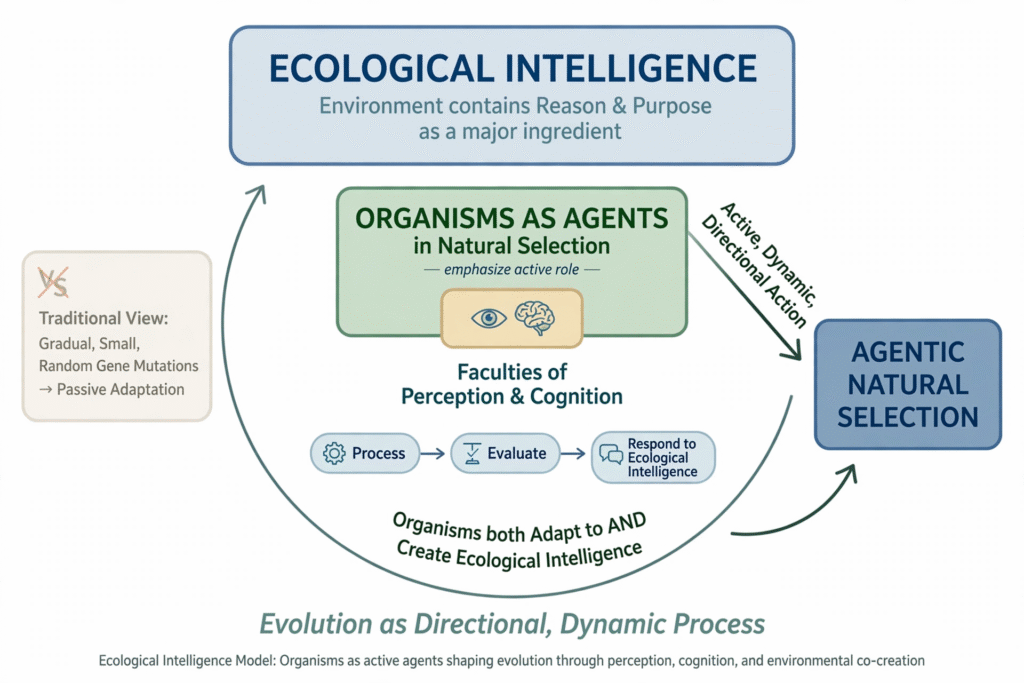
If natural selection measures fitness for survival and reproduction, then we must ask what is doing the selecting and what is being selected. If it is the environment, then we clearly also created it, even if it takes time to understand its impact on us. The niche we create is profoundly psychosocial. Humans are not alone in doing this. Self-identity and social identity, together with anticipation, are also key aspects of ecological intelligence.
Examples of Problem-Solving in Nature
Bird song and local identity
Songbirds learn to sing. As in human speech acquisition, songbird vocal learning depends on early auditory experience. The avian auditory cortex—specifically the primary auditory area, field L, and higher-level analogues such as the caudomedial nidopallium (NCM)—processes acoustic signals and stores memory templates essential for birdsong learning and perception. It is another crucial example of how function develops through interaction with ecological intelligence. Bird song is modifiable and habitat-dependent. They are not simply genetically determined.
Species match their local conditions, using specific whistles or trills depending on how sound is affected in their home location. For example, birds in dense forests sing simpler songs that travel well through thick leaves. Young birds learn tunes from their parents and nearby neighbours, creating unique local variations or dialects. For example, the wood pigeon’s song, ‘my toe bleeds Be-tty’, is commonly sung in some parts of the UK as ‘my toe bleeds Ju-li-a’. Researchers found that particular cells in the brains of swamp sparrows from Pennsylvania and New York, which have regional song differences, responded only to songs sung in their own accent.
This shows how group identity arises within local ecological intelligence. This may be one way active group selection plays a part in evolution, as local males may be better adapted to the neighbourhood, making their offspring more likely to survive than those fathered by intruders.
Bats and Moths
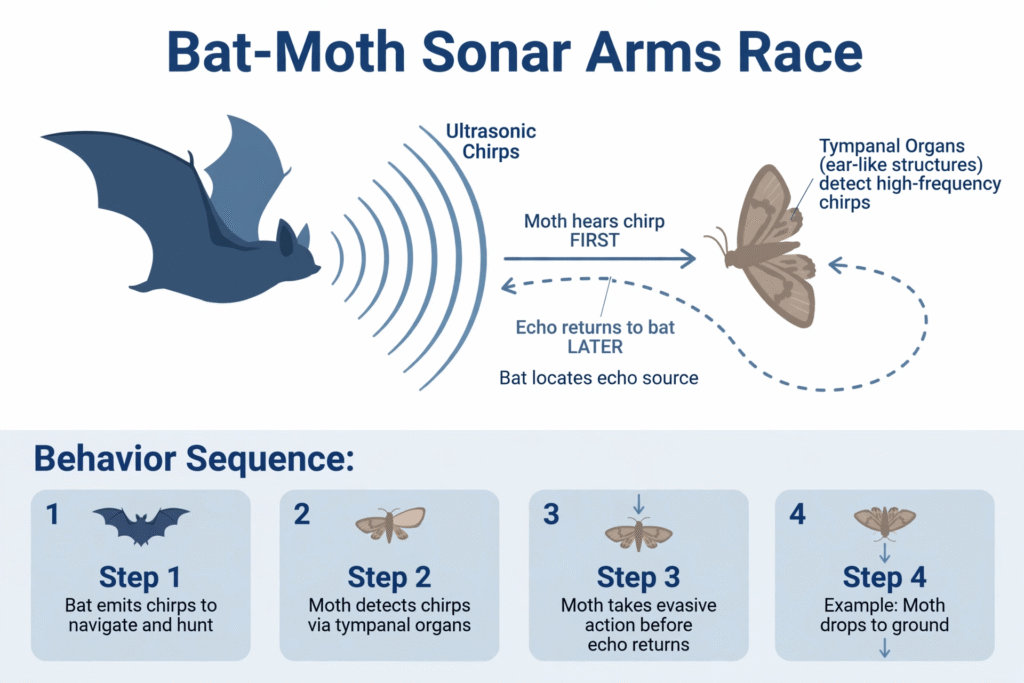
Insect-eating bats find their food in flight by sonar, by emitting ultrasonic chirps and locating sources of echoes. Moths detect bats by using specialised ear-like structures called tympanal organs that pick up the high-frequency ultrasonic chirps of hunting bats. Bats navigate by using ultrasonic chirps. Moths can successfully avoid bats in the dark by hearing their chirps before the echoes bounce off the moths and return to the bats. The moths can then take evasive action, and in some species, simply drop to the ground (figure 3)
The Role of Collaboration in Ecological Intelligence
Whether wittingly or not, collaboration is also a key feature of ecological intelligence. We presented an example of this in a previous article, considering the intimate relationship between plants and fungi. A hidden underground web forms when fungal threads join plant roots. This is the mycorrhizal network. People often call it the “wood wide web”. This system links separate plants together in forests and fields. This mycorrhizal network lets plants communicate and share vital nutrients.
Another article emphasised the interconnectedness of organisms in an ecosystem. Organisms generate the driving forces of the self-regulating living system. It is robust in adapting to circumstances, yet often delicate. Climate change is driving species migration, which can upset conservation efforts and requires judgement. So, conservation isn’t about keeping the system static or choosing species, but about building resilience, which itself involves and fosters change. Organism behaviour may change in response to ecosystem shifts. A changing climate disrupts the natural cues—such as temperature, snowmelt, and rainfall—that wildlife rely on for survival.
Lessons for Human Systems from Nature
The ecosystem is an adaptive process with population ebbs and flows; it consists of dynamic, interactive organisms. An ecosystem isn’t a static picture; it breathes and moves. Living with it, organisms use ‘ecological intelligence’; they read, respond to, and act on signs, and actively shape niches. We need to understand the language better to understand this intelligence. We need to see life as a problem-solving and creative process.