
Exploring the Fascinating World of Mycorrhizal Networks
What Are Mycorrhizal Networks?
Estimated reading time: 6 minutes
A hidden underground web forms when fungal threads join plant roots. This is the mycorrhizal network. People often call it the “wood wide web”. This system links separate plants together in forests and fields. This mycorrhizal network lets plants communicate and share.

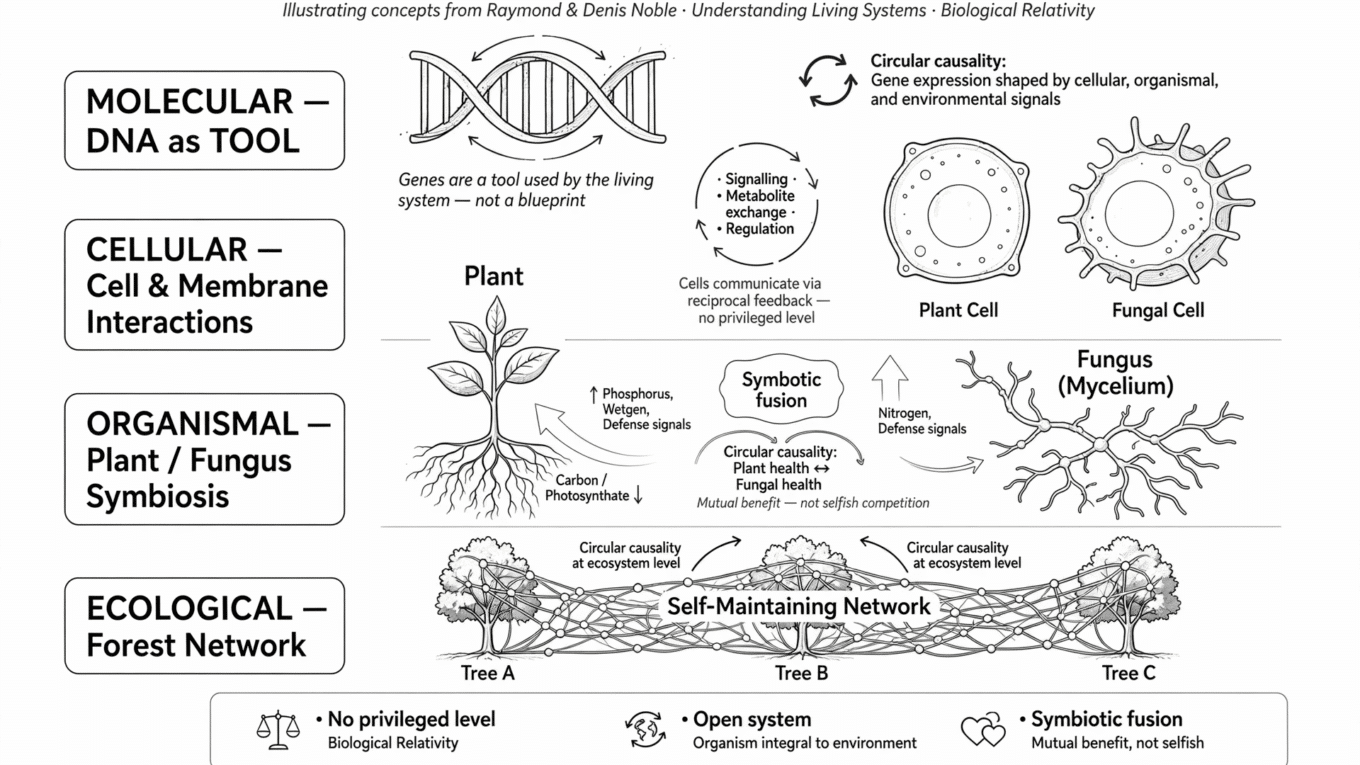
The mycorrhizal network is presented here as part of a complex ecological system with components above and below ground.
In our book, Understanding Living Systems, Mycorrhizal networks are not an aside; they are one of our core worked examples of living systems as interconnected relationships. Two chapters are particularly relevant. In Chapter 3, we consider the role of self-maintaining networks, while in Chapter 6 we consider forests not simply as groups of trees but as symbiotic relationships.
Living systems operate at multiple levels
Mycorrhizal networks are a good example of our concept of biological relativity: living organisms operate at multiple levels and must be analysed as networks at the molecular, cellular, organismal, and ecological levels, with causal factors working in many directions simultaneously to maintain the system. The mycorrhizal association between plant roots and their fungal symbionts, which is essential for most plant communities, shows there is no privileged level of causation. The functional boundary is not the plant genes or the plant’s skin; it is the forest network itself. (see Figure 1.) In the diagram, this self-maintaining network is shown as a complex meshwork of components above and below ground. Organisms also communicate above ground with symbiotic relationships between plants and animals.
Biological relativity: living organisms operate at many levels with no privileged level of causality. The concept was developed as a non-gene-centred view of causal relationships in living things. No genetic blueprint explains the complex interrelationships in ecological systems. The genomes are tools of the systems.
The Role of Mycorrhizal Networks in Plant Health
Mycorrhizal networks play a vital role in exchanging nutrients and signals between fungi and plants, and they affect plant growth, resilience, and survival. This level of functionality provides robustness to the system as a whole, with many fungal species, many plant hosts, and multiple chemical currencies. Knock out one link, and the nutrient flux continues. Nevertheless, as we consider in this article, significant disruption can cause massive damage to the ecosystem. Robustness comes from the network, not from a single part of it (the principle of relativity in action).
Fungi trade water and minerals from the soil for food sugars made by plants through light (photosynthesis). They act as a bridge between plants: One single fungus can connect to the roots of many plants, even if they are different species. Sharing Resources: Plants can share food, water, and defence signals through the fungal web. Older trees can help feed young saplings growing in dark shadows.
Boosting plant growth
Mycorrhizal networks directly boost plant growth, immune response, and overall survival. Massive Root Extension: Fungal hyphae (long, thread-like tubes or filaments) that make up the main body of a fungus. They are much thinner than plant roots, so they can squeeze into microscopic soil pores. This expands the effective root surface area by up to 1,000 times, allowing the plant to absorb far more nutrients. Targeted Nutrient Delivery: Fungi are highly efficient at mining and delivering phosphorus and nitrogen. These are two of the absolute most critical elements for plant tissue growth and leaf development. The “Mother Tree” Subsidy: Shaded seedlings connected to the network receive a steady stream of carbon and sugars from older canopy trees. This vital function keeps seedlings growing even in low-light environments where photosynthesis is impossible.
Plant protection
The network acts as both an environmental shield and an early-warning defence system against external threats. During dry spells, the expansive mycelial web draws water from deep underground layers that shallow plant roots cannot reach, thereby keeping the plant hydrated. When a pest attacks a plant, chemical warning signals travel through the fungal network to neighbouring plants. This prompts healthy neighbours to preemptively produce defensive toxins like jasmonic acid, boosting community-wide resistance. Mycorrhizal fungi can immobilise and lock away heavy metals (like lead or cadmium) in the soil, preventing these toxins from entering the plant’s sensitive root system.
Mycelial refers to the mycelium, which is the root-like, vegetative network of tiny, branching threads called hyphae that make up the main body of a fungus.
Impacts of Mycorrhizal Networks on Ecosystem Sustainability
The intimate relationship between the mycorrhizal network is a key ingredient of ecosystem sustainability. Modern agricultural practices—particularly intensive tilling, chemical overuse, and monocropping—severely fragment and degrade underground mycorrhizal networks, turning a living soil ecosystem into a sterile growing medium.
Tilling (digging, stirring, and overturning soil to prepare land for growing crops) massively disrupts this underground world of plants and trees. Ploughs and rototillers physically slice and crush the delicate, microscopic fungal threads (hyphae). This instantly dissolves the network, destroying the bridges between plants. When the network is broken, the fungi must expend massive amounts of energy to regrow from spores. Moreover, if tilling happens repeatedly, the fungi eventually run out of energy and die off completely. Tilling destroys the soil structure. Without fungal hyphae holding the dirt particles together like a net, the soil becomes prone to blowing away in the wind or washing away in the rain.
In Understanding Living Systems, we emphasise that organisms are niche creators. Plants do not wait for nutrients; they manipulate the environment by feeding fungi carbon in exchange for phosphorus, nitrogen and water. Fungi do not wait for commands; they forage, reroute and signal. The forest itself becomes the niche that organisms create and inherit. Thereby showing that inheritance is more than simply genetic. As we say in our book:
“Plants manipulate their environment and entice other forms of life to do things for them. Perhaps they are the masters of the forest. They also are demonstratively sentient – sensing changes in the vicinity and the presence of others. They also make intelligent, creative choices in response to change. Life uses a multitude of languages, but all life communicates.” Noble and Noble, Understanding Living Systems, CUP, 2023.
Exploring Future Research Directions in Mycorrhizal Studies
Further research will no doubt increase our understanding of this extraordinary network working beneath our feet as we walk in the forest. It is as significant as the birds and the bees above ground, and the rodents that help spread the forest. We need to explore how to foster this interrelationship in agriculture and conservation. As the old farming adage has it, the answer lies in the soil.
Key Takeaways
- Mycorrhizal networks, or the ‘wood wide web’, are underground systems formed by fungal threads connecting plant roots, allowing communication between plants.
- These networks enhance plant health by exchanging nutrients and signals, boosting growth, resilience, and survival.
- Mycorrhizal networks protect plants from environmental threats and diseases by providing drought shielding and pest warning systems.
- Modern agricultural practices disrupt these networks, leading to soil degradation and loss of ecosystem sustainability.
- Future research into mycorrhizal networks can improve agricultural and conservation practices, highlighting their importance in ecosystems.