
The Collared Dove’s mysterious spread
Estimated reading time: 9 minutes
Key Takeaways
- The Collared Dove spread rapidly across Europe due to human assistance, rapid breeding, and ecological adaptations.
- Adolescent birds travel up to 600 kilometres, establishing pioneer colonies through a process called jump dispersal.
- Genetic mutations may have triggered a shift in migration behaviour, leading to a consistent northwesterly trajectory.
- Urbanisation has provided abundant food sources for Collared Doves, as they adapt to human environments, especially in new towns.
- The first Collared Doves settled in the UK in the 1950s, marking a significant avian colonisation in British history.
The Eurasian collared dove (Streptopelia decaocto) has undergone one of the greatest natural avian colonisations in history. The Collared Dove’s spread is remarkable for how rapidly the species expanded its range. For centuries, the species lived mainly in the warm regions of Asia, India, and the Middle East. By the 1600s, it had reached Turkey and parts of the Balkans.
Around 1930, however, the population underwent an explosive genetic or behavioural shift towards a highly “dispersive” strategy. As a result, adolescent birds began travelling up to 600 kilometres from their birthplaces. They followed a strict north-westerly direction. Over the next roughly 40 years, the species spread across Europe at an astonishing average rate of 45 km per year. So what’s the secret of the collared dove? Perhaps the answer lies in niche partitioning and the dove’s adaptability to humans.
Why did the expansion happen so rapidly?
Three plausible explanations for the collared dove’s spread are human assistance, rapid breeding, and sideways infilling.
Human assistance drove the expansion, which mirrored Europe’s mid-20th-century urbanisation. As suburbs, grain storage facilities, and agricultural fields spread, they provided an abundant, year-round food source. Moreover, collared doves mature within a year and can raise multiple broods each season. This allows new pioneer populations to establish quickly. Once the main corridor to the northwest became established, later generations then spread sideways to fill remaining habitats. By the end of the 20th century, collared doves had colonised roughly 2.5 million square kilometres of European territory.

The genetic hypothesis
Biologists have long puzzled over the Eurasian collared dove’s (Streptopelia decaocto) rapid, highly directed expansion, which defied the usual pattern of gradual population spread. Instead, adolescent birds travelled hundreds of kilometres to establish isolated pioneer colonies. This process is known as “jump dispersal.” They consistently moved northwest.
Notably, this same direction and behaviour emerged almost simultaneously across Europe in the 1930s. Later, it emerged in North America in the 1980s. These observations have led scientists to hypothesise that a genetic mutation may have driven the pattern.
Researchers have also scrutinised the species’ genetics to address a related biological mystery: how it expanded across continents without suffering the severe genetic bottlenecks that typically threaten small founder populations. To investigate, they have analysed the birds’ DNA through three primary lenses.
The Leading Hypothesis: “Peripheral Mutation” and Fixed Directionality
Renowned evolutionary biologist Ernst Mayr first popularised the idea that a genetic alteration in a peripheral population at the edge of the dove’s historical range triggered the spread of the collared dove.
The behavioural shift: Doves traditionally remain in one area, migrating only short distances to find food or adjust to changes in altitude. However, the hypothesised mutation altered their innate neurological wiring. It shifted some birds from a sedentary lifestyle to a highly dispersive behavioural state.
The genetic fixation of direction: The fixed compass heading makes the genetic theory especially compelling. Whether expanding from the Balkans into Europe or from Florida into the United States, the birds followed a northwesterly trajectory. Therefore, ornithologists argue that this consistent direction points to genetic fixation. They argue that a specific navigational or migratory gene may have mutated and become permanently established in colonising lineages.
But as we have argued in our book Understanding Living Systems, single genes are rarely so persuasive or so clearly causal.
Tracking Hybridisation and Mutational Shifts
Genetics has also been used to explore how the species interacts with its close relatives:
Researchers have examined the genetic relationship between the Eurasian collared dove and the domesticated Barbary dove (Streptopelia roseogrisea). Genetic and phenotypic evidence suggests that where the two species meet outside their native ranges, the Eurasian collared dove absorbs the Barbary dove’s genes through hybridisation (cross-breeding between species). This gradually displaces its distinct genetic lineage.
By contrast, similar genetic studies in North America have found virtually no evidence of extensive historical hybridisation between native Mourning Doves and other dove species. These findings confirm that, despite sharing backyard habitats, Mourning Doves remain strongly isolated by mate choice. This is an example of strong niche separation by behaviour,
Mourning doves choose their mate through a specific courtship ritual that involves vocal calls, display flights, and mutual grooming. Mating habits in Eurasian collared doves are remarkably similar to those of mourning doves, as both belong to the same bird family (Columbidae) and share a core blueprint of monogamy, aerial display flights, and affectionate mutual grooming. However, they differ noticeably in their distinct vocalisations, flight mechanics, and explicit bonding gestures.
Key Behavioural Differences maintaining niche separation.
Nesting Roles:
For both species, the male leads the female to potential sites, but the Eurasian collared dove is much more adapted to human structures. They will readily choose window ledges, gutters, or utility poles over trees.
The Wing Clap:
During the initial upward flight of the display ritual, the male Eurasian collared dove aggressively claps his wings together to produce a sharp cracking sound. Mourning doves rely more on the natural whistling sound their wing feathers produce when launching into the air.
Courtship Feeding:
While both species rely on close-quarters allopreening (gentle pecking and cleaning of each other’s neck feathers) to solidify their pair-bond, collared dove pairs frequently use courtship feeding as a final reinforcing step right before the female lowers her posture to mate.
Mate selection shows that natural selection, as Darwin understood it, is an active, dynamic process that leads to the emergence of separate species through niche partitioning. In contrast, it can also lead to gene sharing when cross-breeding occurs. As we emphasised in Understanding Living Systems, ‘genes do not make choices; organisms do.”
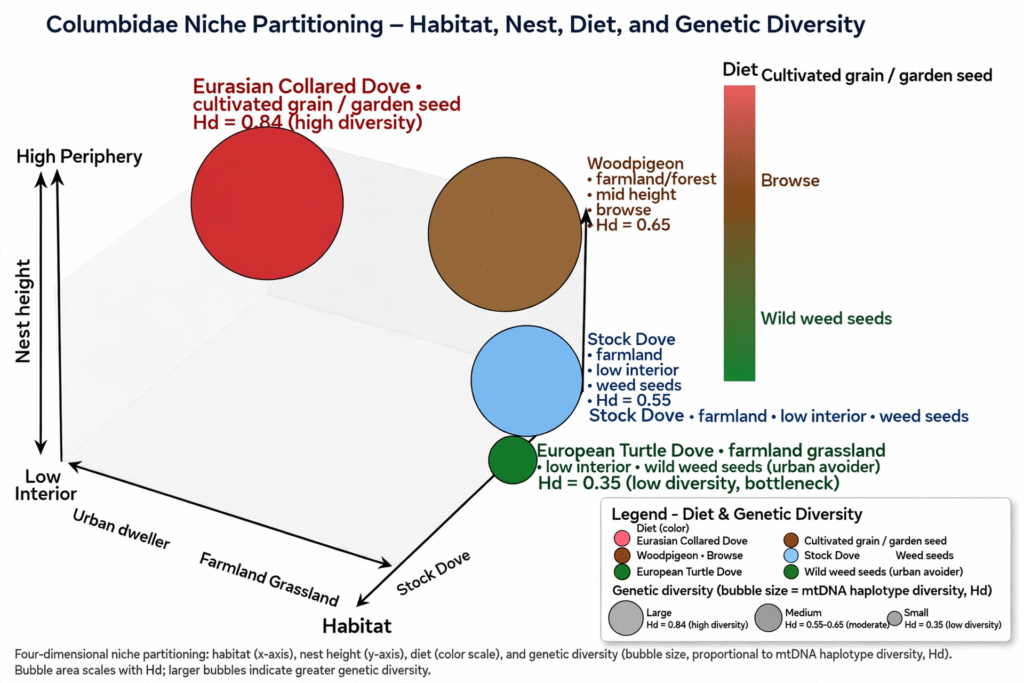
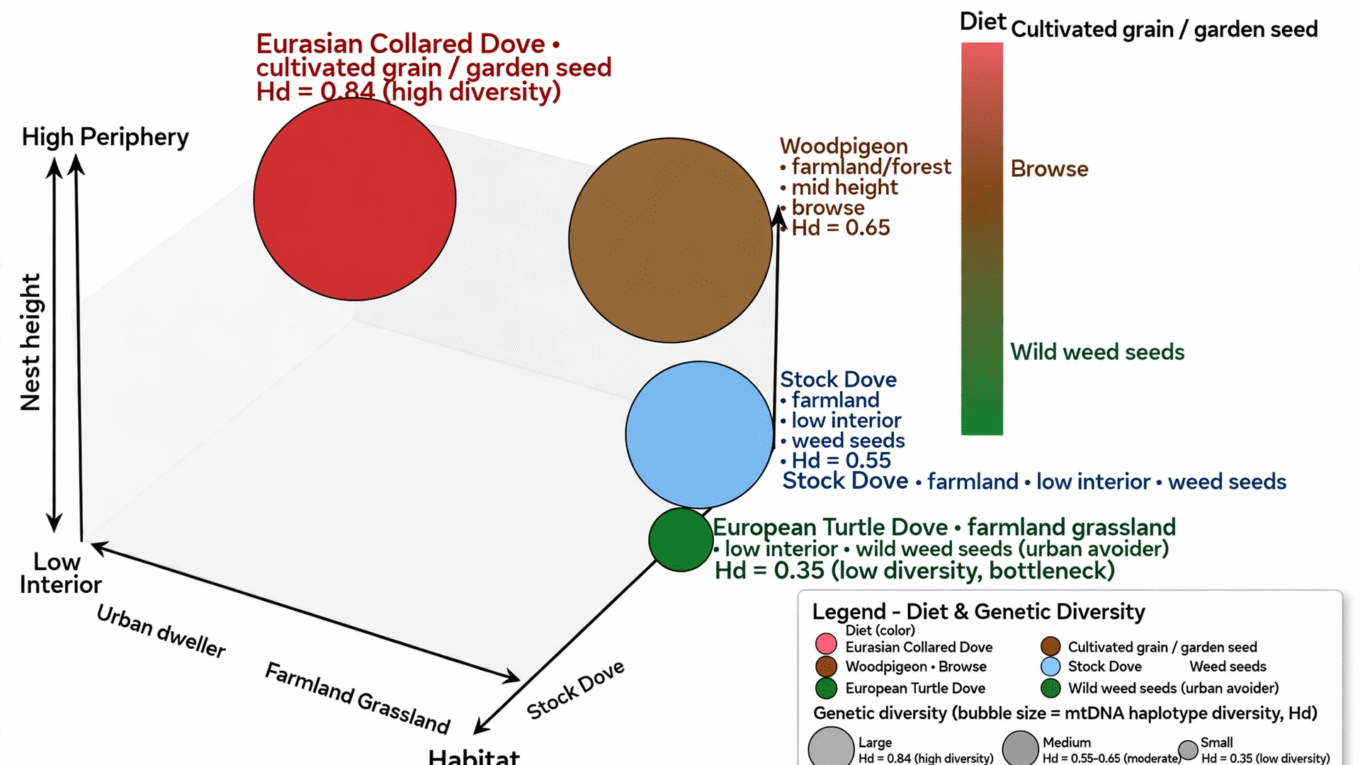
Also, in our book, we argue that reproduction does not mean making replicas. Instead, it produces change and expands the potential for further change, or adaptability. Genes alone, therefore, cannot explain reproduction, even though they may supply new pieces for life’s jigsaw puzzle of fitness. Habitats also change rather than remain static. The spread of the Collared Dove, for example, reflects its ability to adapt to human activity. As human societies changed, they created new opportunities for the Collared Dove to spread (Figure 2).
A four-dimensional model
The diagram illustrates four-dimensional niche partitioning among related species: the Eurasian collared dove, wood pigeon, stock dove, and European turtle dove. Human agriculture and urban living—with cultivated gardens and abundant seeds—created new opportunities for collared doves and other adaptable species. This example shows how organisms actively respond to and adapt to new opportunities. Similarly, urban foxes have developed behavioural characteristics that differ from those of their rural counterparts.
The theoretical model shows four-dimensional niche partitioning among related species: the Eurasian Collard Dove, wood pigeon, stock dove, and European Turtle Dove. Niche partitioning is reflected in four dimensions: habitat, Nesting, Diet, and Genetic Diversity. The colours represent feeding strategy.
Collared Dove spread with human urban living
Its ability to establish a niche alongside human activity may also have driven its rapid spread across Europe and the United States. Moreover, it spread in generational leaps. Over a relatively short historical period, Europe underwent a profound transformation in urban living, shifting from an overwhelmingly rural, agrarian society to a deeply urbanised continent.
In the year 1800, Europe had an overall urbanisation rate of only about 8.5%. Britain became the world’s first predominantly urban society around 1851. Today, approximately 74% of Europe’s population lives in urban areas. Europe is on a fast track to reach around 80% to 90% urbanisation as part of a century-long global trek to cities spanning from 1980 to 2080.
Radical Shift in Human Demographics
So, how well does the model of the relationship between collared doves and human activity stack up? How well does it explain the exceptional spread of the species?
Demographics are changing how urban Europeans live faster than any other factor. In 1950, only about 13% of Europeans lived alone. Today, one-person households account for more than 50% of the population in most Western European capital cities. As a result, cities have radically reshaped housing, apartment architecture, and public spaces to accommodate independent living.
Meanwhile, the movement of people from rural areas to towns and cities—known as rural-to-urban migration—stands as one of the most defining demographic shifts in human history. This migration is driven primarily by the search for economic opportunity, industrialisation, and better access to services.
A critical, modern shift in how humans migrate to urban areas is the destination itself. While massive megacities (like Tokyo, Shanghai, or Lagos) capture global attention, most urban migration actually occurs into small and medium-sized regional towns.
These smaller urban centres serve as vital stepping stones. Rural migrants move to nearby local market towns first, adapting to urban economies before ever considering a move to a primary capital or megacity. This provides habitats suitable for adaptable birds such as the collared dove.
Growth of New Towns in the 1950s
By the early 1950s, as the UK recovered from World War II, the government had designated the core sites for the first wave of New Towns. Throughout the decade, state-funded Development Corporations managed these master-planned communities, which grew exponentially. The government designed the towns to contain London’s growth and absorb its overspill. As a result, thousands of families moved into towns such as Stevenage—the first designated New Town—as well as Crawley, Harlow, Hemel Hempstead, Basildon, and Bracknell every month during the 1950s. Towns were also built to support specific industrial sectors. For example, Corby (designated in 1950) grew rapidly to support the booming steel industry, while Newton Aycliffe and Peterlee were built in County Durham to provide modern housing for miners and industrial workers.
These new towns were planned with abundant green space. Heavily influenced by Ebenezer Howard’s “Garden City” movement, these towns integrated extensive parklands, rolling green belts, and preserved trees, contrasting sharply with the concrete, smog-filled cities residents left behind.
The first settler collard doves in the UK
Eurasian collared doves first arrived in the UK in the 1950s, marking one of the most remarkable bird invasions in British history. In 1952, observers recorded the first collared dove in Marton, Lincolnshire. Then, in 1955, a pair successfully bred near Cromer, Norfolk, marking the beginning of the species’ permanent settlement in the UK.