
The human threat to turtles
Estimated reading time: 8 minutes
Key Takeaways
- Human threat to turtles arises from habitat destruction, poaching, pollution, and climate change, putting numerous species at risk.
- Turtles serve as a barometer for climate change, as their reproductive success and migration patterns are affected by rising temperatures.
- Sea turtles face threats from altered ocean currents and temperature changes, which impact their migration and sex ratios, with more females being born due to warmer sands.
- Illegal wildlife trade contributes to the human threat to turtles, exacerbating their risk of extinction worldwide.
- Turtles play vital roles in ecosystems, and the human threat to turtles disrupts their symbiotic relationships, affecting both them and other species.
Human threat to turtles
We are killing turtles through our egregious quest for energy and food, driven by habitat destruction, poaching, plastic pollution, accidental capture in fishing gear, and, fundamentally, climate change. Unless we find a solution and politicians are willing to act, global warming will destroy their habitats and so much of life on Earth. The human threat to turtles is real and growing. Human threat to turtles continues to escalate, affecting species across the globe.
Turtles are a barometer of climate change
Sea turtles are the only reptiles that migrate long distances to lay their eggs on a favoured beach. As a result, they are a barometer of climate change because they are sensitive to even small temperature changes. For example, a marine turtle’s sex is determined during egg incubation on the nesting beach, and the mix of males and females depends on sand temperature. Sadly, the threat from human activity to turtles also disrupts this delicate balance.
Sea turtles travel up to 10,000 miles or more each year, moving between warm tropical nesting beaches and colder foraging grounds rich in food.
Global warming disrupts sea turtle migration by altering ocean currents, changing water temperatures, and shifting the timing of when turtles travel to feeding and nesting grounds. Ultimately, turtles face greater risk due to the human threat that persists worldwide.
Darwin and the Galapagos Islands
While visiting the Galapagos Islands in 1835 on his famous voyage of discovery, Charles Darwin noticed differences in the turtles he saw on each island. He also realised that each tortoise type had traits adapted to the specific conditions on the island it lived on. Thus, the turtles provided a significant empirical observation for his theory of evolution by natural selection. This discovery also set the stage for understanding how a human threat to turtles can compromise their unique adaptations.
We learn so much from Turtles, for they have been around for over 220 million years. Yet now, Turtles are a threatened group, and we are the threat, with more than half of the 360 species of turtles and tortoises at risk of extinction because of human pressures on their survival.
Altered Ocean Currents
Sea turtles use natural ocean circulation and currents as migratory highways. Warming waters shift these currents, forcing turtles to swim longer or unfamiliar routes. Changes in current speed and location affect how newborn turtles disperse into safe offshore areas, increasing their exposure to predators.
The main predators of sea turtles change as they grow: crabs, birds, and raccoons eat eggs and hatchlings on land, while large sharks and killer whales hunt adults in the ocean. Young turtles swimming near the surface are easy targets for diving birds and dolphins.
Temperature regulates gender
Temperature regulates gender, so as global warming raises sand temperatures, it produces a disproportionately higher number of female turtles. This is real, not a theoretical academic suggestion tucked away in an obscure academic paper. At one major nesting site in northwestern Costa Rica, 90% of hatchlings were female. But this is not the only threat. In addition, humans threaten turtles’ ability to reproduce successfully.
Turtles lay their eggs in the sand, and rising sea levels are reducing nesting sites. Through a combination of human-made climate change and other human activities, turtles face extinction. In effect, human actions continue to pose a significant threat to the remaining turtle populations.
Turtle’s Tears and The Salt Balance Problem
Turtles have evolved to live on land, in the sea, and in freshwater. Access to water and salt balance are key to their survival. Arid-living tortoises have bladders that store water and can hold up to 20% of their body weight in fluids. This is especially important given the human threat to turtles has affected freshwater availability in many habitats.
To regulate salt balance, sea turtles excrete excess salt from their tear glands. Threats from humans can upset these delicate biological mechanisms in wild turtle populations.
It is now illegal in the UK to import or sell live wild-caught protected species of tortoises or products made from them without a permit for commercial purposes. So breeders can only sell captive animals bred from parental stock they care for. But this is far from the truth worldwide. Sadly, trafficking and illegal trade still exist, contributing to the ongoing human threat to turtles across the globe.
A 2018 report on trafficking in Indonesia found 4,985 individuals of 65 different tortoise and freshwater turtle species across just seven locations over four months. Nearly half of these were threatened with extinction, according to the IUCN Red List of Threatened Species, showcasing one way a human threat to turtles manifests through illegal markets.
Rising sea levels, higher tides, and more frequent storms, which are likely as the climate changes, wash away turtle nests and permanently destroy nesting beaches over time. Without anywhere to lay their eggs, the turtles cannot reproduce. This shows how environmental impacts, driven by humans, act as a modern threat to turtles.
Symbiotic relationships
Turtles are important for understanding living systems, not least because they engage in symbiotic relationships with other species. In places like the Amazon, turtle tears foster a unique symbiotic relationship with butterflies. Because herbivores like butterflies cannot readily obtain sodium, they gather on basking turtles to drink their tears. This behaviour, known as lachryphagy, provides the insects with the crucial minerals they need to survive. However, when considering symbiotic relationships, it’s crucial to remember that the human threat to turtles could ripple through ecological systems far beyond turtles themselves.
Although turtles produce tears constantly, they wash away easily in the water. Their tears become most noticeable when female turtles crawl onto land to nest. On the beach, the thick, goopy tears serve a dual purpose: They lubricate and hydrate the eyes to keep them from drying out, and they flush away abrasive sand and harmful bacteria while the turtle digs her nest. These adaptations have helped turtles survive for millions of years, but human intervention has never been the primary threat, affecting behaviours as basic as nesting. Now, it is.
Turtle adaptation to deal with salt
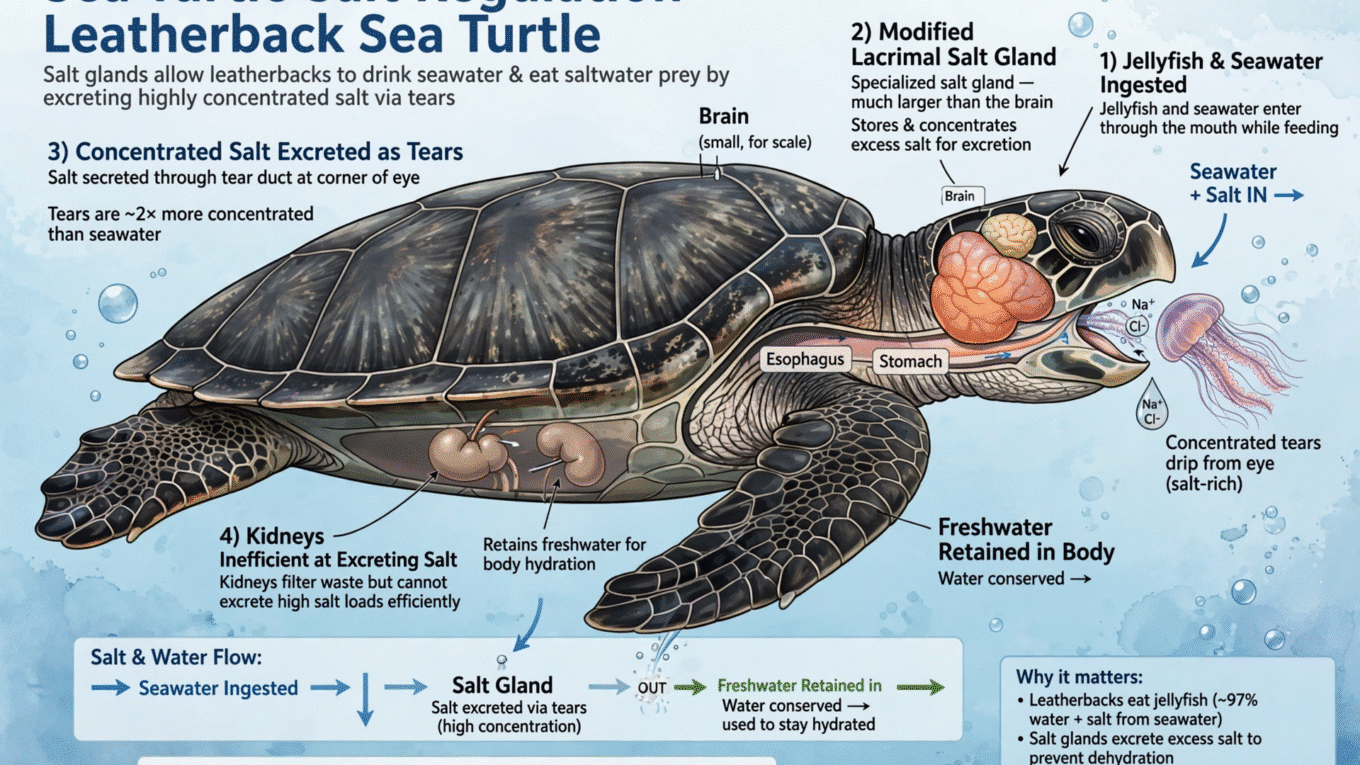
Because sea turtles live in a highly saline environment and consume a salt-heavy diet (like jellyfish), they absorb a dangerous amount of sodium. Unlike mammals, reptilian kidneys are inefficient at filtering out large volumes of salt through urine. To survive, they evolved modified lacrimal (tear) glands located behind their eyes. These glands excrete a saline solution twice as concentrated as seawater. For instance, a leatherback turtle must continuously secrete up to 8 litres (that’s 2 gallons!) of tears every hour just to safely process its food. Nevertheless, ongoing human threats mean these impressive adaptations may not be enough to secure the future of turtle species (Figure 1)
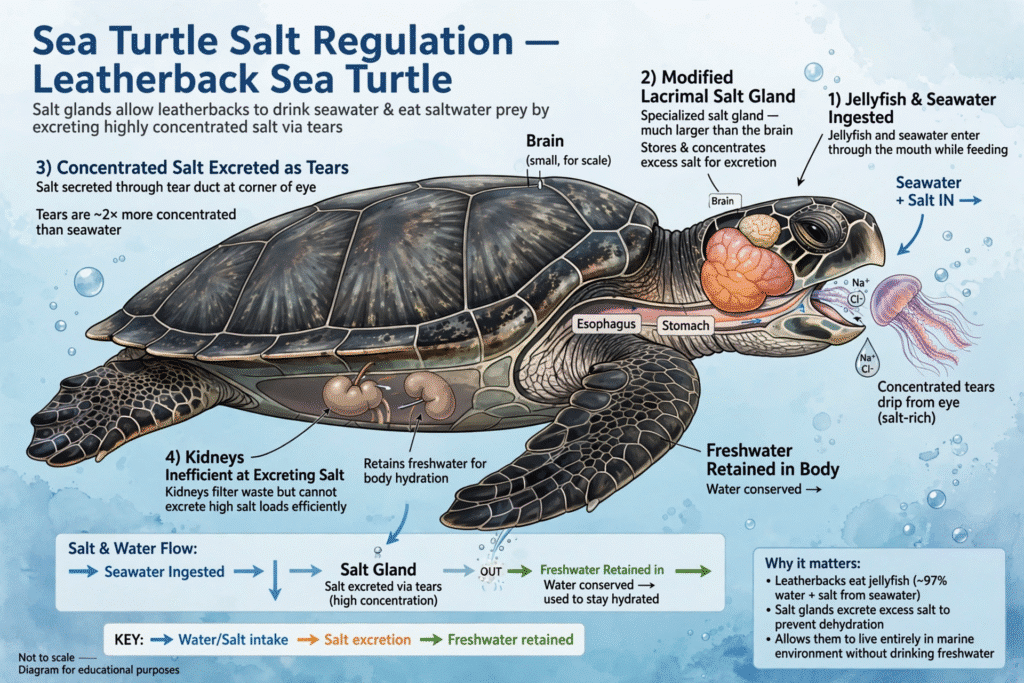
Concentrate: The modified lacrimal salt glands behind the eyes — much larger than the brain — filter excess Na+ / Cl- from the blood.
Out: Those glands excrete tears about 2x as salty as seawater through the tear duct at the corner of the eye. For every litre of seawater in, 500ml of double-strength tears out = 500ml freshwater gained.
Why not kidneys: Sea turtle kidneys filter waste but can’t make urine saltier than blood, so they are inefficient for high salt loads. They retain the freshwater for hydration, while the salt gland does the heavy lifting.
Should we take that with a pinch of salt?
That specific number comes from oceanographer Helen Czerski’s book The Blue Machine (2023), quoted in Live Science:
“Leatherback tears are thick and viscous and almost twice as salty as the ocean. To keep eating without killing herself with salt, the turtle must cry around 8 liters [2 gallons] of tears every hour.”
It’s meant to illustrate the cost of a jellyfish diet — a jellyfish is 96% water and about 4% salt, so less than 1% is useful food, meaning the turtle takes in three times as much salt as food in every mouthful.
In the scientific literature, measured secretion rates from experimental salt loads are on the order of millilitres to tens of millilitres per hour, not litres, and vary with size and salt load.
The 8-litre figure is a popular-science extrapolation for a large, actively feeding adult leatherback (nearly 2m long) continuously eating salty jellyfish. So, we should think of it as an upper-bound illustration rather than a routine lab measurement. A leatherback’s head is mostly salt gland, so it can sustain very high flows when feeding, but it doesn’t cry 8 litres non-stop all day!