
Climate change and Aquatic Osmoregulation
Estimated reading time: 13 minutes
Key Takeaways
- Climate change disrupts water and salt balance in aquatic ecosystems, particularly affecting protists’ survival.
- Rising temperatures lead to ocean freshening, which causes a hypotonic crisis for marine protists, while saltwater intrusion creates hypertonic conditions inland.
- Adaptation strategies like the ‘salt-out’ method allow protists to thrive in high-salinity environments by managing osmotic pressure.
- Gene transfer from prokaryotes to eukaryotes enhances protist adaptability, enabling them to respond quickly to osmotic shifts.
- Compounding effects of temperature and salinity stress challenge ecosystems, highlighting the urgent need for understanding climate change and osmoregulation.
Climate-Driven Disruptions of Water and Salt Balance
Climate change is changing the water and salt balance of the world’s aquatic ecosystems. Because they are small and directly exposed to the surrounding water, protists face strong pressure to adapt. The link between climate change and aquatic osmoregulation is especially important, as protists must adjust their systems to regulate water and salt levels in real time to survive climate-driven changes.
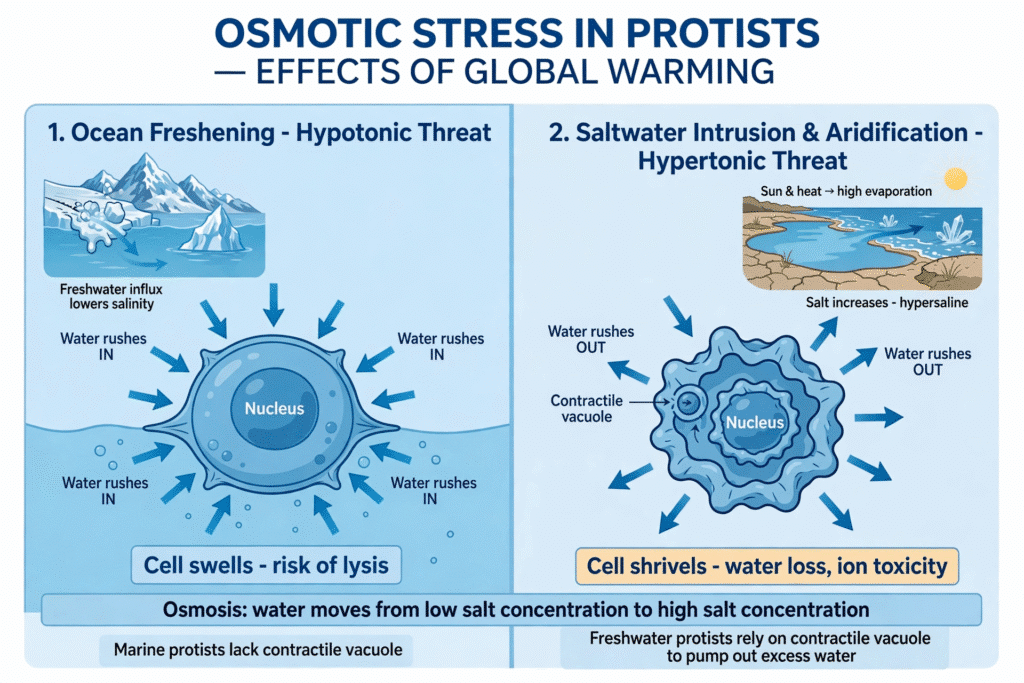
Global warming disrupts the balance of water and salt in protists through two opposing climate-driven effects:
- Ocean “Freshening” (The Hypotonic Threat)
In polar regions such as the Arctic and Antarctic, as well as in coastal zones, rising temperatures accelerate sea-ice melting, glacier retreat, and intense rain events. Consequently, massive amounts of fresh water flow into the sea, drastically lowering the salinity of marine habitats. The Cellular Crisis: Marine protists, adapted to an isotonic or hypertonic ocean (more salty), suddenly encounter a hypotonic environment (less salty). As a result, water rushes into their cells.
- Saltwater Intrusion & Aridification (The Hypertonic Threat)
Conversely, in inland regions and low-lying coastal zones, rising sea levels force seawater into freshwater rivers, estuaries, and agricultural lands. Meanwhile, severe droughts increase evaporation in lakes, transforming freshwater into brackish or hypersaline (saltier) conditions.
Biologists often sort protists into three informal categories based on their functional traits:
- Animal-like protists (Protozoa): Unicellular organisms like Amoeba and Paramecium that ingest food.
- Plant-like protists (Algae): Autotrophs like green algae and diatoms that make their own food through photosynthesis.
- Fungus-like protists: Decomposers such as slime molds that absorb nutrients from decaying organic matter.
Climate change and aquatic osmoregulation in eukaryotes
The development of the semipermeable cell membrane was crucial for early life because it allowed accurate genetic replication, biochemical reactions, and energy production. In addition, microbial cytoplasm contains high concentrations of nucleic acids, proteins, and metabolites, which create osmotic pressure. This pressure draws water into the cell and increases turgor pressure in cells with walls. External osmolarity can change and act as a common environmental stress, affecting an organism’s growth and survival. Researchers have also studied how bacteria respond to changes in osmolarity, helping establish the basis for understanding osmotic adaptation in eukaryotes.
Halophilic means “salt-loving” and refers to organisms that grow and thrive in environments with high salt levels.
“Salt In” or “Salt Out”
Bacteria, Archaea, and many salt-loving protists adapt to high salinity mainly by either accumulating ions through the “salt-in” strategy or producing organic osmolytes through the “salt-out” strategy. Studies show that Halocafeteria seosinensis, Pharyngomonas kirbyi, and Schmidingerothrix salinarum are common in saline habitats. They use the salt-out strategy by accumulating solutes such as glycine betaine, myo-inositol, and ectoines. Some protists also have genes for producing ectoine and hydroxyectoine—genes once thought to occur only in prokaryotes. They likely acquired these genes by feeding on bacteria and through lateral gene transfer.
The ‘salt-out’ strategy is a way microorganisms, such as moderately halophilic bacteria and marine microbes, adapt to high-salt environments. They keep salt ions out of their cytoplasm and build up small organic molecules called compatible solutes.
How the ‘Salt-Out’ Strategy Works
- Exclusion of Ions keeps levels of ions such as sodium and chloride low to prevent damage to cellular machinery.
- Accumulation of Compatible Solutes: The cell makes or actively takes up high amounts of neutral, highly water-soluble organic compounds.
- Common Solutes: Examples include glycine betaine, trehalose, and ectoine.
- Cellular Protection: These compatible solutes balance the osmotic pressure of the outside environment without interfering with normal enzyme function, protein folding, or cell membranes.
Osmolytes are small organic compounds that cells use to maintain fluid balance, volume, and stability under environmental stress. They help cells survive changes in water availability, high salinity, and extreme temperatures without disrupting normal cellular functions.
Halocafeteria seosinensis is biflagellated with a smooth anterior flagellum and never glides on surfaces. A genus of tiny, marine flagellates capable of handling extremely high salt loads while hunting for prokaryotes.
Gene duplication and lateral gene transfer may have supported protists in adapting to salt stress. The microbial cytoplasm contains nucleic acids, proteins, and metabolites, which generate a high osmotic potential that attracts water and increases turgor pressure.
The role of the cytoplasmic membrane
The cytoplasmic membrane plays a crucial role, as it selectively allows substances to enter and exit the cell (biologists call this selectivity a semipermeable membrane). In hyperosmotic environments, water moves out of the cell, causing plasmolysis and reducing turgor pressure. Conversely, in hypoosmotic conditions, water influx increases turgor, risking cell rupture.
Aquaporins
Aquaporins, specialised water channels, facilitate rapid water transport during osmotic changes. However, their precise contribution to microbial adaptation remains not fully understood.
Pressure-sensitive channels
Osmoregulation in protists requires a process that senses and responds to changes in salt balance. In this case, the process responds to the resulting change in cell membrane stretch (turgor).
Turgor refers to the state of being swollen, bloated, or distended,
Microbial cells take up ions through transport systems. They also synthesise or import compatible organic osmolytes to retain water. Under hypoosmotic stress, microbes quickly expel these solutes. They do this through mechanosensitive channels (sensitive to stretch of membrane), which are common across bacteria, archaea, and eukaryotes. These channels respond passively and rapidly to increased membrane tension caused by water influx during osmotic upshifts. These pressure-sensitive channels open and close within milliseconds. They are very fast and crucial during sudden osmotic down-shock. However, they are not necessary for microbes that grow steadily in high-osmolarity conditions.
Hijacking genes?
The evolutionary significance of horizontal gene transfer from prokaryotes to eukaryotes remains debated. Nonetheless, eukaryotes are well known to acquire new metabolic traits and stress resistance. They often acquire gene clusters from ingested bacteria or archaea, helping them adapt.
Real-Time Adaptation:
Most marine protists lack fully functional contractile vacuoles (see below), so they rapidly alter their cell membranes. They upregulate the stretch-sensitive ion channels to expel internal salts and solutes, lowering internal osmotic pressure and preventing further water influx.
The Synergy Trap as water warms:
Recent research reveals a dangerous compounding effect—lowered salinity severely reduces a protist’s thermal tolerance. While marine protists usually tolerate warmer water, a simultaneous drop in salinity undermines their cellular stress defences, leaving them highly vulnerable to marine heatwaves.
The Cellular Crisis even terrestial species are affected.
Heat, floods, droughts, and storms increasingly threaten biodiversity and ecosystem functioning as global climate change intensifies. Moreover, soil salinisation— the excessive accumulation of soluble salts in soil—poses one of the most serious climate change-related threats to terrestrial life, particularly plants and microorganisms. Suddenly, freshwater protists face a wall of salt. As a result, water rushes out of their cells, threatening them with severe dehydration and plasmolysis.
Real-Time Adaptation
To avoid shrivelling, these protists immediately slow down or shut off their contractile vacuoles to conserve every drop of internal water. At the same time, they activate energy-hungry sodium-potassium (Na+/K+) pumps to actively pump out excess salt, while rapidly producing internal protective sugars and amino acids (osmolytes) to match the external saltiness.
https://pmc.ncbi.nlm.nih.gov/articles/PMC12189284/National Institutes of Health (NIH) | (.gov)
Shifts in Protist Survival Strategies
The Shift to “Mixotrophy”
Beyond individual cell mechanics, climate change is shifting entire protist communities toward a survival strategy called mixotrophy. Mixotrophic protists can both photosynthesise (like plants) and hunt for food (like animals).
Studies show that when temperature and salinity stress make osmoregulation too energy-expensive, purely photosynthetic or purely predatory protists struggle. Mixotrophs survive by dynamically switching their feeding mode—using energy from eating bacteria to power the high ATP demands of their struggling ion pumps.
Broader Ecological Impacts on Osmoregulation in protists
Climate change has several broader impacts on osmoregulation in protists. Temperature, pH, and salinity play crucial roles in shaping biological communities. Salinity is particularly important because it strongly affects species’ osmoregulatory capacities across diverse aquatic habitats.
Climate change exacerbates salinity concerns by elevating temperatures and altering precipitation patterns. Consequently, freshwater and marine systems experience more intense and unpredictable salinity variations. Salinity stress creates major ecological challenges for aquatic organisms.
Climate change further destabilises aquatic ecosystems; in addition, salinity stress poses a significant threat to their stability. Furthermore, genetic and epigenetic modifications help enhance resilience. Moreover, host organisms interact with their microbiomes, which further boosts their adaptability.
Mechanisms of Osmoregulation in protists
In hypoosmotic environments, organisms lose ions to the surrounding water. To maintain osmotic balance, ion transporters such as Na+/K+-ATPase (NKA) and Na+/K+/2Cl− co-transporters (NKCC1) actively expel Na+ and retain K+. In contrast, in hyperosmotic environments, organisms must avoid excessive ion buildup. In this case, NKCC1-mediated Na+ inflow is increased to support ion absorption, whereas NKA promotes the extrusion of surplus Na+ to maintain homeostasis.
Adaptive Strategies and Community Shifts
Climate-driven salinity fluctuations challenge these adaptive systems, pushing them to their limits. Various species actively explore strategies to cope with changing salinity levels. Salinity shifts alter species distributions by modifying organisms’ physiological and behavioral traits, which in turn influence competition, predator–prey relationships, and community structure.
The evolution of osmoregulatory mechanisms enables aquatic organisms to colonise diverse ecological niches [9]. These adaptations occur at molecular, physiological, ecological, and behavioural levels, allowing species to better manage varying salinity conditions. Moreover, organisms with greater genetic diversity tend to exhibit a wider range of physiological responses to salinity fluctuations, thereby increasing their chances of survival in variable environments. Additionally, the microbiome plays a significant role in shaping how aquatic organisms respond to changing salinity levels.
Salinity Gradients and Extremes
Climate change is altering salinity dynamics in marine ecosystems, primarily through increased evaporation, shifting precipitation patterns, and polar ice melt, all of which contribute to both hyper- and hyposaline conditions.
Aquatic ecosystems display a wide range of salinity levels, from less than 1 ppt in freshwater to over 400 ppt in hypersaline habitats. In estuarine regions, where freshwater meets seawater, salinity fluctuates daily or seasonally between 0.5 and 35 ppt due to tides, river inflows, and evaporation.
For example, in the Aral Sea, rising salinity—particularly from sodium sulfate as the lake shrinks—has changed the water’s ionic composition, affecting the osmoregulatory processes of aquatic organisms. These organisms adapt to high chloride and sulfate concentrations by undergoing significant physiological modifications in their metabolic and ion-transport mechanisms to maintain homeostasis. These extreme conditions drive adaptations and notable shifts in community composition. Many invertebrate species are replaced by lentic taxa better suited to the increasing salinity.
Extreme salinity fluctuations occur in hypersaline environments, where salinity exceeds that of seawater. As salinity surpasses 35 g/L, only species with exceptional salinity tolerance can persist, leading to the dominance of crustaceans, particularly Artemia, the most prevalent taxon in these ecosystems.
The dominance of specialised species in hypersaline environments underscores organisms’ remarkable adaptability to fluctuating salinity levels. This creates a dynamic interplay between bottom-up (invertebrate-mediated) and top-down (avian predation) mechanisms that preserves the productivity of hypersaline ecosystems despite their lower biodiversity.
Compounding Stressors and Ecosystem Disruption
The compounding effects are particularly severe when temperature and salinity stressors coincide, as seen in mussels that show elevated expression of stress-related genes under both low salinity and high temperature. Consequently, the physiological impacts of these combined stressors are leading to concerning ecological change. These climate-driven changes are further complicated by ocean acidification, which affects behaviours and survival rates in fish larvae. Moreover, climate-induced shifts are also driving significant changes in species distributions, resulting in disease outbreaks across several species and broadly impacting ecosystem dynamics. These shifts disrupt host–pathogen relationships, often favouring pathogen proliferation over host defences, especially in ectothermic species.
Unicellular organisms use a regulated gene network to survive osmotic shifts.
Unicellular organisms actively survive osmotic shifts by using a tightly regulated gene network. These genes encode sensors, channels, and pumps that enable cells to detect volume changes and quickly move water and solutes. This core genetic architecture for unicellular osmoregulation falls into three major functional categories.
1. osmosensors and mechanosensitive channels
First, osmosensors and mechanosensitive channels detect changes in the cell’s environment. Before a cell can respond to osmotic stress, it must sense the physical stretch or shrinkage of its plasma membrane. For example, the MscS and MscL genes (mechanosensitive channels of small and large conductance) spring into action when a marine protist suddenly encounters fresh water—a hypotonic shock. Water rushes in and stretches the membrane, and these genes immediately express emergency relief valves. As a result, the protein gates open in response to membrane tension, allowing internal solutes to flood out rapidly and preventing the cell from bursting. Additionally, SLN1 and SHO1 (two-component osmosensors)—best studied in yeast but conserved across many unicellular eukaryotes—encode membrane-bound histidine kinases. When the cell faces hypertonic stress (salt shock), these sensors trigger an intracellular warning signal.
Histidine kinases (HK) are specialised enzymes that add a phosphate group from ATP to a specific histidine residue on themselves, serving as core sensors in cellular signal transduction. An environmental cue binds to the HK’s extracellular domain, activating its catalytic domain to transfer a phosphate from ATP to a conserved histidine residue within the protein.
This shows how the system uses the genome as a tool for adaptation, rather than as a command centre. In this case, a short signalling pathway, or signal transduction system (TCS), mediates it. This involves two components at the membrane: 1) the sensor histidine kinase (SHK), which is the modulator that senses a change, and 2) a response regulator protein (RR). The process is energised by ATP phosphorylation, which induces a conformational change that alters affinity for DNA (or other targets, such as enzymes). This process produces a coherent response to the environmental change, such as changes in gene expression or target enzymes. Researchers first described this system in the 1980s.
2. The HOG pathway
Second, the master regulators—namely, the HOG pathway—coordinate the cellular response. When osmosensors detect a drop in external water availability, they activate a highly conserved genetic cascade. The HOG1 gene (High Osmolarity Glycerol) templates a mitogen-activated protein kinase (MAPK). Upon osmotic stress, the Hog1 protein rapidly translocates to the cell nucleus. There, Hog1 acts as a transcription factor, switching off genes related to standard cell growth and switching on dozens of stress-defence genes.
3. Effector genes
Third, effector genes—including for pumps and osmolyte synthesisers—execute the cellular adaptations. Once the HOG1 pathway is activated, it drives the expression of the machinery required to restore cellular balance.
GPD1 and GPP2 (Glycerol-3-phosphate dehydrogenase and Glycerol-1-phosphatase) respond to hypertonic (salty) stress by becoming highly upregulated. As a result, they divert the cell’s standard sugar metabolism, producing large amounts of glycerol—an organic osmolyte that safely increases internal concentration without harming cell proteins.
ENA1 (P-type ATPase sodium pump) encodes a powerful ion pump that uses ATP to actively remove toxic sodium (Na+) ions from the cell against a concentration gradient.
NHA1 (Na+/H+ antiporter) acts as a secondary transporter that uses the inward flow of protons (H+) to expel sodium and lithium, thereby maintaining internal pH and ion balance.
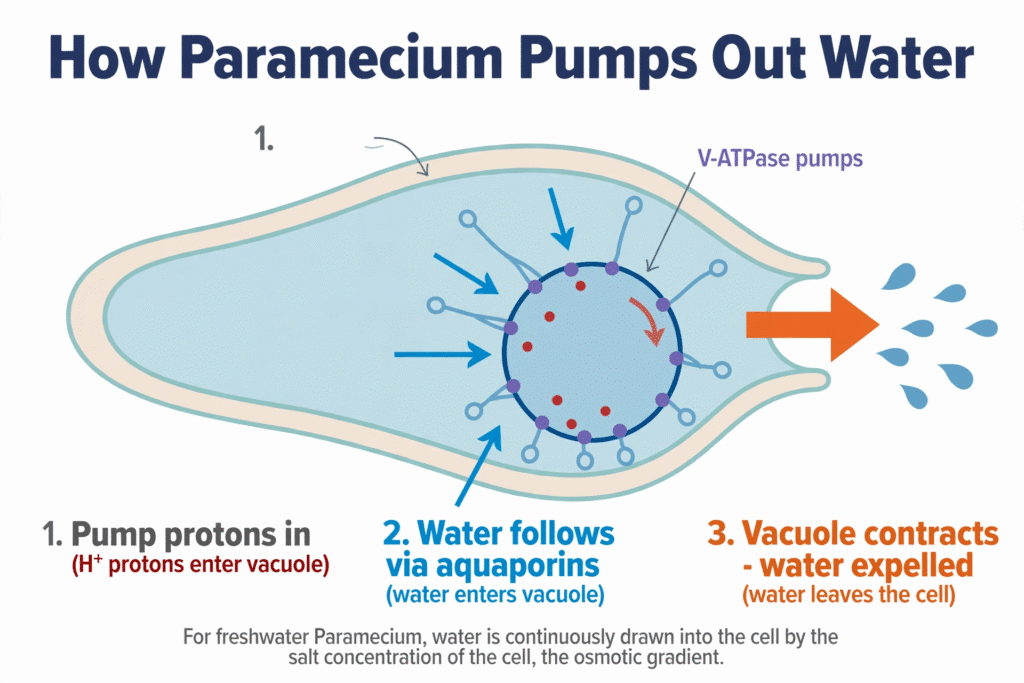
The Contractile Vacuole
In freshwater protists such as Paramecium, the contractile vacuole (Figure 2) depends heavily on the V-ATPase gene family. These genes encode vacuolar proton pumps, which flood the vacuole interior with hydrogen ions. This process creates an electrochemical gradient (a voltage difference) that draws water inside via aquaporin channels, allowing the cell to efficiently pump out excess water.
Anatomy (Structural Components)
- Contractile Vacuole Complex (CVC): A star-shaped or circular central pore system found in freshwater protists like Amoeba and Paramecium.
- Radial Arms / Canals: Tiny tubules that radiate outward to collect excess water and ions from the cytoplasm.
- Spongiome: A network of small vesicles and tubules surrounding the canals that reabsorb ions before water expulsion.