
Adaptation across generations
Key Takeaways
- Adaptation across generations allows organisms to respond rapidly to environmental changes through epigenetic mechanisms.
- Maternal and paternal signals, along with transgenerational epigenetic inheritance, provide offspring with advantages suited to specific habitats.
- Studies show that epigenetic adaptations can lead to niche separation and may contribute to speciation over time.
- Epigenetic changes, like DNA methylation, can regulate genes without altering the DNA sequence, enabling physiological adaptations.
- Overall, adaptation across generations involves a dynamic process of learning, agency, and interaction that shapes ecosystems.
Estimated reading time: 18 minutes
The traditional view holds that evolution occurs through natural selection acting on gradual, random mutations. For much of the last century, this gene-centred perspective dominated biology, giving agency little or no role. Evolution simply had to be blind, and agency implies some kind of anticipation. It became dogma. It also proposed barriers that would prevent information from passing between generations through germ cells except for information encoded in the genome. However, evidence now shows that organisms can pass traits gained in one generation to subsequent generations— and they do so regularly. It is part of biology.
In the 1980s and early 1990s, researchers proposed that developing organisms could receive nutritional information through eggs, sperm, or the mother during pregnancy. In mammals, maternal signals cross the placenta or affect its function. These signals may help prepare offspring for similar nutritional conditions (adaptation across generations). Researchers initially doubted this idea. Since then, the field has grown to examine how early development influences later health and disease. Researchers also study how these effects can pass between generations. Now, epigenetics is a key to understanding how organisms can readily adapt transgenerationally to environmental change.
The advantages of rapid, across-generational adaptation.
These adaptations offer two key advantages across generations: they can be localised to a specific habitat and readily reversed as conditions change. Moreover, different groups of the same species may adapt physiologically or behaviourally in response to their habitats and niches. These differences can create or strengthen niche separation, which can contribute to speciation over time by promoting reproductive isolation within a group. Reproductive isolation may be behavioural, structural, physiological, or a combination of these factors. In turn, it prevents genetic dilution. Niche partitioning reduces competition and increases biodiversity, as adapted groups find new ways to survive.
Acquired characteristics
Lamarck (1744 – 1829) proposed that characteristics acquired in one generation could pass to future generations (adaptation across generations), and Darwin agreed. However, for much of the last century, modern science rejected this idea. Scientists were so convinced that this could not happen that they proposed a barrier to prevent it, often called the Weismann barrier. As we explain in our book, *Understanding Living Systems*, no such barrier exists. Where a barrier does exist, it acts selectively, allowing key ingredients to pass to the germ line—the eggs and sperm—and to the developing embryo. The developmental origin of health and disease shows us one way this happens. For a good account see
The ‘Weismann barrier’ holds that hereditary information travels only from germ cells to body cells, so organisms cannot pass on changes they acquire during their lifetimes. Weismann acknowledged that no evidence supported the barrier; it simply had to be so. In this sense, proponents established it as a law rather than a theory. It dominated 20th-century thought.
Key material transferred to the germ cells
We now know that key material, including mRNAs, is passed to germ cells. The system not only instructs its own genome but also influences the offspring’s genome. An mRNA is a single-stranded molecule that carries genetic instructions from a cell’s DNA to its protein-making machinery. But there is more. Many of the genome upregulations during an organism’s lifespan can also be passed on to germ cells. In this way, physiological adaptations can be passed on. The offspring do not start with a blank slate. In many ways, the offspring anticipate the environment they will be born into.
During normal egg development (oogenesis), neighbouring ovarian support cells (granulosa cells) actively transfer specific, vital sets of maternal mRNAs into the growing oocyte. Paternal mRNAs are also transferred to the sperm cells. Thus, the developing embryo receives these crucial molecules from both parents.
Epigenetic inheritance (epi – means upon, near to, or in addition)
Scientists once thought that epigenetic markers, such as DNA methylation, were wiped clean from generation to generation. However, we now know that organisms selectively transfer many of these markers to the germline. By passing this information to their offspring, organisms give them a head start in adapting to changing conditions. Scientists call much of this process epigenetic inheritance. Moreover, when these conditions persist, the organisms can function in ways that may consolidate the genetic inheritance. For example, it can alter mate selection; a group may arise that privileges particular traits. We do not yet know whether this happens. For example, many species may adapt this way to the effects of global warming.
So, what happens?
Methylation is a vital biological process in which a small chemical tag called a methyl group attaches to a molecule, such as DNA or a protein. Think of it as a cellular modulator switch: it can turn genes “on” or “off”, up or down, and change how molecules function without altering the underlying genetic template. When a methyl group attaches to DNA, it switches the gene off. Methylation plays a crucial role in adaptation, and when cells conserve this switching process, it can support adaptation across generations.
conducting the score
This is a bit like using a piano’s loud and soft pedals to shape a note’s sound. More broadly, the cell system regulates gene expression, much like a conductor guides an orchestra. But each generation can write its own version and pass it on. Furthermore, that version can be shaped to the niche requirements. This shows how genes become not static, deterministic elements, but part of a flexible motif.
A methyl molecule, more accurately called a methyl group, consists of one carbon atom bonded to three hydrogen atoms. Its chemical formula is –CH₃. The carbon atom has one open bond that connects to another atom, so a methyl group rarely exists on its own. Instead, it acts as a chemical building block or “tag” that attaches to larger molecules, such as DNA, proteins, or hormones.
Let’s consider a few examples.
Convergent Hypoxia adaptation
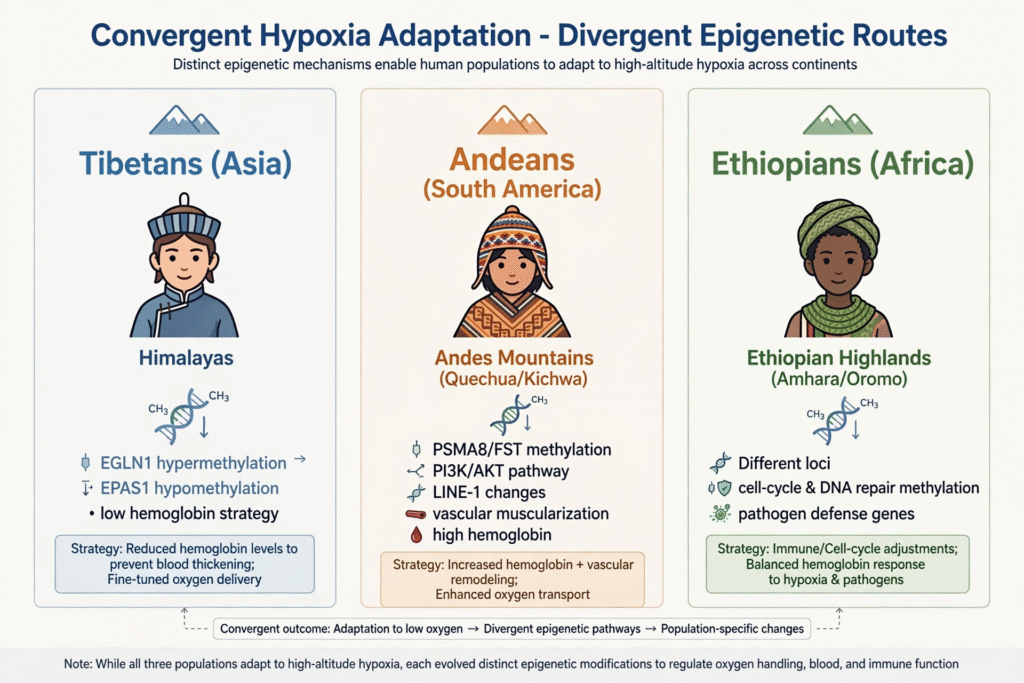
Humans – three continents, three epigenetic strategies
All highland humans face low-oxygen conditions, but Tibetans, Andeans, and Ethiopians use different genes and methylation patterns.
A) Andeans – developmental and whole methylome evidence:
Childebayeva et al. (2021) compared genome-wide DNA methylation across three groups of Peruvian Quechua: 1) high-altitude lifelong residents, 2) migrants born at high altitude who moved to low altitude, and 3) low-altitude lifelong residents.
They found 779 differences between the high- and low-exposure groups, enriched for genes involved in red blood cell production, glucose metabolism, and skeletal muscle development. Critically, some methylation marks were only present if exposure happened before birth and in childhood – e.g. around a gene involved in the breakdown of sugar – suggesting epigenetics as a developmental adaptation across generations.
A related analysis found LINE-1 global methylation and EPAS1 methylation differences associated with both current and lifetime exposure to hypoxia in Quechua.
Highland Kichwa in Ecuador vs lowland Amazonian Ashaninka.
Pryor et al. (2025) studied how altitude affects highland Kichwa in Ecuador compared with lowland Amazonian Ashaninka. They identified epigenetic changes through DNA methylation (switch). The strongest signals involved the PSMA8 gene, associated with vascular regulation, and the FST gene, associated with heart muscle regulation. A pathway associated with muscle growth and new blood vessel formation (PI3K/AKT pathway) produced the second-strongest signal. The authors hypothesise that these changes explain the increased muscularisation of small arteries and higher blood viscosity observed in Andeans, representing a vascular adaptation distinct from that of Tibetans. They also identified 39 differentially methylated pigmentation-related genes, which may reflect an adaptation to increased UV exposure.
B) Ethiopians
Alkorta-Aranburu et al. (2012) sampled Amhara and Oromo people living at high and low altitudes. They found that neither variants associated with haemoglobin variation in Tibetans nor other variants at the same loci influenced the trait in Ethiopians. Thus, Ethiopian and Tibetan highlanders appear to have adapted to the same environmental stress through different variants and genetic loci. In addition, comparing CpG methylation levels between highlanders and lowlanders identified several significant signals at individual genes among the Oromo. More broadly, an earlier study found significant genome-wide epigenetic differences between Ethiopians living at high and low altitudes.
C) Tibetans vs lowland Han
Earlier studies found higher EGLN1 methylation in high-altitude Tibetans than in low-altitude Chinese populations. By contrast, Tibetans tend to have lower methylation in EPAS1-related regions. EGLN1 encodes PHD2, while EPAS1 encodes HIF-2α; both genes contribute to hypoxia regulation. This pattern aligns with broader physiological differences: Ethiopians show little reduction in oxygen saturation or increase in haemoglobin, whereas Tibetans show low oxygen saturation but little increase in haemoglobin, and Andeans show high haemoglobin. These groups therefore follow different physiological pathways with distinct epigenetic correlates.
Common routes but different regulatory loci
Other species also show varied epigenetic adaptations, and the HIF pathway serves as a hub across them. Researchers have identified changes in EPAS1, EGLN1, EGLN3, and HIF-1α/HIF-2α, though these changes occur at different stages. Don’t worry too much about the specific genes – the message here is that switching at different stages in the complex can produce different outcomes, or different combinations can produce similar outcomes.
For example, Tibetans hypermethylate EGLN1 (switch off), while Quechua hypomethylate EPAS1 and LINE-1 repeats (switch on). Kichwa methylate the vascular genes PSMA8 and FST, as well as the PI3K/AKT pathway. Ethiopians methylate different cell-cycle and DNA-repair genes, deer mice methylate Egln3, and yaks hypomethylate HIF promoters. These cross-generational adaptations primarily involve DNA methylation of CpG islands (see below), which alters gene expression without changing the DNA sequence. Developmental windows often shape these patterns; for instance, early-life exposure can lock in epigenetic marks in Andeans. This is the significance of adaptation across generations.
What Happens in Hypermethylation?
- Gene Silencing: Excess chemical tags called methyl groups attach to specific regions of DNA (such as CpG islands near gene promoters).
- CpG islands appear at the beginning of genes, in regions called promoters. Promoters act like an “ignition switch,” telling the cell where to start reading the genetic template.
- Blocks reading of the affected gene, preventing it from producing its intended proteins.
- Epigenetic alteration: The underlying DNA sequence remains unchanged, but the cell changes how it uses or expresses that code.
Wherever we look across ecosystems, we find epigenetic adaptations across generations. This also includes adaptations to the effects of global warming.
1. Coral- thermal tolerance memory
One of the best-studied marine examples of epigenetic adaptation involves thermal tolerance in corals. Liew et al. (2020) studied the brain coral Platygyra daedalea at NYU Abu Dhabi and KAUST, comparing colonies from the extreme heat and salinity of the Persian Gulf with those from the Gulf of Oman. Through reciprocal crosses, they found a strong environmental signature in the corals’ epigenomes that parents transmitted to offspring via sperm and eggs. These inherited epigenetic modifications may enhance thermal tolerance, enabling corals to respond more rapidly to environmental change.
The researchers proposed that epigenetic conditioning could produce pre-adapted coral colonies and larvae to seed populations, helping reefs recover naturally as they decline. Reference: Liew et al. (2020), Nature Climate Change.
Earlier work showed that epigenetic mechanisms regulating gene expression and stress repair in response to thermal stress, as well as adaptation across generations, can occur over shorter timescales than genetic adaptation.
2. Fish – the epigenetic trap vs buffering
During development, exposure to high temperatures can leave a biological imprint on European seabass (Dicentrarchus labrax) that passes to offspring even when they have not experienced heat themselves. Temperature can alter DNA methylation, and about 5% of the heat-induced marks in parental sperm persist in unexposed offspring. The authors describe two patterns: an “epigenetic trap,” in which a marine heatwave leaves a heritable imprint that may not benefit fish if conditions return to normal; and “epigenetic buffering,” in which fish exposed for two consecutive generations develop compensatory profiles resembling those of never-exposed fish, thereby dampening the effect. This shows the adaptability potential of adaptation across generations. It need not be on or off, but can be modulated.
The study by Sánchez-Baizán et al. (2025) also found methylation changes in the sex-development genes sox9a and hsd17β10. Because high temperatures increase the proportion of males, these changes may be relevant to temperature-related sex development.
This study demonstrates how temperature shapes the epigenome and highlights the potential of epigenetic plasticity and inheritance for species adaptation and conservation amid global warming.
Other studies have found that the little skate (Leucoraja ocellata) is a K-strategy species that adapts genetically slowly. However, it can adjust its growth and metabolism more rapidly in warmer oceans through DNA methylation. Lighton et al. demonstrated this in their study, “Adaptive Phenotypic Response to Climate Enabled by Epigenetics.”
K-strategy species (or K-selected species) are organisms that live near the carrying capacity of their environment, favouring high quality and survival over large numbers of offspring. The letter “K” comes from ecological formulas and stands for the maximum carrying capacity of a habitat.
Similarly, studies of marine sticklebacks (Gasterosteus aculeatus) exposed to ambient, +1.5°C, and +4°C warming scenarios found that parental acclimation dynamically reprograms DNA methylation and hydroxymethylation. These changes occur throughout offspring development.
3. wild guinea pigs
Weyrich et al. (2016) have found that wild guinea pigs (Cavia aperea) respond to higher temperatures by altering DNA expression. These epigenetic changes may adjust the activity of specific genes, and some may pass on to offspring. For example, males housed at 30°C, compared with those housed below 5°C, showed significantly altered methylation in at least 10 genes linked to body temperature regulation. Moreover, offspring conceived after their fathers experienced heat showed different methylation patterns, suggesting that sperm may carry a signal of “preparedness.” This established that non-genetic (epigenetic) modifications induced by environmental thermal stress can be transmitted to subsequent generations, potentially helping wild populations adapt to shifting climate and temperature ranges.
4. Reptiles and amphibians
The list goes on
- Sea turtles: Temperature-dependent sex determination predicts that warming could produce nearly 100% females. However, studies suggest that epigenetic adaptation may help prevent skewed sex ratios by modifying methylation of the aromatase gene, potentially maintaining balance.
- Frogs: The EU-funded GEBACC project on Xenopus tropicalis explicitly examined the genetic and epigenetic basis of adaptation to climate change. It found that selection on locomotion traits is partly epigenetically controlled.
- Brown anole lizard (Anolis sagrei): Hu et al. studied populations colonising eight Caribbean islands from a common source population. After just four days, genome-wide methylation patterns were already linked to habitat quality, suggesting rapid epigenetic matching to habitats and potentially relevant to warming niches.
5. Plants – crops
And finally, returning to high altitude, but this time in plants
In Brassica, Arabidopsis, and rice, heat stress induces changes in CHH methylation that alter flowering time and drought tolerance. Moreover, reviews predict that global warming will reduce crop yields by one-third by 2050. Therefore, researchers are exploring epigenetic priming to alter how crops respond to temperature. As with the previous hub, early-life exposure leaves a methylation mark that changes metabolic strategy.
Adaptation across generations in evolution.
In all cases, epigenetic adaptation across generations provides a faster, reversible layer on top of genetics. Furthermore, it is a responsive change that can be inherited for one to three or more generations. In that sense, it is directional. Thereby allowing adaptation to change more quickly than natural selection through random mutations. Furthermore, if the conditions persist, the adaptation can persist. Theoretically, such adaptation may also then become incorporated into the genome itself. This is evolution as a physiological process: adaptation across generations.
Epigenetics and Niche partitioning – key ingredients of adaptation across generations
Niche partitioning strengthens ecosystem resilience. However, it could also alter behaviour, anatomy, or physiology enough to create a new species if embedded in the genome. Epigenetic adaptations passed down through generations may also help organisms occupy different niches by adapting to local habitat conditions.
Let’s consider the model in Figure 2.
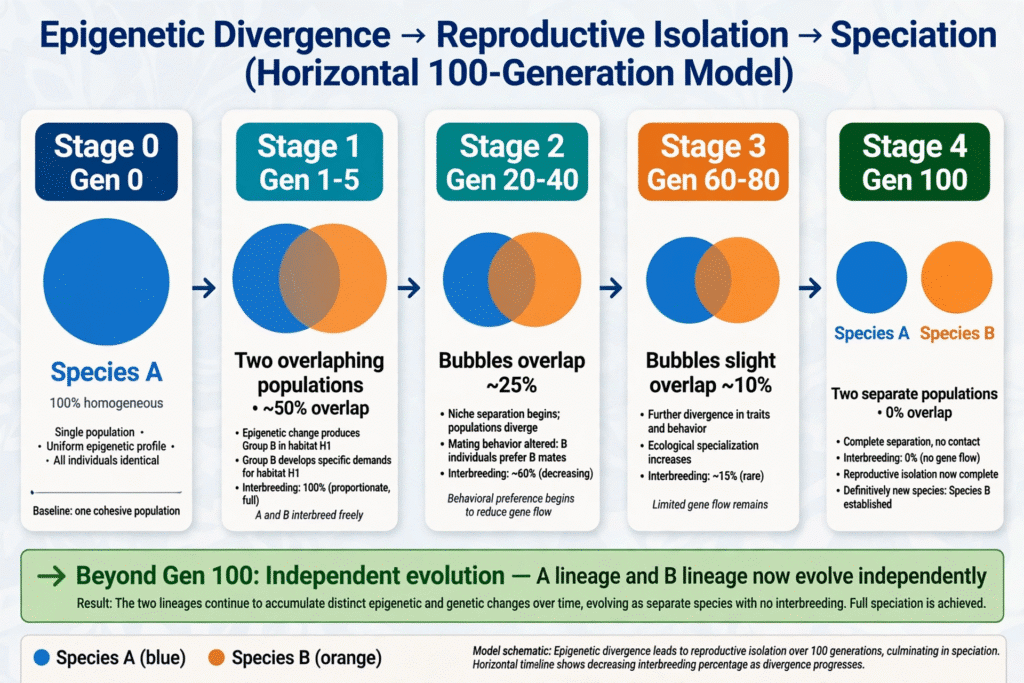
A model of adaptation across generations
The model suggests how epigenetic changes could cause a group within a species to diverge sufficiently to become, or be categorised as, a new species. Initially, the group breeds frequently with others of its species (Species A) where home ranges overlap. However, the demands of its particular habitat trigger epigenetic modifications that adjust its function to match those demands. Many of these changes will be multifaceted, physiological and behavioural, producing niche changes (stage 2), leading to further divergence and less interbreeding with the core species A.
By stage 3, interbreeding is rare, consolidating changes within the group and reducing dilution, thereby allowing further divergence. In stage 4, niche separation is consolidated. Note that in the model, bubble overlap refers to niche overlap, not necessarily geography. Niche separation can occur in time rather than space, or in both. It can also be behavioural within a given space. Organisms carve out their niche. They create niches rather than simply occupying them. Furthermore, it is an ongoing, dynamic or reactive process. It is also an exploratory process that takes advantage of opportunities.
The dynamic, exploratory process of exploiting opportunities has been a key factor in the rapid spread of the collared dove. Niche separation is an adaptation across generations. The model’s advantage is that it can adapt quickly, even within a single generation. This is certainly faster than standard evolutionary models based on gradual, random gene mutations. The change is both responsive and targeted, as we see with the adaptations to high altitude. But how realistic is such a model?
To submerge or not to submerge?
A crucial behaviour in damselflies is oviposition, or placing their eggs, either above or below water. Some damselfly species always lay their eggs underwater, but recent studies suggest that this behaviour is not a fixed genetic trait; instead, circumstances can change it. Similarly, although species in the family Lestidae generally prefer to lay eggs above the water’s surface, egg laying underwater does occur, even if relatively infrequently at the localised scale. However, recent findings indicate that under certain localised conditions, submerged egg laying may become a common tactic. This variability suggests behavioural plasticity in female choice.
Learning in adaptation across generations
The Emerald damselfly, Lestes sponsa, commonly occurs in temperate zones. While researchers have frequently documented submerged oviposition in other Odonata species, they have rarely observed or described this behaviour in Lestes sponsa. In a recent study, Helebrandová et al. (2019) examined oviposition tactics and found that Lestes sponsa often oviposits underwater. To explore the roles of males and females, they experimentally paired individuals from submerging and non-submerging populations. Notably, when submerging males were coupled with non-submerging females, submersion did not occur; however, the reverse pairing resulted in submersion, showing that submersion is female-led. Ultimately, their research shows that damselflies can adapt and respond to different situations, highlighting insects’ learning potential.
Experience and choice matter
These findings suggest that populations even of the same species may differ in their ovipositional histories. In Lestes sponsa, submerged oviposition is particularly evident at both regional and local scales. By contrast, in Erythromma lindenii, it occurs among geographically separated populations across the species’ distribution. This behavioural difference could then be a candidate for niche separation in stage two of the theoretical model (Figure 2). As the authors point out
“choices of individual damselflies have led to the evolution of a complex pattern of submerged oviposition behaviour, with roles during submergence varying between males and females… specimens of different populations interact with each other, driving the resulting behaviours. This plasticity and adaptability is a keystone for the successful continuance of the prehistoric order of Odonata.“
That is active agency in evolution. The static, gene-centred approach loses it. Genes are not the masters; they are an instrument the system plays. Organisms are not ‘adapted’; they are adaptable and adapting (that is, adaptive) in a continuous, iterative process. Selection doesn’t act on the gene; it acts on its expression. The symphony doesn’t exist to maintain the notes. The notes exist for the system to play many melodies.
changes in reproductive morphology
Rapid divergence in genital structures may drive early reproductive isolation, but evidence for this is mixed. However, using interspecific introgression lines between two Drosophila species that diverged ~240,000 years ago, Frazee et al. (2021) tested whether small differences in genital morphology reduce fitness. Variation in male posterior lobe shape significantly reduced reproductive success before and after fertilisation, supporting the idea that genital divergence can quickly cause reproductive isolation and niche separation. Males with divergent lobes also shortened their mates’ lifespans.
An introgression line (IL) is a specially bred strain of an organism that carries a single, specific DNA segment from a donor parent.
Additionally, genital divergence reduced oviposition and fertilisation, suggesting females may prefer certain lobe shapes and that these traits could be subject to cryptic female choice. Thus, this study shows both structural and behavioural influences on reproductive success.
As noted by these researchers, “several recent studies in a variety of taxa support the idea that morphological divergence in external genitalia can indeed cause RI (Reproductive Isolation) early during the speciation process via both mechanical and sensory incompatibilities”
Conclusions
The traditional view holds that evolution occurs through natural selection acting on gradual, random mutations. For much of the last century, this gene-centred perspective dominated biology, giving agency little or no role. Evolution simply had to be blind, and agency implies some kind of anticipation. It became dogma. It also proposed barriers that would prevent information from passing between generations through germ cells except for information encoded in the genome. However, evidence now shows that organisms can pass traits gained or expressed in one generation to subsequent generations— and they do so regularly. It is part of biology.
Organisms use their genomes flexibly and adaptively, enabling them to exploit distinct niches—that is, to take advantage of different opportunities or adjust to changing conditions. This niche divergence, in turn, can create opportunities for genetic change. Mutations that hinder organisms in one set of circumstances may benefit them in another. Moreover, these mutations may already exist in the general population, but their effects may be diluted or offset. As the Drosophila study suggests, small changes in genital morphology may significantly affect reproductive isolation through female mating preferences.
Reproduction does more than create identical beings: it creates variations and drives a species’ adaptation through behaviour and agency. Likewise, ecosystems rely on diverse, complex interactions among species and groups. By creating and changing niches over time and across places, organisms build flexibility and often discover new ways to survive. Adaptation spans generations and never stops. It also includes learning and social transmission. Organisms do not begin without a legacy of experience; they arrive prepared to anticipate the capacities survival requires—and to modify them as conditions change.