
The Role of Indigenous Knowledge in Human Survival
Understanding Indigenous Knowledge
Key Takeaways
- The article discusses how urbanisation and globalisation contribute to the alienation of humans from ecological intelligence, particularly Indigenous knowledge.
- It emphasises that Indigenous knowledge is vital for understanding ecosystems and offers holistic, adaptive insights essential for conservation practices.
- The loss of Indigenous knowledge impacts both mental health and environmental sustainability, as modern lifestyles disrupt traditional connections to nature.
- Supporting locally-led conservation efforts and reintegrating Indigenous knowledge can enhance ecological resilience and community well-being.
- Ultimately, the article calls for renewed attention to Indigenous knowledge conservation as crucial for future ecological health and human survival.
Estimated reading time: 23 minutes
In our book, *Understanding Living Systems*, we discuss ecological intelligence extensively. In short, ecological intelligence refers to the knowledge and understanding organisms develop and use as they actively engage with their habitats. These interactions embed this intelligence in local environments and ways of life. Moreover, organisms pass much of it from one generation to the next, both biologically and culturally, while continually adapting it in response to change. Humans also possess ecological intelligence, which takes cultural form as Indigenous knowledge. This raises two important questions: Has globalisation affected the embedded nature of our ecological intelligence? If so, what are the consequences for humans as a species and for other species?
Alienation from Ecological Intelligence
In this article, I argue that postmodern societies have become increasingly alienated from ecological intelligence rooted in Indigenous knowledge. This alienation is evident in our agricultural practices: we rely on mechanistic methods that force nature to produce in abundance, supplying urban populations with cheap food that often travels thousands of miles. Moreover, as humans shape their habitats increasingly around psychosocial needs and goals, mental health problems continue to rise. In turn, the niches we create have become more psychosocial than material.
Postmodernism in sociology is a perspective that argues that society has moved beyond the modern era into a fragmented, media-saturated, and pluralistic age in which universal truths and grand theories no longer hold sway.
Are we losing indigenous knowledge?
We often overlook the need to protect humans as a species. After all, the human population is growing at pace. But when we look at ecological diversity, we realise a problem: the nature of that growth and its consequences. In a previous post, we noted that in 1800, Europe’s overall urbanisation rate was only about 8.5%. Britain became the world’s first predominantly urban society around 1851. Today, approximately 74% of Europe’s population lives in urban areas. Europe is on a fast track to reach around 80% to 90% urbanisation as part of a century-long global trek to cities spanning from 1980 to 2080. Now, with a ‘housing crisis’, towns are spreading, and more are being planned. This is increasing the distance between our psychological-social habitat and the ecosystems that sustain us.
Globalisation allows us to produce food thousands of miles from where consumers live. As a result, we grow increasingly distant from the habitats destroyed to make that production possible. We may read about this destruction or watch it in videos, but we rarely encounter its consequences in our own culture or daily lives. Although we understand the impact intellectually, we lack the firsthand experience that could make its costs impossible to ignore.
Indigenous knowledge refers to the understanding and practices developed by indigenous communities over generations, rooted in their unique cultural experiences and relationships with the natural environment. (UNESCO)
Rapid demographic shifts
Demographics are changing how urban Europeans live faster than any other factor. In 1950, only about 13% of Europeans lived alone. Today, one-person households account for more than 50% of the population in most Western European capital cities. As a result, cities have radically reshaped housing, apartment architecture, and public spaces to accommodate independent living.
Meanwhile, the movement of people from rural areas to towns and cities—known as rural-to-urban migration—stands as one of the most defining demographic shifts in human history. This migration is driven primarily by the search for economic opportunity, industrialisation, and better access to services. It is also driven by global warming, pollution, political and military conflict, and population growth.
A critical, modern shift in how people migrate to urban areas is that the destination itself matters. While massive megacities (like Tokyo, Shanghai, or Lagos) capture global attention, most urban migration actually occurs into small and medium-sized regional towns.
Urban Living and Ecological Knowledge
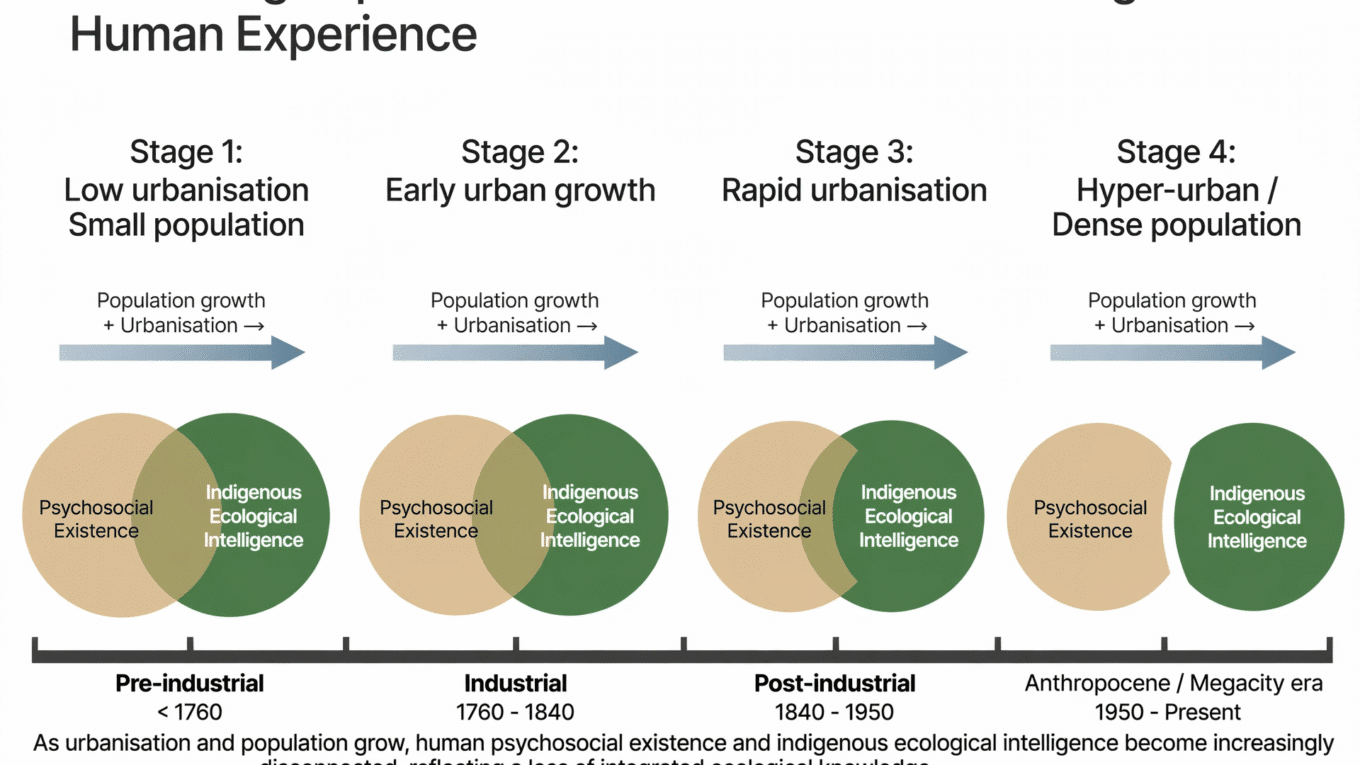
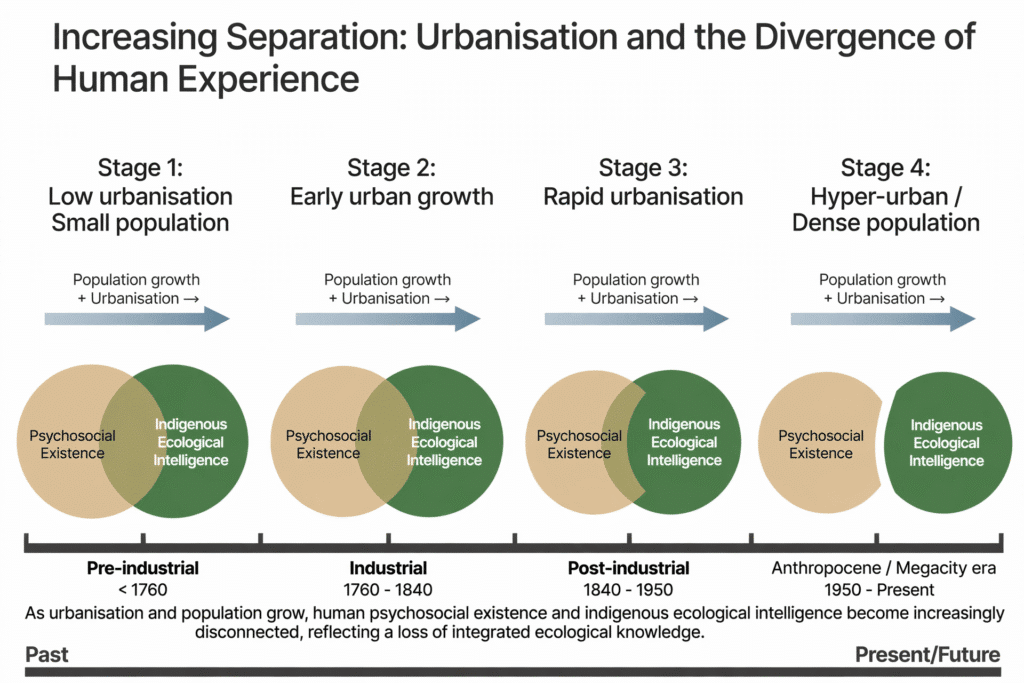
Rapid advances in urban living have disconnected our psychosocial intelligence from our Indigenous ecological intelligence (Figure 1). The environments we navigate differ substantially from the relatively predictable settings of previous generations. As a result, we live in an increasingly uncertain world, and the events driving that uncertainty often seem beyond our control. However, no “pre-industrial” human lies dormant within us, waiting to emerge if we change the landscape. If it did, it would be difficult to know what to change.
IIn many ways, we have lost Indigenous and experiential knowledge. Today, we encounter it mainly in books, on television, and through computer screens. We can see parts of the world our ancestors could never reach, yet we experience them from a distance, not as part of the rhythms of daily life. We may be able to improve our condition, but only by bringing this knowledge back into lived experience. To do so, we must first understand the contours of Indigenous knowledge and how it works.
Features of indigenous knowledge
Indigenous knowledge generally has three defining characteristics. Crucially, communities pass knowledge across generations through stories, ceremonies that mark occasions in time and place, and ritualised practice rather than formal schooling. It often includes a holistic origin narrative that connects understanding of the physical world with the ecological and psychosocial realms into a comprehensive system. This system adapts over time as communities face new environmental and social challenges.
This raises an interesting question. Does it really matter whether the core beliefs of the narrative are ‘true’ in the sense of how they work in creating a coherent sense of being? Put another way, are belief systems necessary?
Amnesty International estimates that around 5000 indigenous groups, totalling 476 million people across 90 countries, make up 6.2% of the global population and speak more than 4000 languages.
Three core contours of Indigenous knowledge
In addressing these questions, it is helpful to consider three key features of Indigenous Knowledge.
- Intergenerational: Such knowledge is often passed down orally through stories, ceremonies, and daily practice rather than formal Western schooling.
- Holistic: By nature, it connects the physical, spiritual, ecological, and social realms into a single, comprehensive system.
- Adaptive: It evolves continuously as communities face new environmental and social challenges.
In a sense, these are accepted ‘wisdoms’ rather than objective truths. Their strength comes from their longevity, though people often reinterpret them over time to meet new needs and address new challenges. They are often allegorical, even when firmly rooted in lived experience. Yet this knowledge can also be immediately practical, encompassing everything from herbal medicine to finding food.
A Generation of Change
In early industrialised countries such as the United Kingdom, change moved so quickly that people could see its effects within a single generation—the generation often called the “boomers.” I belong to that generation; I was born in 1947. We watched cities expand rapidly and the extended family begin to fade.
But the change can be seen in two stages: industrialisation and globalisation. The UK’s industrialisation reshaped communities, with lifelong identities forming around the new factories and the mines that extracted the fossil fuels driving the expansion. Canals, and later railways, were built to transport goods, particularly food, to feed the growing towns and cities. But these communities developed their own indigenous knowledge around anticipating continuity. The UK rapidly ‘de-industrialised ‘; within a generation, the coal pits closed, and the mills gave way to foreign and cheaper imports as globalisation and free trade gathered pace.
The UK de-industrialised rapidly in the second half of the 20th century, accelerating sharply in the 1970s and 1980s. Old certainties, and even old uncertainties, gave way to new uncertainties. After World War II, manufacturing accounted for roughly 33% to 40% of the UK’s GDP and millions of jobs. From the 1950s to the end of the 1980s, manufacturing’s share of GDP shrank from around 33%–40% to roughly 8%- 10%, marking one of the fastest and deepest de-industrialisations of any major industrial nation.
Family Ties
Family ties still shaped my childhood. Although I was born and raised in London, I often visited my grandparents, aunts, and uncles in two neighbouring villages outside Leeds in Yorkshire. Nearly everyone in one village was related, or their families had lived alongside one another for generations. My aunt, whose home I often stayed in, lived just one street away from my maternal grandparents. She worked at the local Co-op in the neighbouring village, where she served customers she knew by name. She also knew their children, cousins, aunts and uncles. Many had attended the same school—and, decades earlier, so had my mother.
A common language
They spoke a common dialect rooted in Old Norse and Old English. Although it sounded like a distinct language—and in many ways was one—it also reflected the place and time in which it developed. As part of their social coherence, the dialect embodied indigenous knowledge and carried meanings specific to the speakers’ lives across so many generations.
We crossed a farmer’s fields to travel between the villages. We passed the church and graveyard, where we recognised family names spanning generations. Perhaps we remembered those generations as we sang together about the land, the harvest, nature, birds and bees. Local culture passed down much of this knowledge: an understanding of the intricate relationships within the cycles of life, reproduction and death, and a sense of belonging.
A Day in the Fields
Each morning during harvest, the villagers gathered to wait for the farmer’s tractor and trailer. When it arrived, we climbed aboard and went pea picking. We spent a hard day picking peas and earned our pay by the sack-load. The work was seasonal; we lived on and off the land. What happened to us, in large part, happened to us all. We remembered.
Now, looking back, I feel something has been lost. What remains is an echo: distant chatter, laughter and togetherness, now fading. Like the echo of a brass band playing a tune we recognised.
Stories Across Generations
I tell you this as a story—a true story from my own life. This is how Indigenous knowledge passes between us. We explain the world to each other through narrative, through stories passed from generation to generation.
If I could hold my father’s hand now, we would span three centuries—or at least our collective feet would have trod in three centuries. My father was born in 1896 and died in 1957. I am writing this in 2026.
How Postmodern Society Impacts Mental Health
Sociologists link the pressures of fragmented contemporary life to rising anxiety, depression, and struggles with identity. The scale of the problem is reflected in global data tracked by the Institute for Health Metrics and Evaluation: since 1990, mental health disorders have nearly doubled and now affect around one in seven people worldwide. Anxiety and depression are the most common, with anxiety increasing especially sharply. The trend is also evident in England, where the mental health charity Mind reports that common mental health issues rose by about 45% between 1993 and 2024. Young adults aged 16–24 have been affected most, with rates reaching 25.8%. Recent research also points to a particularly heavy burden among dispossessed Indigenous populations.
The Loss of “Ontological Security”
Our sense of being. As my biographical narrative describes, traditional structures once provided a predictable sense of meaning and togetherness. I describe the United Kingdom in the 1950s and 1960s. So much has changed in my lifetime. In a fluid, postmodern world, the erosion leaves people isolated and destabilises what sociologists call “ontological security”—the structural sense of security and stability required for basic mental well-being. This helps explain the rapid rise in the broader anxieties referred to above.
The “Empty Self” and Consumerism
Psychologist Philip Cushman (1990) describes how postmodern individuals, cut off from deep community ties, can come to experience what he calls an “empty self.” In an effort to fill that void, they may turn to consumerism and social media, only to find their sense of inadequacy, isolation, and anxiety deepening. Over time, this cycle reinforces the very feeling of separation already described. Perhaps this is what I referred to as ‘a sense of loss’.
Hyper-Awareness of Risk
Meanwhile, scholars such as Ulrich Beck observe how globalisation and media saturation expose us to a constant stream of information about crises, from climate change and pandemics to economic instability. Over time, this relentless flow can foster a persistent, low-level anxiety and collective panic, intensifying the effects of fragmented social life. On social media, events unfold in a fast-moving swirl of instant reactions, whether or not the information is true. Rather than encouraging active engagement, this environment can deepen despair.
The Postmodern Critique of Psychiatry
From a theoretical perspective, postmodernism suggests that mental illness is not simply an objective biological fact, but is also shaped by language, culture, and institutional power. This view can be woven into a broader story about the loss of ecological and Indigenous knowledge, and about how we understand the self in relation to others.
Power and Labelling
Drawing on Michel Foucault’s work, postmodernists describe psychiatry as a system of social control. In their account, those in power draw the line between “normal” and “abnormal,” using it to pathologise behaviours that depart from economic or social expectations. The history of “drapetomania,” once used to label enslaved people who tried to escape, and the former classification of homosexuality as a mental disorder illustrate this argument. One point is that seemingly irrational behaviour can make sense within a dysfunctional social state.
This leads us then to another question. To what extent can a society be considered dysfunctional?
Certainly, a mismatch between the speed of change and the biological system’s ability to adapt may underpin many of postmodernity’s mental health issues. But this is distinct from supposing an ideally adapted organism is waiting to emerge. However, mismatch matters.
The Move to “Postpsychiatry”
Thinkers in the movement known as postpsychiatry argue that mainstream mental health relies too heavily on rigid, bureaucratic checkboxes (like the DSM) and pharmaceutical “fixes”. In response, they advocate a holistic, “biocultural” approach that prioritises the patient’s personal narrative, local context, and lived experiences over strict medicalisation.
There is a strong parallel here. Connecting the postmodern critique of mental health with our holistic systems biology shows that both fields fight the same battle, just on different terrain.
Both models reject rigid, reductive, deterministic “grand narratives” in favour of fluid, multi-layered systems where agency and context shape outcomes.
Deconstructing the “Genetic Metanarrative” vs. “Chemical Imbalances”
As this blog has noted elsewhere, the dominant “grand narrative” in modern biology has long been gene-centrism (popularised by Richard Dawkins’ “selfish gene” metaphor), which holds that DNA is a master blueprint dictating all biological and behavioural outcomes. This concept became culturally and politically embedded in the 20th Century, peaking with the Human Genome Project. Whether Dawkins likes it or not, it is a belief system. It has all the hallmarks of a belief system; it creates a narrative through metaphor and allegory.
A Pincer Movement of Despair
Humanity has faced a pincer movement of depressive determinism. On one side is the idea that our genes control our fate. On the other is the seemingly unstoppable, apocalyptic threat of climate change and global warming. Both create a feeling of powerlessness. We need renewed optimism in human endeavour, and that requires a radical shift in thinking. So, what has created the problem?
The Promise and Limits of Genomic Medicine
First, the belief in genetic control has driven the expansion of genomic medicine, which has promised cures but delivered few. It has also fostered a mistaken view of living systems, locking biological science and medicine into a narrative that made systems biology harder to fund. For example, universities across the UK renamed departments to reflect a shift toward molecular approaches and away from systems approaches. In turn, universities became postmodern factories producing the latest products of genomic research.
Modernity, Knowledge, and Uncertainty
In The Consequences of Modernity, Anthony Giddens reflects on the ‘contours’ of modernity, arguing that modern science, while appearing to offer certainty through objective knowledge, arguably generates more uncertainty than security. This occurs in two primary ways. First, materiality in fields such as physics fundamentally rests on uncertainty. Second, the rapid expansion of knowledge creates moral issues that humanity struggles to address in time.
We now see this across new technologies, whether in artificial intelligence or within medical science and reproduction.
Modernity and the Radicalisation of Doubt
Giddens’ central argument is that modernity has radicalised doubt. Although Enlightenment and early modern scientists believed that replacing tradition with reason and empirical science would yield concrete, objective answers and absolute social security, the opposite has occurred.
In a “high” or “late” modern world, science does not eliminate uncertainty; instead, it institutionalises it. Giddens explains this through two key mechanisms: the subversion of materiality and the velocity of knowledge.
Subversion of Materiality in Physics
At the most fundamental level, modern sciences such as quantum mechanics reveal that the physical world operates on probability and fundamental indeterminacy, rather than on absolute, predictable mechanics. Yet, as we have argued, this doesn’t rule out agency in living systems. Living systems harness probabilities in goal-directed function.
The Velocity of Knowledge and Ethical Lag
In a deeply reflexive society, knowledge remains tentative until proven otherwise. As knowledge is generated, revised, and expanded at an exponential rate, it consistently outpaces humanity’s ability to develop moral, legal, and institutional frameworks to govern it. One reason I set up a centre for reproductive ethics and rights in the UCL Institute for Women’s Health was to consider the ethical issues arising from new medical interventions, not least gene-based therapies. Our ability to do things has outpaced our capacity to deal with the consequences. This creates problems from the beginning to the end of our lives. With the capacity to do ‘good’ comes also the facility to do ‘harm’.
The Impact of Scientific Certainty on Social Cohesion
When presented as absolute truth, science undermines the certainties rooted in indigenous knowledge, which relies on engagement and shared goals. Furthermore, a purely utilitarian ethical framework can erode ethics grounded in empathy or concern for others. Science offers truths that go beyond belief systems, yet these belief systems served to bind social groups. The situation becomes even more complex when specific scientific ‘truths’ become embedded in collective thinking, as seen with the modern synthesis approach to science; these very uncertainties create the foundation for free choice.
After Virtue
Rethinking Progress and Science’s Limits
Science should speak more humbly and honestly about its limits, especially when we ask how best to live. Yet we often present the future as settled and insist we “accept progress.” But does it count as progress to deny living systems agency? And does it count as progress to call our sense of intention and free will an “illusion,” then banish it from textbooks and exclude it from science? We cannot stop progress, but we can ask what progress means. How we do things often matters more than whether we do them. We face this conundrum with the advent of Artificial Intelligence. Would it – could it – ever understand the nature of indigenous knowledge or culture as the product of a lived experience?
In his landmark 1981 work After Virtue, the moral philosopher Alasdair MacIntyre targets the Enlightenment as the key moment of civilizational and moral failure. To MacIntyre, this broader transition into modernity failed to fulfil its promise of human liberation and progress because it consistently destroyed Aristotelian teleology. This is an argument we have also made in biology.
The Rejection of Human Purpose (Telos)
Classical and medieval philosophy—largely inherited from Aristotle and later systematised by Thomas Aquinas—centred on teleology: the belief that human beings have an inherent purpose, goal, or ideal state of flourishing (telos).
The Pre-Modern Framework: Morality was viewed as a functional guide to transition a person from “human-nature-as-it-happens-to-be” to “human-nature-as-it-could-be-if-it-realised-its-essential-nature”.
The Dualism of Human Nature and Indigenous Knowledge
The modern framework also created a form of dualism through the concept of an inner self, portraying civilised humans as something entirely different. It preserved a divide between our animal nature and our humanity: animals, in this view, act on instinct, while humans rely on reason. Moreover, this simplistic distinction is embedded in our language and culture and stems from the idea that there is an ideal way of being. It sometimes comes with the idea that we are ‘really’ all ‘hunter-gatherers’, in a new concrete jungle.
A New Wisdom of the Age?
Even modern science has culturally embedded components. It has created a new narrative about ‘the secret of life,” with “codes,” “blueprints,” and ‘selfish’ genes that “control us, body and mind.” Presented as a new wisdom of the age, these ideas were offered as truth—something we, like children, were expected to accept. We came to believe that this truth held the answers to our problems, and it became our new ‘indigenous knowledge.’ How often we hear it rendered as ‘it’s in the DNA’, even when referring to non-living objects. DNA became the source code of life. The wisdom handed down from generation to generation. It isn’t, and it has no wisdom beyond being one key part of a complex system. That is why we challenge this view in our book, Understanding Living Systems. It is not beyond reason to do so.
Indigenous Knowledge, Ecological Intelligence, and Empowerment
Indigenous knowledge does not mean that an “Indigenous” person is hidden within each of us, waiting to be tapped into. Rather, Indigenous knowledge is precisely what the term suggests: it is Indigenous, rooted in a particular habitat and the niche, or way of living, that a species creates. The major problem is that we are losing Indigenous knowledge—the ecological intelligence needed to survive in the “jungle.”
Put another way, we have lost the power to create our niche. In postmodern society, empowerment is consumerist and financial. In ethics, for example, we emphasise “autonomy,” but expressing it may depend on financial means. Real autonomy comes from the ability to shape one’s lived experience and make choices about it. Perhaps the truth is that people increasingly feel disempowered, even in apparently thriving economies.
A recent UNICEF report concludes that this feeling spans multiple generations and socioeconomic backgrounds, driven by complex political, technological, and economic shifts. Sociologists, psychologists, and policy researchers identify several interconnected systemic forces that contribute to this phenomenon.
The Renaissance and Enlightenment Shift
Renaissance science and philosophy began aggressively dismantling the old worldview. In doing so, they arguably replaced a purposeful, teleological universe with a mechanistic, materialist one. In doing so, they discarded the idea that human nature has a natural or divine destination. Furthermore, they viewed other species as little more than machines. Descartes argued that humans were different because they had a mysterious, immaterial soul, body, and mind dualism. But it need not have been this way. Its bold horizon of enlightenment could have remained open.
The Modern Synthesis Removes Biological Agency
As we have argued, the Modern Synthesis framework reshaped biology on a broad scale. Its proponents rejected purpose and goal-directedness in biological systems, stripping living systems of agency. In doing so, they established a new material dualism, separating the genome from the body in what became known as the gene–vehicle split. They cast the gene as both the system’s controller and the unit of evolutionary selection. The ‘gene pool’, in turn, was treated as distinct from the body, while the organism was portrayed as existing to preserve genes within that ‘pool ‘. Ultimately, these claims were presented as “truth.”
The mechanistic view treated evolution and biological systems in general as operating by ‘blind chance’. Our book, Understanding Living Systems, shows that this view is a deeply mistaken interpretation of how biological systems work.
Organisms as Active, Self-Directing Systems
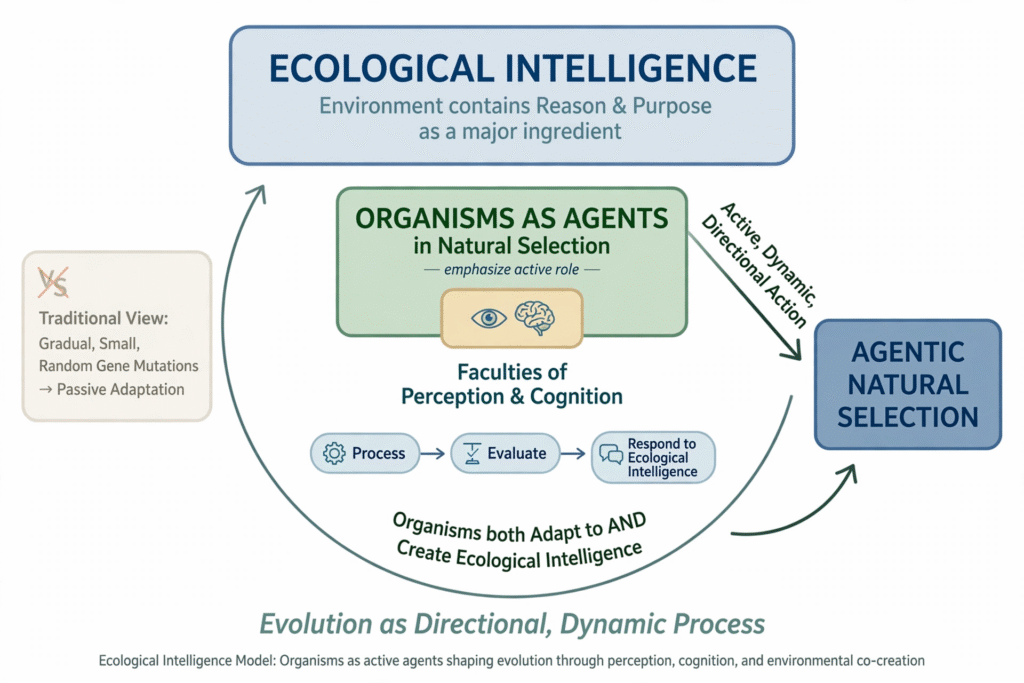
Our book, Understanding Living Systems, explicitly dismantles this modern synthesis view. We show that the genome is not a blueprint but an integrated toolkit that the cell and the wider organism orchestrate. Rather than flowing only “up” from genes to the mind, causation moves through a complex, circular web, with the environment and the mind shaping our biological being (Figure 2). This perspective engages with ecological and social intelligence and draws on, and creates, our ‘indigenous knowledge’—or, at the very least, it should. Moreover, the book challenges deterministic, mechanistic views of life: we are not machines. As Aristotle understood it, organisms are souls; that is, they have motivations, intentions, and the capacity to make decisions. In that, they do not need Descartes’ dualism or any other kind of dualism.
The Mental Health Connection
As with biology and medicine in general, mainstream psychiatry has increasingly relied on a similarly reductive, gene-centric narrative: that mental illnesses are primarily hardwired genetic defects or fixed “chemical imbalances” in the brain.
Just as we argue that a gene has no meaning outside the context of the whole living, ecologically embedded organism, postmodern sociologists argue that a psychological symptom has no meaning outside the context of a person’s culture, life history, and socioeconomic environment. In this sense, treating anxiety or depression purely as an isolated “broken mechanism” is the ultimate form of biological reductionism.
Agency, Free Will, and “Harnessing the Noise”
The Politics of Powerlessness
Critics of both hard genetic determinism and extreme postmodern sociology argue that these perspectives can leave individuals feeling powerless—either trapped by their DNA or reduced to passive victims of a fragmented society. This sense of powerlessness increasingly shapes our politics. As events seem to spiral “out of control,” slogans like “take back control” have become mantras of postmodern politics, and not always with good intent.
At the same time, globalisation has weakened the apparent influence of political institutions. Although these institutions were established to preserve peace and promote human rights, they now seem increasingly powerless. Moreover, social media—bolstered by massive investment in shaping public perceptions—continues to undermine them.
Indigenous Knowledge in Conservation Practices
Supporting Indigenous Knowledge Through Locally Led Conservation
A major challenge is deciding how—and whether—to foster Indigenous knowledge to address the global forces threatening it. Conservation projects rarely succeed without local community support. Therefore, projects rooted in local contexts, understood by communities, and supported from within are more likely to succeed than those imposed from above. Moreover, Indigenous knowledge can provide a powerful foundation for engagement. By supporting local communities as they confront globalisation and climate change, we can help them rebuild sustainable local economies that work with—not against—the ecosystems they depend on.
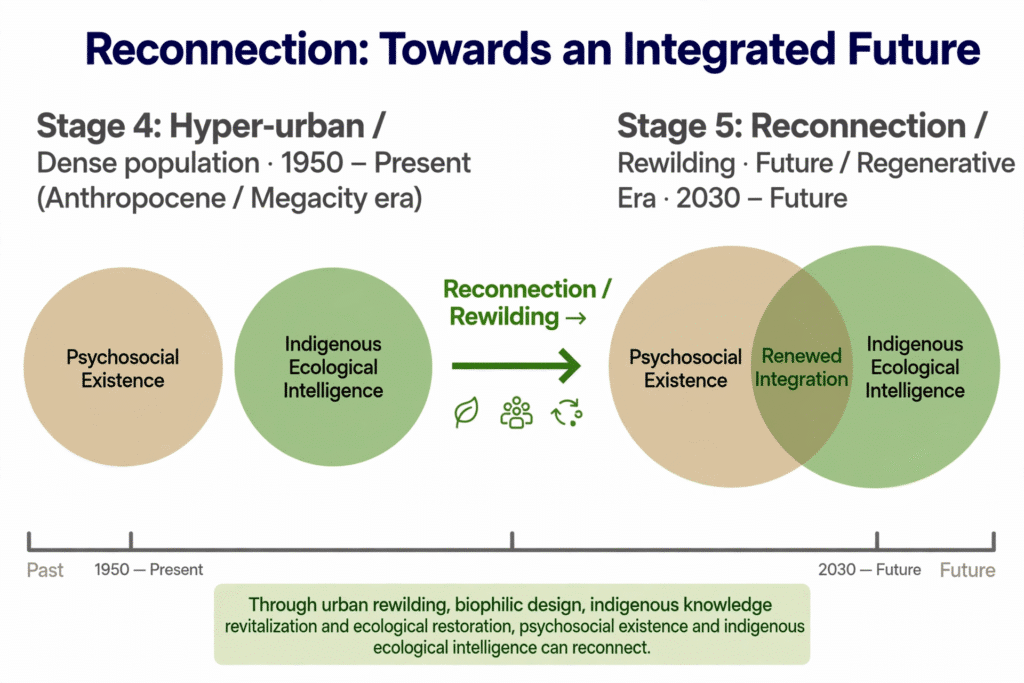
One approach is to strengthen the ‘rewilding’ process by empowering local communities and encouraging engagement. But this should be both an objective and a means of enhancing our ecological intelligence. In doing so, it will also build indigenous knowledge. We should build it into any major planning. We can do the same by reviving traditional arts and crafts.
The Value of Indigenous Knowledge
Indigenous knowledge can reveal what ‘objective’ science may miss about an ecosystem: what it feels like to be part of it. In other words, experience-based local knowledge matters. If we wait for enough scientific information to confirm that knowledge, we may never act. We may also miss decisions grounded in contextual logic and ecological intelligence. Moreover, a 1991 World Bank report argued that working with Indigenous systems is cost-effective, participatory, and sustainable—three goals the Bank actively pursued.
Building Conservation from the Ground Up
In a previous post, we argued that conservation projects work best when local communities consent to them. Instead of imposing preconceived ideas about rewilding, we should build from the ground up. That means fostering—not prescribing—a fixed set of ‘indigenous’ values and allowing new forms of “indigenous knowledge’ to evolve.
There may be no quick fix. Nor is there an ideal ‘indigenous’ person within us, waiting to be released. However, if we free ourselves from our postmodernist straitjacket, we may find new ways to understand who we are—or who we want to be. There is no ‘right’ or ‘wrong’ way. Rather, we can create a culture shaped by our relationship with the natural environment. The goal is not to recreate what once was, but to create what works better.
Challenges and Recognitions
Climate change and indigenous knowledge
Although Indigenous Peoples contribute only a tiny share of global carbon emissions, they are among the first to experience climate change’s direct impacts. Because their lives are deeply connected to the natural environment, climate change poses a distinct threat to their way of life. It also endangers the habitats and ecosystems they rely on for food, water, medicine, livelihoods, and cultural identity. But while seeking to foster these communities, their language, and their culture, we must also act to recreate the conditions for such intelligence in our urban environments. We should perhaps ask what kind of economic understanding is needed for this to happen?
The Future of Conservation and Indigenous Knowledge
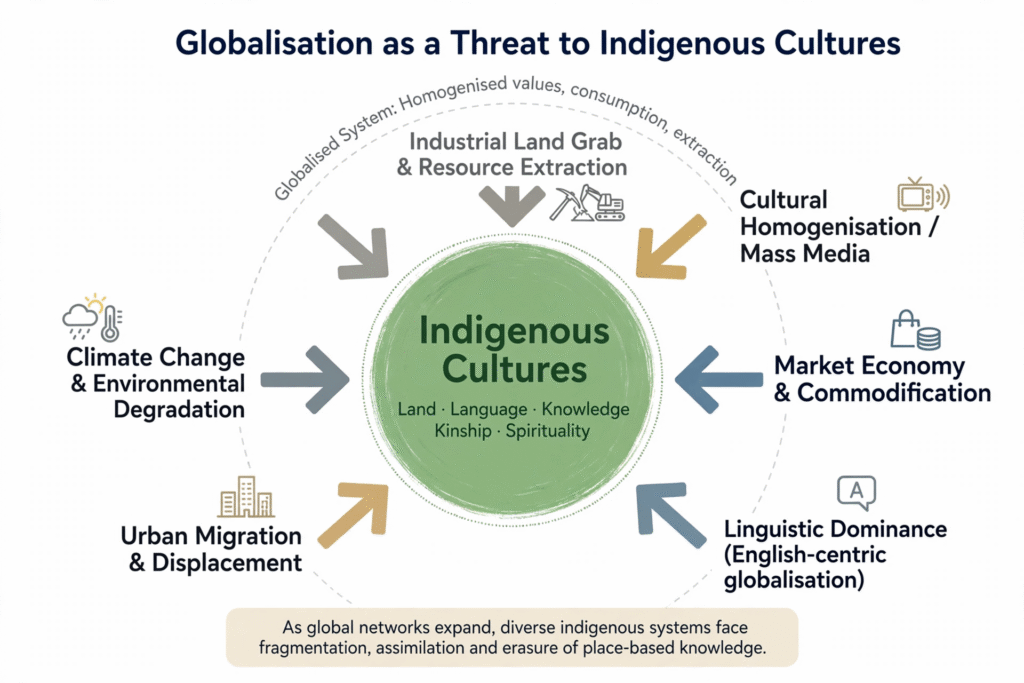
I have argued that we should be as concerned about the loss of indigenous knowledge in our urban landscape as we are or should be about the loss of indigenous cultures. The consequences of its loss are broader and deeper, affecting the health and well-being of human populations.