
The Role of Insects in Ecosystem Health
Understanding the Role of Insects in Ecosystems
Estimated reading time: 8 minutes
They are all around us. They are pretty much everywhere. Yet, we still have so much more to discover about them. Over one million insect species have been discovered and described, but estimates suggest there may be as many as 10 million on Earth. There are approximately 1.4 billion insects for every person on Earth. The total weight of all the insects is about 70 times that of all the people. Insects play a massive role in ecosystem health.
Insects can be found in almost every habitat, from mountain ranges covered in snow to the hottest deserts on the planet. They pollinate our food, recycle waste, feed other animals, control pests, and play a major role in soil health. Insect pollination provides a massive one-third of all the food we eat.
Pollination Contributions of Insects
Plants attract pollinators with a mix of bright colours, sweet scents, distinctive shapes, and food rewards such as nectar and pollen. We’re familiar with the role of honey bees, but many other insect species also play this vital role as pollinators. Many insects are shaped for a purpose and have evolved alongside plants. Flowers and insects present to each other as a lock and key. It isn’t an incidental relationship.
Visual guides and attractors
Plants attract specific insect species in many ways. Petals act as visual guides: Brightly coloured petals signal food to flying insects, with specific colour preferences. Bees, for example, tend to favour blue, purple, yellow, and white, while hummingbirds (yes, a bird) are drawn to vibrant reds and pinks. But many patterns are invisible to us. Many flowers have ultraviolet nectar guides invisible to humans that direct insects straight to their centre. We tend to see all this as a daylight activity. Yet, there are night-blooming flowers, often pale or white to reflect moonlight for nocturnal moths.
Scents and odours
Many plant species produce Sweet fragrances: pleasant aromas draw in bees, butterflies, and bats looking for food. In contrast, some plants produce unusual odours, mimicking, for example, rotting meat or fungus to lure flies and beetles.
Shapes and forms
Flowers are shaped to make it easier for specific insects to access them. So, lipped or flat flowers give insects like bees a landing spot, while trumpet shapes fit the long beaks or mouthparts of hummingbirds and butterflies. Some shapes are exclusive, with specialised forms restricting access to specific pollinators and ensuring the right pollen reaches the right plant species. Thus, the lock-and-key analogy applies.
Food Reward
Nectar is a sweet, sugary liquid that insects eat. It is a good energy food, and flowers offer protein-rich pollen that animals eat or gather for their young, which brushes onto their bodies in the process.
These guides, attractors, scents and odours, shapes and forms, and food rewards have all evolved in an intimate relationship with insects and other animals. In this process, plants and insects act as agents in a give-and-take exchange. This is another example of symbiotic relationships guiding evolution. But it isn’t a one-way street. Insects and plants communicate.
How bees unlock the pollen
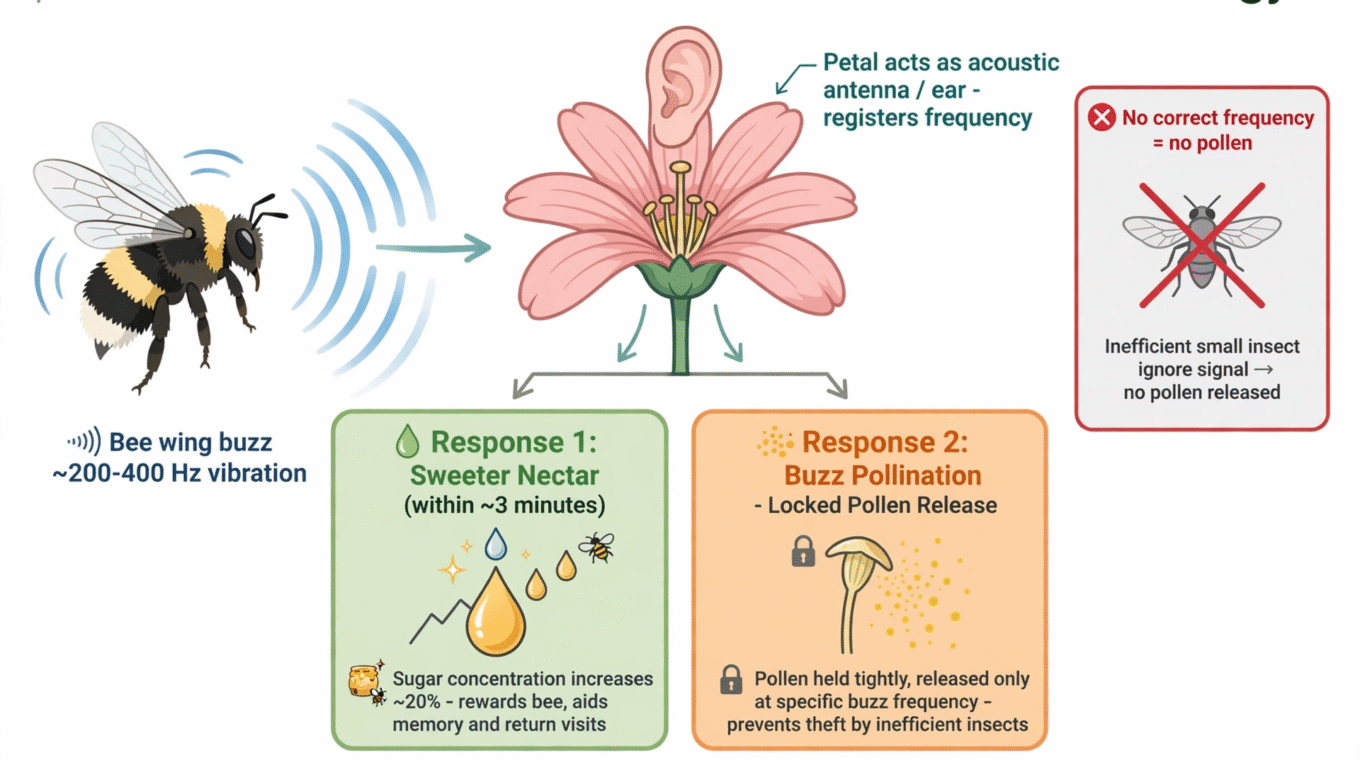
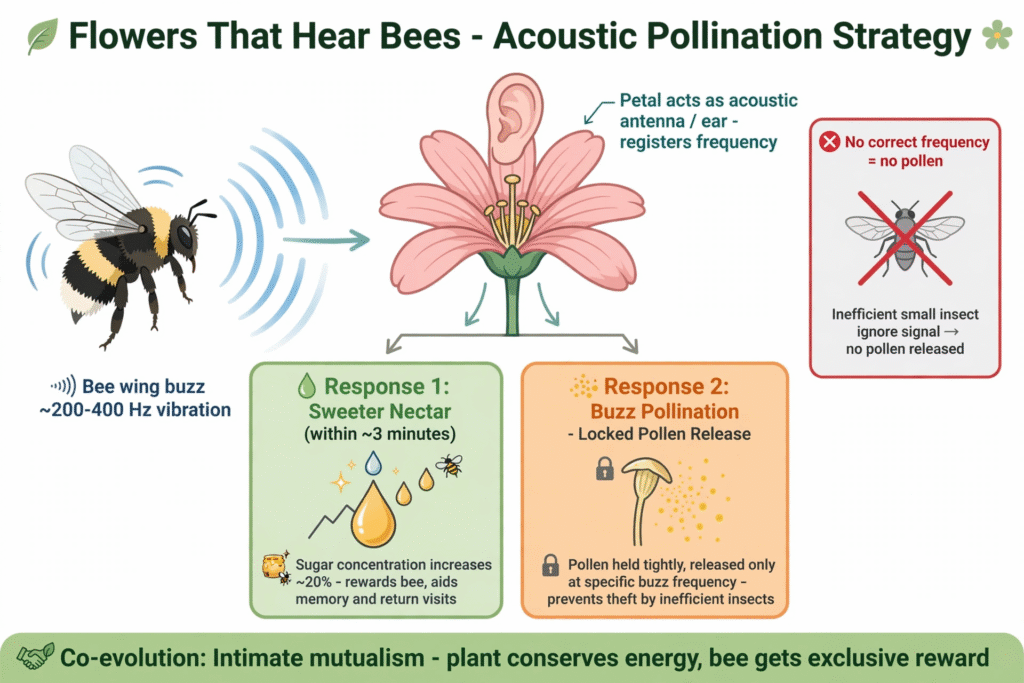
The physical buzz of a bee acts as a powerful vibrational key that fundamentally changes how a plant behaves. Rather than just an accidental sound of flight, the vibration—known as sonication—triggers rapid plant responses, from an explosive release of hidden pollen to a sudden increase in sugar production.
About 9% of the world’s flowering plants (including crops like tomatoes, blueberries, and aubergines) hide their pollen inside tightly sealed, tube-like structures called poricidal anthers. A bee (such as a bumblebee or solitary bee) grabs the flower, uncouples its wings, and rapidly vibrates its powerful thoracic flight muscles. This powerful, high-pitched vibration shakes the flower violently. It forces an explosive “puff” or stream of pollen grains out of tiny pores at the tips of the anthers, coating the bee’s body so it can be carried to the next flower. Intriguingly, Honeybees are physically unable to perform this trick. Some bees ‘bumble’ with purpose.
The flower is a sense organ
Plants can essentially “hear” approaching pollinators and anticipate their response. Research, including studies highlighted by National Geographic, shows that certain flowers act like ears. When a flower’s petals register the acoustic frequencies and physical vibrations of a bee’s buzzing wings, it acts as a stimulus. Within minutes of sensing the buzz, the plant temporarily increases the sugar concentration in its nectar. This dynamic response rewards the visiting bee with extra energy, helping the insect remember the plant and return.
Mutual benefit
Pollen requires immense energy for a plant to produce, making it a precious resource. By locking it away and releasing it only when subjected to a highly specific vibration frequency, the plant prevents “greedy” or inefficient insects from stealing its reproductive cells. The buzz ensures the pollen is exclusively reserved for the most effective, specialised pollinators. This is clearly an intimate arrangement and would have been a mutual driver in evolution between plant and insect. (Figure 1)
Without a bumblebee’s high-frequency buzz, the tomato plant will produce very little or misshapen fruit. Sweet bell peppers, jalapeños, and habaneros all share the same flower structure as tomatoes. Blueberries and cranberries have bell-shaped flowers that dangle downward. Bumblebees hang upside down from the flowers and buzz them to release a shower of pollen.
Insects and Nutrient Cycling
Breaking Down Plant Debris
Insects act as nature’s primary waste managers, playing a critical role in breakdown, decomposition, and soil enrichment. Without them, dead matter, fallen leaves, and animal waste would pile up, trapping vital elements like nitrogen, phosphorus, and carbon underground and away from living plants. Insects like termites, wood-boring beetles, and millipedes physically chew up tough plant fibres and wood. By chewing large leaves and wood into tiny fragments, insects drastically increase the organic matter’s surface area. This fragmentation allows fungi and bacteria to move in quickly, accelerating the final stages of decomposition.
Processing animal waste and carrion
Dung beetles bury and consume animal manure. By rolling dung into the earth, they deliver nutrients like nitrogen directly to plants’ root zones while also aerating the soil. Blowflies and carrion beetles lay eggs on deceased animals. Their larvae (maggots) rapidly consume the tissue, recycling vital proteins, fats, and minerals back into the local food web before harmful pathogens can spread.
Nutrient-rich excrement and soil aeration
When insects digest leaves, wood, or waste, they excrete a powdery byproduct known as frass. Frass is highly concentrated in immediately bioavailable nitrogen, potassium, and phosphorus. It functions as an organic, slow-release fertiliser that plants can absorb through their root systems. Tunnelling insects—such as ants, cicada nymphs, and beetle larvae—move organic material from the surface down into lower soil layers. Their physical tunnels introduce oxygen and create pathways for water to flow, allowing plant roots to access newly recycled nutrients more efficiently.
Threats to Insects and Ecosystem Health
The “insect apocalypse”
Insect populations worldwide are declining sharply, a crisis scientists often call the “insect apocalypse.” Estimates suggest that global insect biomass is dropping by about 2.5% each year, driven primarily by human activity, industrial practices, and environmental shifts.
The single greatest driver of insect decline is the destruction and fragmentation of natural environments.
Habitat disruption
Vast landscapes of diverse wildflowers and meadows are routinely converted into monoculture crop fields and pastures. The expansion of cities, paved roads, and manicured lawns replaces vital nesting sites and host plants with concrete or sterile landscapes. As ecosystems are broken into small, isolated patches, insects struggle to travel, find food, migrate, or maintain genetic health.
Pesticides
https://foe.org/blog/the-insect-decline-crisis/Broad-spectrum chemicals and systemic pesticides (like neonicotinoids) leach into the soil, water, and wildflowers. They impair insects’ navigation, foraging behaviour, and immune systems, even at low doses. Weed-killing sprays remove non-crop wild plants and weeds, eliminating the primary food sources and larval host plants that caterpillars and wild bees need to survive.
Conclusion
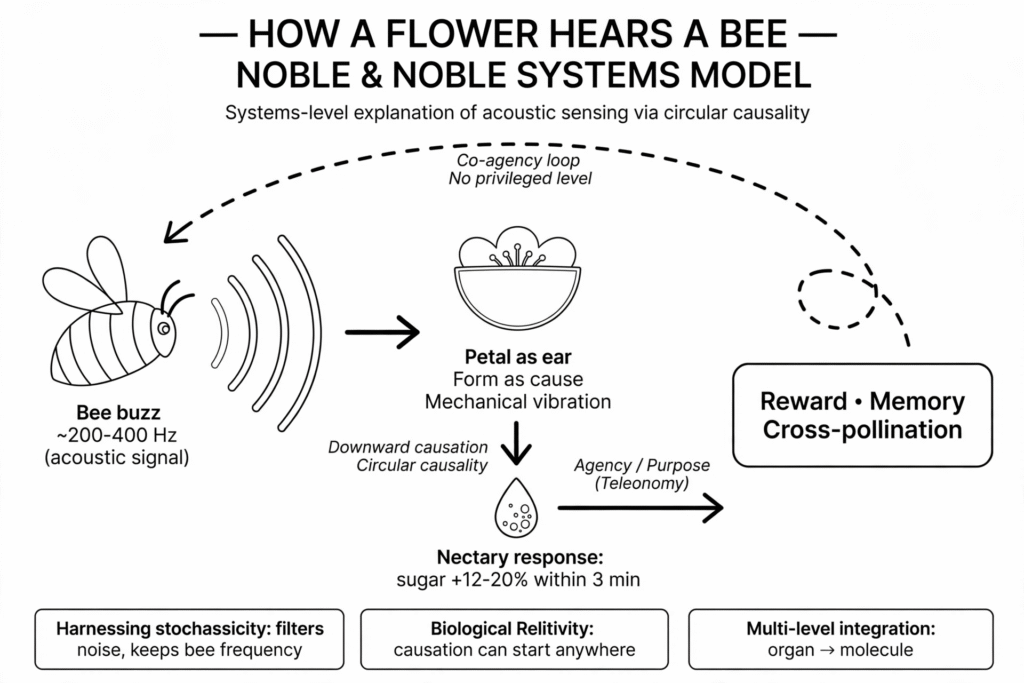
In a previous post, we showed how the mycorrhizal network fits into the Noble and Noble model in our book, Understanding Living Systems. The mycorrhizal network is part of a complex ecological system with components above and below ground. Equally, the intimate interrelationship between plants and insects plays a vital role above and below ground.
The commensal relationship between insects and plants has been a major driver in evolution. However, no genomic blueprint exists for this relationship beyond the varied faculties that make it possible (Figure 2). This example shows two agents constructing a shared niche. A bee learns, and the plant anticipates; both modify each other’s selective environment. This is an example of nested integration: organelles within cells, cells within tissues, organisms within social and ecological interactions.
The signal stimulates sugar concentration. Thus, the bee’s behaviour is altered by learned association and returns to the benefit of both parties in the commensal relationship,
Key Takeaways
- Insects greatly contribute to ecosystem health by pollinating plants, recycling waste, and supporting soil health.
- Pollination occurs through complex relationships between insects and plants, evolving over time to benefit both parties.
- Certain insects, like bees, facilitate pollen release through unique vibrational techniques, enhancing plant reproduction.
- Insects serve as nature’s waste managers, breaking down organic material and returning essential nutrients to the soil.
- The ongoing decline of insect populations, termed the ‘insect apocalypse,’ threatens ecosystem stability and health.