
The Interdependence of Species: How Ecosystems Function as a Whole
What is Species Interdependence?
Estimated reading time: 10 minutes
Key Takeaways
- Species interdependence drives ecosystem functionality, highlighting cooperative relationships among various organisms.
- Parasitic and mutualistic interactions explain different dynamics in ecosystems, such as the relationship between the Glanville Fritillary butterfly and its parasitic wasp.
- Producers, consumers, and decomposers play key roles in ecosystems, contributing to energy flow and nutrient recycling.
- Biodiversity enhances the resilience and adaptability of ecosystems by allowing species to share resources and reduce competition.
- Changes in species behaviour, such as those seen in woodmice, exemplify adaptability in response to fluctuating resources, demonstrating the importance of interdependence.
Ecosystems are webs of interdependent species. In our book, Understanding Living Systems, we discussed life on Earth as a ‘give and take’ cooperative. We emphasised the adaptable relationships between species, that is, their interdependence, even in predator-prey relationships. This contrasted with a view of nature as ‘red in tooth and claw’. Ecosystems function through dynamic interdependence among species. This interdependence has been and remains a major driver of evolution, honing the faculties of ‘fitness’ within it.
Often, the interdependency is intimate and direct. For example, in the relationship between plants and particular pollinator species. However, much of this dependency is more distant in consequence, location, or time, yet no less important. The diversity of species in an ecosystem will often compensate for any loss or decline in a given species. Changes in predator-prey dynamics may cascade through the ecosystem. Thus, species diversity matters to the resilience of ecosystems and habitats within them. Yet, even when the relationship is direct and intimate, it can be either parasitic (one species benefits at the expense of another) or mutual (each species gains some benefit).
Parasitic relationships
Consider parasitic wasps, for example. As parasitoids, they lay their eggs on or in the bodies of other arthropods, sooner or later causing the death of these hosts. One wasp, Hyposoter horticola, employs a sinister tactic to get inside its host, the egg of the Glanville Fritillary butterfly, Melitaea cinxia. A female wasp lays its own egg inside that of the butterfly before the tiny caterpillar is about to hatch. This is an intimate parasitic relationship in more ways than one. This species of wasp will only lay its egg in those of one species of butterfly. It is an example of host specialisation.
Host Specialisation
- Exclusive Host: The parasitic wasp relies entirely on the Glanville fritillary (Melitaea cinxia) for its development.
- No Preferences Among Species: Because it does not target other butterfly species, preference does not apply; it is genetically and behaviourally tuned solely to find and utilise M. cinxia.
- The wasp locates the specific egg clusters on host plants (such as Plantago lanceolata and Veronica spicata) using specialised olfactory and environmental cues tied specifically to the Glanville fritillary and its food plants.
- These two species, parasite and host, have been locked in an evolutionary dance.
Foraging strategy
Fitness and foraging strategy drive this interaction. The wasp competes with rival females, whose presence alters its behaviour. Its tactics shift with host abundance and the proportion of healthy hosts, while host susceptibility changes over time. Despite these factors, the wasp flexibly locates suitable targets within genetic constraints.
Butterflies lay clusters of 100–200 eggs on host-plant leaves. In June and July, wasps parasitise the eggs just before hatching. In spring, the parasite larva consumes the caterpillar and pupates inside it. Wasps monitor egg deposits, using ovipositors to test maturity, allowing them to lay eggs at the optimal time. The butterfly has three defences.
Chemical Warfare (Dietary Sequestration)
The butterfly’s strongest defence is chemical. As caterpillars, Glanville Fritillaries feed on ribwort plantain and spiked speedwell, which contain toxic iridoid glycosides (aucubin and catalpol). The caterpillars safely absorb and concentrate these toxins.
These plant chemicals boost the caterpillar’s immune system. Caterpillars with toxin-rich diets show higher encapsulation rates: their blood cells surround and kill invading wasp eggs or larvae before they can grow.
Physical and Behavioural “Safety in Numbers”
Because the female wasp has only a brief window to lay eggs, the butterfly employs behavioural defences. Gregarious Nesting: eggs are laid in dense clusters, and the caterpillars hatch into protective silken webs. Dilution Effect: Even if a wasp breaches the cluster, it usually infects only a third of the caterpillars, leaving most safe.
An Accidental Ally: The Hyperparasitic Wasp
A third defence is accidental: the butterfly benefits from an “enemy of my enemy” dynamic. Hyposoter horticola is hunted by a rarer hyperparasite, Mesochorus cf. stigmaticus. When Hyposoter lays an egg inside a caterpillar, Mesochorus injects its own egg into the Hyposoter larva. The hyperparasite kills the attacker, reducing Hyposoter numbers and benefiting the butterfly.
Mutualism in ecological relationships
Mutualism describes an ecological relationship where both species actively help each other survive, find food, or stay safe. Consequently, sea anemones and clownfish form a partnership: clownfish seek shelter in the anemone’s stinging tentacles, while the anemone receives nutrients from clownfish waste and protection from predators.
To further illustrate mutualism, consider these two classic examples of how species work together to survive, eat, or stay safe:
Sea Anemones and Clownfish (Protection & Nutrient Sharing)
- First, clownfish benefit because sea anemones use their stinging tentacles to deter most predators. Since clownfish develop a special mucus layer, they avoid getting stung and actively choose the anemone as a safe home and nursery for their eggs.
- Meanwhile, anemones benefit as clownfish attract prey toward their tentacles and chase away butterflyfish that threaten the anemone. In addition, clownfish waste supplies vital nutrients that benefit the anemone.
Mycorrhizal Fungi and Plant Roots (Resource Exchange)
- In this relationship, the fungus benefits because it cannot photosynthesise to make its own food. By weaving its threads (hyphae) around plant roots, it directly accesses the sugars and carbohydrates the plant produces through photosynthesis.
- At the same time, the plant benefits as the fungus’s sprawling underground network acts like a secondary root system, dramatically increasing the plant’s ability to absorb water, phosphorus, and nitrogen from the soil. In addition, it acts as a communication system between plants.
Key Roles of Species in Ecosystems
Stepping back, we can consider another way to view ecosystem interdependencies. We can consider the general roles species play as producers, consumers, and decomposers. Producers produce energy and building blocks that sustain life. Consumers use that energy and nourishment to sustain themselves, grow, and move. Decomposers break down dead plants, animals, and waste materials.
Producers
- Definition: Organisms that make their own food using energy from the sun or chemicals. They are also called autotrophs.
- Role: They form the base of the food chain and create energy for the entire ecosystem.
- Examples: Plants, trees, grasses, algae, and some bacteria that use photosynthesis.
Consumers
- Definition: Organisms that cannot make their own food and must eat other living things to get energy. They are also called heterotrophs.
- Role: They transfer energy through the food chain by eating producers or other consumers.
- Types:
• Herbivores: Plant-eaters that feed on producers (primary consumers like deer or rabbits).
• Carnivores: Meat-eaters that prey on other animals (secondary or tertiary consumers like wolves or eagles).
• Omnivores: Animals that eat both plants and meat (like humans or bears).
Decomposers
- Definition: Organisms that break down dead plants, animals, and waste materials.
- Role: They act as nature’s cleanup crew, returning vital nutrients back into the soil and air so producers can reuse them.
- Examples: Fungi (like mushrooms), bacteria, and detritivores like earthworms and millipedes
Chains in complex webs of interdependence
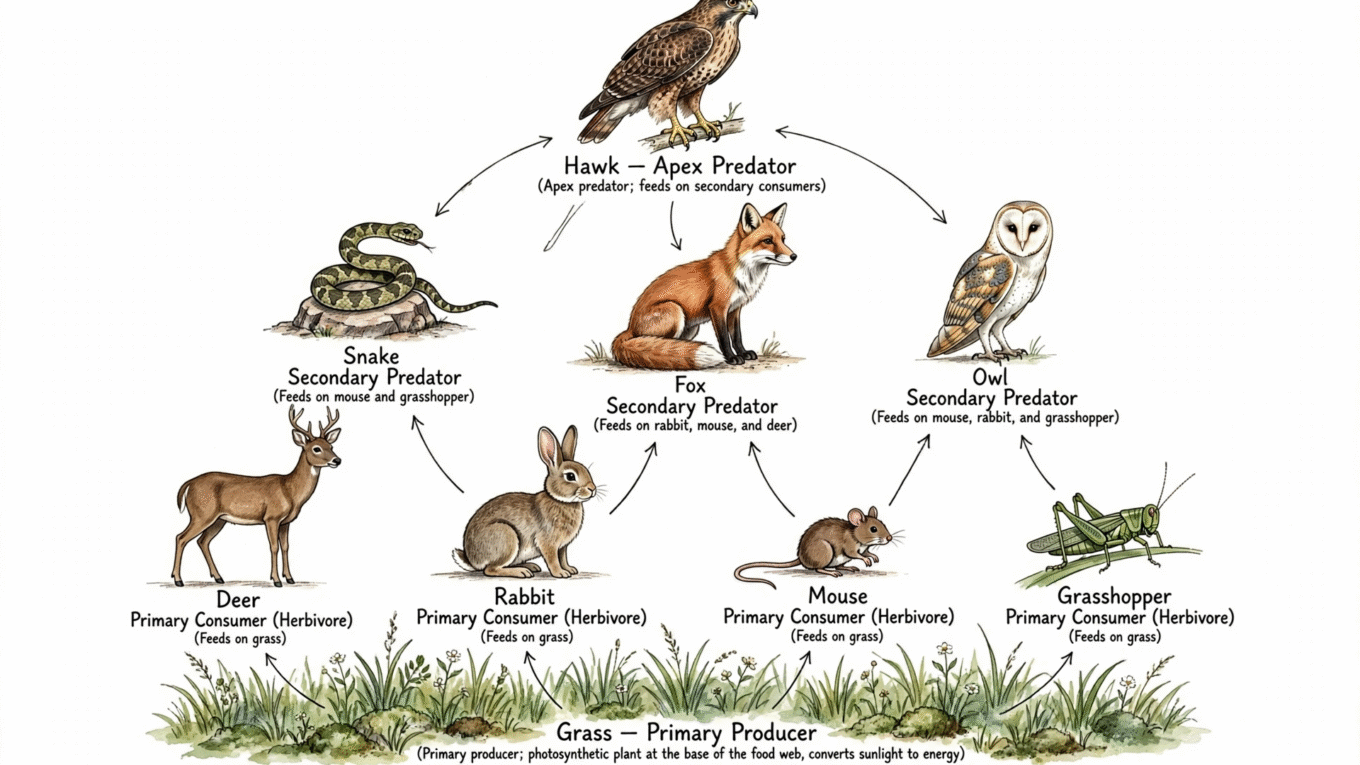
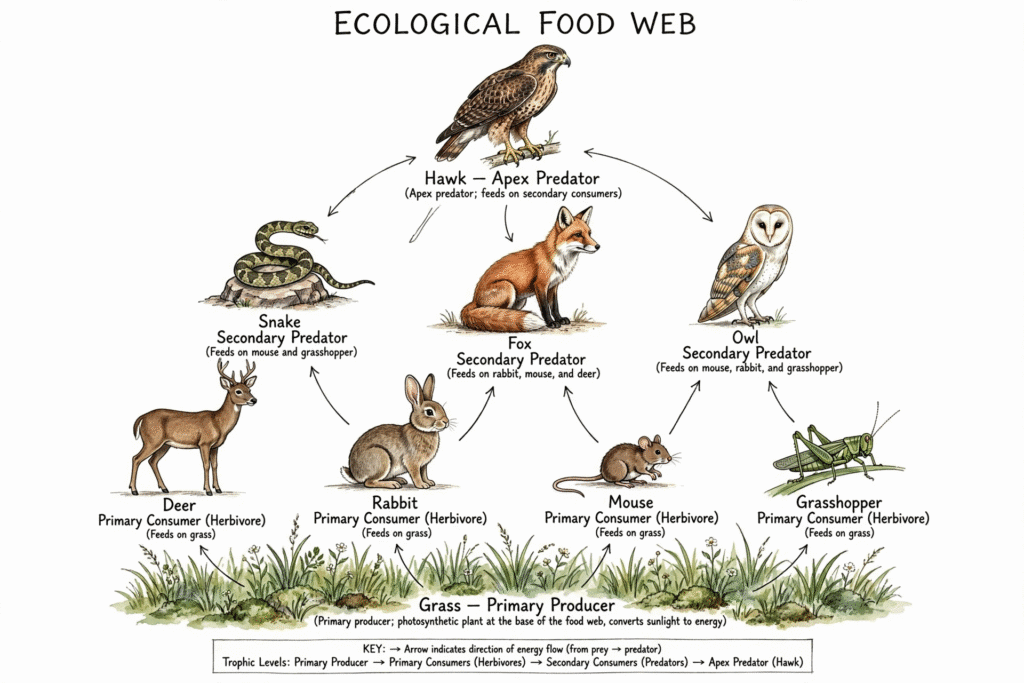
We often represent this as food chains, but ecosystems are better understood as interlocking chains that form complex webs of interdependence. Species diversity plays a key role in sustaining these webs and enhancing their resilience to change. With sufficient diversity, a web can remain intact even when, say, an invasive predator removes or depletes parts of a given chain. Furthermore, many organisms can opportunistically fill or substitute for a vacant niche. Let’s consider an example of part of a web (Figure 1).
The webs within webs
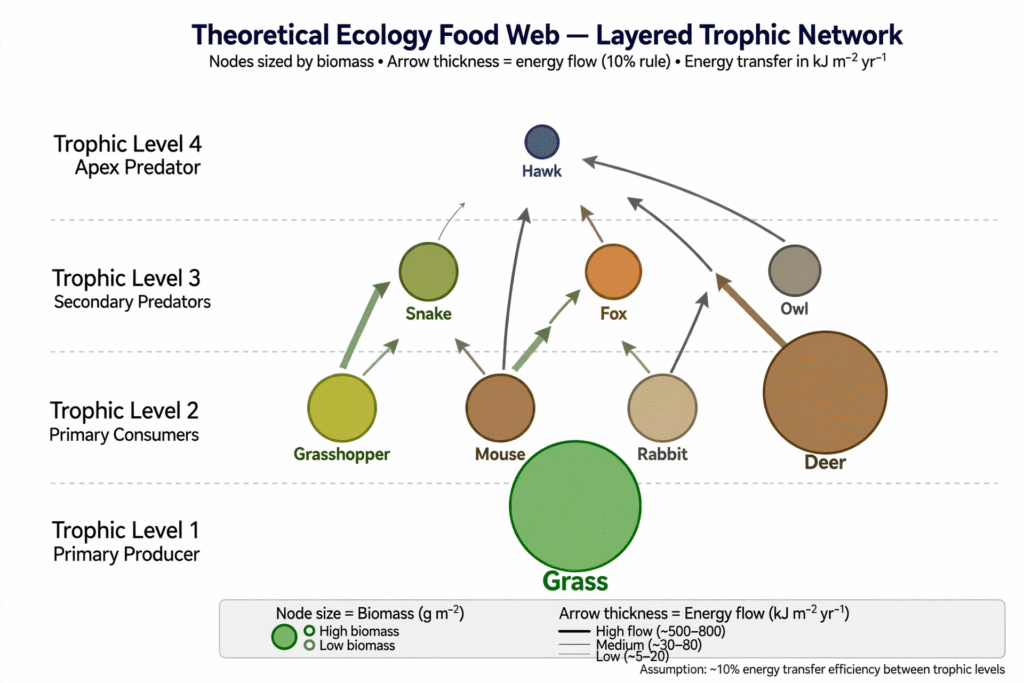
At any point in the web shown in the diagram, we can identify further webs of interdependence that cross boundaries (figure 2). These boundaries constrain behaviour, while niches and habitats remain dynamic. Moreover, they change in response to the presence of others. For example, woodmice alter their behaviour as population size or resource availability changes. Consequently, territorial behaviour may shift toward cooperation. Thus, interdependence within and between species can adapt over time.
IIn our book, *Understanding Living Systems*, we use the woodmouse as an example. The woodmouse (*Apodemus sylvaticus*) significantly changes its behaviour in response to the abundance and spatial distribution of its food resources. Consequently, woodmice adapt to shifts in resource availability by modifying their home-range size, social structures, dietary choices, and energy-conservation strategies.
Home Range Dynamics
When food resources become scarce, woodmice drastically expand their home ranges. For example, woodmice in resource-poor arable fields maintain much larger territories than those in resource-rich woodlands. Conversely, when resources are plentiful, woodmice contract their territories because they can meet their energetic needs within a smaller area.
Social and Network Behavior
Resource Distribution Effects: The spatial distribution of food alters how woodmice interact. Tracking data show that aggregated (clumped) resources increase social network strength 83-fold compared with widely distributed resources because mice frequently gather around localised food hotspots. Moreover, communal nesting becomes more common during winter as resources and temperatures decline. Woodmice huddle and nest together to share body heat and conserve energy.
Foraging and Diet Flexibility
Woodmice feed opportunistically. When high-energy foods such as seeds, nuts, and tree mast abound, they focus primarily on these resources. However, when these preferred foods become scarce, they shift their foraging toward invertebrates—including snails, earthworms, and insects—as well as fungi and green plants. Furthermore, during autumn resource gluts, such as years of heavy acorn production, woodmice prioritise hoarding and caching seeds in complex underground burrow systems to protect themselves from winter starvation.
Reproductive Habits
Under normal resource constraints, woodmice stop breeding by October. However, when food is exceptionally abundant—for example, during a heavy oak mast—woodmice alter their behavior and continue breeding throughout the winter.
Physiological Adaptation to Food Shortages
When food supplies become critically low during cold spells, woodmice conserve energy by entering torpor. As a result, this temporary, hibernation-like reduction in body temperature and metabolic rate helps them survive severe, acute food shortages.
Impact of Biodiversity on Ecosystem Function
Biodiversity reflects the vitality and resilience of a habitat or ecosystem, as well as its ability to sustain life. It refers to the variety of organisms living in different habitats within an ecosystem. For example, researchers commonly assess biodiversity using three key indicators: 1) genetic diversity within populations of a given species, 2) the number of species in a given habitat, and 3) the number or variety of habitats within an ecosystem. In another sense, it reflects the complexity and resilience of the complex webs of species interdependence. The greater the diversity, the greater the niche adaptability and the resilience of the web.
Closely related species exhibit niche partitioning, sharing a habitat through behaviours that reduce competition in time, space, and for resources. We illustrated this by examining damselfly species with different oviposition strategies. Many species have mutualistic relationships with others that benefit them directly or indirectly. The web of function depends on ecological intelligence, the ability to signal and respond to signs left intentionally or inadvertently by others. Evolution has enhanced these perceptual faculties. The presence of others, whether mutual or predatory, as a benefit or a threat, alters adaptable behaviour. Changes within habitats can cascade down through the system.
But signs can easily be disturbed. This is why what we humans do matters.