
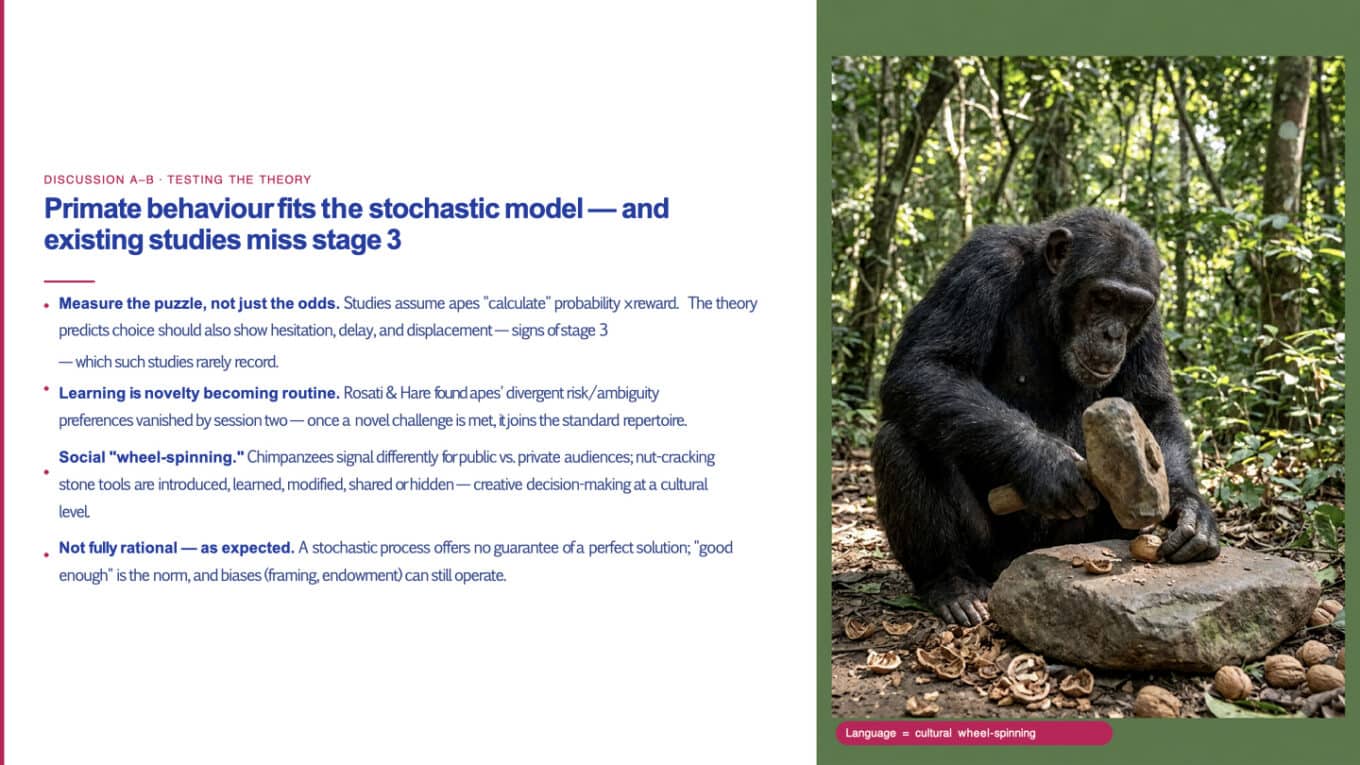
How Organisms Make Choices: Harnessing Randomness to Find New Solutions
In this article, Raymond Noble critically revisits his paper published with Denis Noble in 2018. “Harnessing stochasticity: How do organisms make choices?” by Raymond Noble and Denis Noble, Chaos 28, 106309 (2018), https://doi.org/10.1063/1.5039668.
Key Takeaways
- Organisms harness stochasticity to generate responses to unfamiliar challenges, allowing for creativity in decision-making.
- The proposed five-stage model includes problem definition, searching for existing responses, generating new options, evaluating them, and acting.
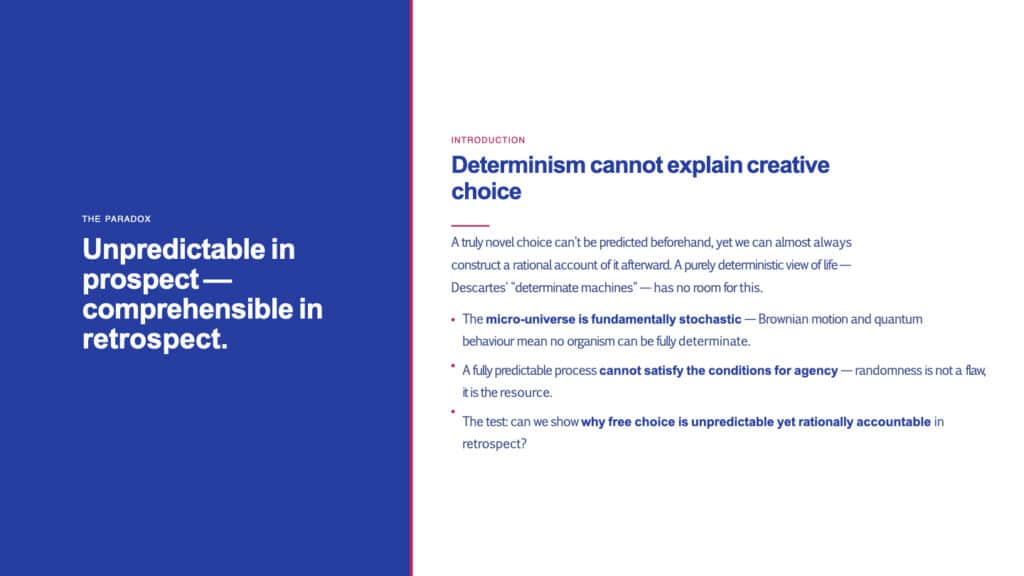
- Choices may be unpredictable beforehand, yet they can be understood after the fact, linking perceived randomness to rationality.
- This framework has significant implications for understanding animal behaviour, learning processes, neuroscience, and evolutionary dynamics.
Estimated reading time: 18 minutes
Why biological choices can be unpredictable before they happen, yet understandable afterward.
Adaptive Intelligence in Changing Ecosystems
When organisms encounter unfamiliar problems, they cannot rely solely on fixed reflexes or existing solutions. Instead, they draw on accumulated knowledge and understanding to interpret ecological intelligence and develop creative responses. After all, neither genes nor fixed behaviours can address every challenge life presents. Genes contribute tools to the system, but they do not control it. This is the difference between faculty (the ability to act) and the action itself. However, this does not mean genes play no role in shaping complex decision-making. Moreover, ecosystems do not function as static jigsaw puzzles with predetermined solutions or pieces that fit neatly together. Rather, changing circumstances continually reshape ecosystems and the challenges organisms face. Behaviour must be adaptable.
Our paper considered the properties of living systems that enable such creativity
Even stylised behavioural responses involve real-time adjustments. As organisms act, they make choices and improvise within the limits of their faculties—their ability to do things. Experience often strengthens that ability, while anticipation helps organisms respond to change and to others’ actions. Flexibility, therefore, is essential: without it, organisms cannot modify their responses. So what enables this flexibility in shaping behaviour?
Randomness vs. Stochasticity: While often used interchangeably, randomness describes an unpredictable real-world phenomenon, whereas stochasticity specifically refers to the mathematical approach or model used to study that uncertainty using probabilities. We used stochasticity in the paper because each level of the system shapes its output using inherent variability. Constraints differ at each level of the nested function, altering probabilities.
Capacities for decision making
In our 2018 paper, we proposed that living systems manage complexity by harnessing stochasticity. They generate possible responses through seemingly random processes and then select the response best suited to each challenge. However, this does not mean that organisms insert a random generator into decision-making, roll dice, or spin a wheel of fortune. Instead, they make rational decisions using faculties of awareness, perception, cognition, and memory—capacities that evolution has honed. They recognise patterns and associations in events and interpret them through conditional logic. Although these faculties vary in their development and function across organisms, they enable living systems to respond effectively to complexity.
Interconnected Systems and Boundaries
When we examine this functionality more closely, we see how boundaries shape stochastic processes. At the cellular level, organelles enable cells to function and interact within tissues. In turn, tissues form organs and organ systems, each of which specialises in distinct functions. These systems work together within the organism, which also shapes their boundaries. Moreover, organisms create niches and interact within habitats and ecosystems, fostering psychosocial awareness. As these interactions expand, the system becomes increasingly open, forming a complex web of causal relationships.
How Living Systems Harness Stochasticity
This idea explains how choice can be both novel and apparently rational. Although we may not be able to predict exactly what an organism will do in advance, we can often understand why its response made sense once it acts. Creativity, therefore, does not require complete novelty. Rather, it means the organism does not rely on a rigid decision-making algorithm—or, if it does, can adapt its logic as circumstances unfold. These adaptations may reflect the organism’s state, motivations, needs, interpretation of the situation, emotions, and expectations about others’ behaviour. Together, these factors reveal creativity’s true nature.
The problem with a purely deterministic view of life
A strictly deterministic view treats organisms as extremely complex machines. This mechanistic view contrasts with the concept of function as process. In principle, if we knew every relevant mechanism and condition, we could predict behaviour with arbitrary precision. However, predictability is not the key ingredient of deterministic systems. Events can be deterministic whether or not we can predict them. After all, we can predict the temperature of water in a flask by the flux of the water molecules. Temperature is directly proportional to the average translational kinetic energy of water molecules, described mathematically by the Kinetic Molecular Theory.
Water is crucial
Because a water molecule’s kinetic energy depends on its mass (m) and speed (v), its root-mean-square speed increases with the square root of the absolute temperature. When water freezes, its molecules form a crystalline lattice and vibrate locally instead of moving freely. As the temperature rises, however, the molecules jiggle, move randomly, and collide with one another—a process known as Brownian motion. These movements also affect particulate matter suspended in the water, causing it to move around. Likewise, when salt dissolves, its ions move randomly through the solution: Na⁺ and Cl⁻ ions in sodium chloride, and K⁺ and Cl⁻ ions in potassium chloride. Thus, increasing temperature drives molecular motion that influences both dissolved ions and suspended particles.
Generating electrical potentials
At the simplest level, living cells harness this stochasticity. For example, they use it to create voltage gradients across their membranes, generating an electrical potential that drives other processes. Living cell membranes are selectively permeable to such ions. Furthermore, larger charged ions, such as proteins, cannot move readily across the membrane. This helps generate an electrical potential. If we know the ion concentrations inside and outside the cell membrane, we can use the Nernst Equation to determine the voltage across it.
Named after German physical chemist Walther Nernst, the Nernst equation captures a fundamental electrochemistry relationship. It calculates the actual electrical potential (voltage) of an electrochemical cell—or a single half-cell—under nonstandard conditions. More broadly, it helps explain how ions move and how selective membranes shape electrical activity. For example, nerve cells use voltage-sensitive gates in their membranes to harness these processes, generating discrete electrical impulses that travel along their axons and trigger transmitter release at synapses. These chemical transmitters then diffuse across the space between neurons and activate gates in neighbouring neurons, allowing signals to pass through a network. Now let’s stand back and look at the network.
Neural Networks Shape Signal Transmission
Neural networks combine excitatory and inhibitory influences to modulate membrane potentials and adjust thresholds for signal generation and neurotransmitter release. At synapses, these influences can suppress transmitter release; at the postsynaptic membrane, they can change membrane potential. They also arise from different parts of the nervous system, modulating neural pathways.
Experience Tunes Network Responses
Moreover, networks can organize into self-reinforcing patterns. Experience can make them easier or harder to excite, or even block signal transmission. These networks can also increase or decrease the force of their outputs, as they do when controlling muscles.
Integrated Systems Guide Movement
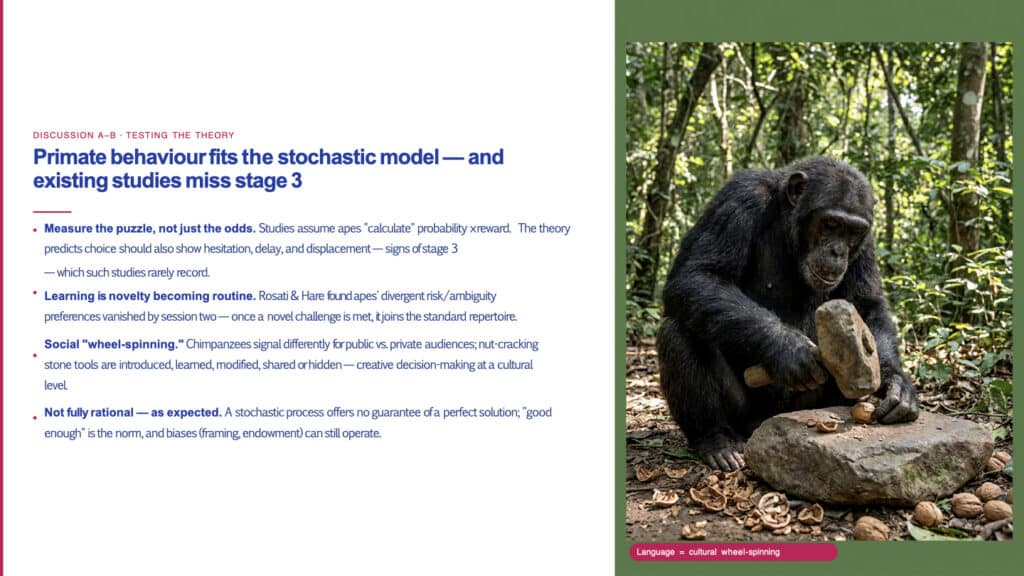
For example, when we walk, excitatory and inhibitory pathways work together to coordinate movement. At the same time, input from systems such as the vestibular system helps us maintain balance, whether we stand still or move. Proprioceptors also continuously relay information about the body and its limbs to the brain. At the muscle-cell level, actin and myosin filaments slide past one another to produce muscle contraction. Yet this mechanism alone cannot explain the direction or purpose of movement. To understand that, we must consider the broader psychosocial context: for instance, a chimpanzee may sit with others and use stones to crack nuts. This creative, learned, goal-directed behaviour shows why we must examine movement across multiple levels.
Action with purpose
We must also understand the situational logic and purpose behind every action. Using a tool is a creative process, and science often struggles to study it because purpose is everywhere yet difficult to measure. We can define purpose as “a reasoned motivation to achieve a particular outcome,” since we can understand a reason only in relation to a goal. Therefore, it is reasonable to assume that organisms act intentionally in a given context: their actions do not merely produce an outcome; rather, they pursue an outcome they intend to achieve. Consider a chimpanzee who has collected many nuts, some of which are difficult to crack. After seeing others use stones to crack nuts, she searches for a suitable one—not too large or too small, easy to handle, and hard enough to work. She selects a stone and strikes the nut with force. When it works, her actions demonstrate intention and, to varying degrees, creativity.
This behaviour isn’t hard-wired in the system. It is a learned behaviour. Some groups of chimpanzees my never us this method of cracking nuts. Nevertheless, it becomes part of the lexicon of purposive action that a chimpanzee can choose. Perhaps they may find similar goals for which a stone can be a useful tool. Chimpanzees use other tools, such as sticks, to collect termites from a nest. They use their bodies, their arms and legs, faces, and sounds to communicate their mood and intention to others. Language is a tool of intention.
Stochasticity Supports Goal-Directed Behaviour
At the cellular level, these processes harness stochasticity to finely constrain electrochemical effects. Beyond that, the brain integrates visual perception, hearing, touch, smell, emotion, cognitive systems, anticipation, and physiological state. By coordinating all these inputs, the nervous system supports purposeful, goal-directed behaviour.
Because organisms regularly encounter conditions without ready-made behavioural rules or preset actions, they must develop useful responses instead of simply retrieving them. Alternatively, they can repurpose existing responses. The wheel need not be reinvented; it may simply be put to other uses.
Stochastic processes are present throughout biology, from molecular motion and ion-channel activity to neural signalling. The key question is not whether biological systems contain randomness, but whether organisms can use it functionally. The answer is yes,
Stochasticity is not just noise
In this context, stochasticity means an inability to predict a particular outcome in advance. It does not mean that all higher-level behaviour must be random. Molecular-level unpredictability can coexist with stable, organised behaviour at larger scales. Randomness is shaped for a purpose, both within and outside the body. This has been a major factor driving the evolution of purposeful faculties.
In our paper, we distinguish stochasticity from chaos: chaotic systems can arise from deterministic rules, whereas stochastic processes do not follow a fixed deterministic sequence. Nevertheless, in the proposed choice process, both can provide variation that appears effectively random to the organism. Our paper examined what provides the underlying flexibility for change. For living systems, the answer lies in both their substance and their arrangement.
The immune system provides the model
The immune system offers a striking example of how stochasticity can produce structured novelty.
When a new antigen enters the body, the immune system may not already possess an antibody that matches it. In response, it greatly increases mutation in targeted regions of immunoglobulin DNA. This creates many possible antibody variants. By chance, a variant may fit the invading antigen, allowing selection and amplification of that successful variant.
The process is not a random outcome without direction. Randomness generates candidate solutions, while selection identifies a working solution.
In our paper, we propose that organisms may use a similar strategy in behavioural and cognitive situations. When an established response proves inadequate, internal stochastic processes may generate new, structured options. An evaluative process can then identify a sufficiently suitable response, particularly when the organism can assess the potential effectiveness of each solution. These are the faculties for anticipating outcomes. They need not be slow and cumbersome, yet some may be more reflective, deliberating over time.
It’s only a game
Ellie Killdunne is a rugby player on England’s women’s team. She primarily plays as a full-back, though she also frequently plays on the wing. Full-back and Winger have different roles. As a winger, she is positioned wide on the edge of the pitch to finish attacking moves and score tries. For this, she has phenomenal speed, but also the ability to ‘second-guess’, or anticipate, her opponents’ moves to take evasive action. Often it is by deception. She is aware of what is going on around her. It is fast, but she moves strategically.
As a full-back, she plays deep behind the team to catch high kicks, defend against line breaks, and launch counterattacks. It takes speed, skill, and training to hone her strategic awareness and stay constantly alert for opportunities to attack or defend. In this role, she works as a team member, staying alert to the positions of both opponents and teammates.
No doubt, many moves are practised many times in training. Yet, decisions still need to be made in the moment. Above all, the strategic objective is to score a try or prevent the opponent from doing so. The game has what we would regard as ‘nested constraints’ at the social, individual, and anatomical and physiological levels. Listing, let alone explaining, all the physiological processes at work would take a textbook. But it is all possible because these processes are flexible. The system is open, not closed.
A five-stage model of organism choice
The paper presents choice as an idealised five-stage process.
1. A challenge defines the problem
An organism’s environment and past history create the conditions it faces. If a routine response suffices, behaviour may become reflex-like. Choice becomes important when no automatic response is available.
2. Existing responses are searched
The organism first draws on previously stored, learned, or inherited solutions. If one already fits the situation, it doesn’t need to search for a new one. Learning and experience hone this process. A well-practised, but more complicated or difficult response may be more effective. This is reflected in Ellie Killdunne’s key awareness. Her choice of moves is greater because of her honed skill set.
3. New options are generated
If no existing response suffices, the organism may activate stochastic processes to generate new possibilities. In animals with complex nervous systems, neural activity likely drives this stage. However, these processes probably continue even when the organism is not making a given decision: the nervous system never shuts down. Instead, it may continuously rehearse possible moves and learn its own “if this, then that’ algorithms, which it can readily call upon when needed. Moreover, even while the organism executes one choice, the system continues to consider possible modifications. All this is a creative process.
4. A comparator evaluates the options
The organism compares its available options with the demands of the challenge. In this paper, we use “template” and “fit” metaphorically: the problem establishes what is needed, and the organism evaluates how well each candidate response meets that need. Thus, the selected response need not be perfect. Like an antibody that binds well enough to help neutralize an invader, a behavioral solution need only be effective enough to meet the challenge.
5. The organism acts
Once the organism finds a workable response, it puts it into practice. However, this schema suggests a unidirectional process, which is why the concept of stages proved problematic. In reality, the stages continue over time and feed back into one another. As the organism acts, it may further modify its response, refining its decision to better achieve its objective. This may be especially true in how the solution is executed. With this in mind, we can reiterate the process.
Choice process: Challenge → Search existing responses → Generate new options → Evaluate fit → Act
Why organism choices can be unpredictable but still make sense
This model resolves an apparent paradox.
Because no observer can know which new possibility or choice will emerge from the stochastic stage, a choice remains unpredictable, or at least uncertain, in advance. However, once the action occurs, we can assess it against the problem it addresses and understand its logic. Thus, a response may be impossible to predict beforehand yet compellingly comprehensible afterwards: unpredictable in prospect, but rational in retrospect.
This does not mean every choice is optimal or fully rational. The proposed process is more likely to produce “good enough” solutions than perfect ones. Decisions often result from balancing advantages and disadvantages, so choice is often necessary. A decision may also be ‘impulsive’ rather than logical.
This again raises the critical question: perhaps we placed too much emphasis on distinct stages in the decision process. However, we used this framing to clarify the point, not to suggest that the process unfolds in clearly defined stages. Our schema also suggests a distinct starting point for the process and a recognisable comparator for ideas. Nonetheless, studies suggest that, in the mammalian system, such specialised brain regions do exist in one form or another.
The human brain compares and combines ideas using a distributed network of higher-order cognitive regions, most notably the prefrontal cortex for decision-making and reasoning, the hippocampus for evaluating memories and concepts via “concept cells”, and specific sections of the temporal lobe (such as the left superior temporal lobe) which encode and piece together conceptual variables like a mental syntax.
So, perhaps our schema isn’t too far from reality.
Choice depends on organisation at multiple levels
The paper also argues that organisms must be understood as open systems operating across multiple levels: molecules, cells, tissues, organs, nervous systems, whole organisms, social groups, and environments. This point is emphasised in the earlier example of Ellie Killdunne.
This is linked to the principle of biological relativity, which holds that no single biological level has exclusive causal priority. Higher-level organization can constrain lower-level processes by setting the conditions under which they operate.
In practice, whole-organism goals and environmental demands may shape when and how stochastic processes activate and how we evaluate their outputs. Randomness supplies variation, while higher-level organisation gives that variation functional direction in how organisms make choices.
What the model predicts about how organisms make choices.
If choice involves generating new possibilities, unfamiliar decisions may show observable signs of a search process. The paper suggests looking for:
- Hesitation or longer decision times when no established response is available
- Displacement activity or behavioral signs of puzzlement during unresolved problems
- Learning and memory effects after a useful solution has been found
- More rigid behavior when systems supporting plasticity or short-term memory are impaired
In the paper, we connect this framework to evidence from primates and fruit flies. Chimpanzees and bonobos can revise later decisions after receiving feedback on uncertain options, which may reflect the incorporation of a successful solution into their behavioural repertoire. In fruit flies, short-term memory mutations are associated with rigid optomotor responses, consistent with a reduced capacity for flexible choice.
The paper also emphasizes that creative problem-solving can occur socially. Chimpanzee communication, tool use, and culturally transmitted nut-cracking practices illustrate how groups can generate, retain, and share useful solutions.
Implications for evolution – how organisms make choices matters
Our paper connects our argument to Karl Popper’s distinction between “passive” and “active” Darwinism.
In a passive view, random variation occurs, and natural selection filters the outcomes. In an active view, organisms themselves help shape evolutionary directions through their behaviour, niche selection, social interactions, and choices. This may be who they mate with and who they cooperate with. At the social level, this may involve any premium the group places on particular skills, attitudes, or behaviours.
This does not reject natural selection; instead, it frames selection as an error-eliminating filter rather than the sole source of novelty. Moreover, organisms actively generate new behaviours and relationships, thereby reshaping the conditions under which evolution unfolds. Consequently, complex societies may reward seemingly conflicting traits, such as intense competitiveness and strong social cooperation. Both traits can serve distinct psychosocial niches within a society or community. Organisms make choices that can influence fitness and evolution.
Furthermore, behavioural differences can contribute to niche separation and reproductive isolation, which, over the long term, may lead to the formation of new species.
A testable hypothesis about how organisms make choices
The paper does not claim that every action is freely chosen or that randomness alone creates agency. Instead, it advances a more specific hypothesis: when existing responses fall short, organisms may actively harness stochastic processes to generate novel options, then evaluate and implement a workable solution. Moreover, even without generating novel options, an organism can make a “free” choice in two senses: it can choose whether to tackle the problem at all. Creativity is therefore not a prerequisite for freedom; an organism need not produce new solutions, though it may adapt existing ones to new situations. No organism is free of its crucial needs; meeting them often involves choices. Furthermore, its faculties will restrict those choices.
That hypothesis can be tested by examining the stages of choice, including when an organism shifts from routine behaviour to exploratory behaviour, how new options are generated, and how a response is selected. Open systems are more creative, or less restricted, than closed ones. The more open the system, the more likely it is that choices can be made. Arguably, such openness has influenced evolution, not least by developing the faculties for choice.
The broader implication is that uncertainty need not be merely a limitation in biology. In living systems, it may be part of the process that makes novelty, adaptation, and agency possible.
Key takeaways
- Organisms may use stochasticity to create possible responses to unfamiliar challenges.
- Choice differs from routine reflex because it is needed when no established response is sufficient.
- The proposed process has five stages: problem definition, search, novelty generation, evaluation, and action.
- A choice may be impossible to predict beforehand but still explainable after it occurs.
- This framework has implications for animal behavior, learning, neuroscience, and evolution.
Attribution
Adapted from “Harnessing stochasticity: How do organisms make choices?” by Raymond Noble and Denis Noble, Chaos 28, 106309 (2018), https://doi.org/10.1063/1.5039668.