
Amazing Facts About Whale Communication
How Do Whales Use Songs to Communicate?
Whales talk, but what do we mean by that, and how do they do it? In our book, Understanding Living Systems, we speculated that whales had a language. Moreover, if we knew the context and syntax, we might be able to listen in on their conversations. More recently, AI has enabled some degree of decoding of the structure of their language. Whales use clicks, whistles, and pulses to communicate. However, there is more. Like humans, their language is cultural and contextual. In fact, each group of whales, and perhaps even each pod, has its own dialect. They play with sound in creative ways, adding trills that others repeat and building sound interactively and creatively using syntax. Furthermore, scientists have now found at least 156 distinct phonetic sounds.
What do Whales talk about?
Merely analysing the sound does not reveal the full picture. For example, humpback whales have been found to produce phrases combined into novel songs that can last for hours. Does this mean that we humans could record such songs and understand what the whale is saying? The answer is most likely not, or at least not the particular message. We would have a better idea if we knew what it was that the whale was singing about, and to understand that, we would need to be the whale or another whale who is receiving the message.
Much of what is communicated may depend on shared history or culture. We would need to get into the dialogue. We would also need to know the context, or what a whale is talking about, hundreds to thousands of kilometres away. Whales communicate over exceptionally long distances using the properties of sound and water. Water is their Internet connection. In short, we would need to perceive the world as a whale does.
Humpback whales can communicate over incredible distances, with their lowest-frequency songs travelling hundreds to thousands of kilometres underwater under ideal conditions. In fact, some of their deepest vocal themes can theoretically propagate “up to 10,000 miles through the ocean without losing energy.” A powerful voice indeed!
This distance matters because it lets a pod function as a close-knit group even over long distances.
Language Structure
New research, published in 2025 in the journal Science and led by Dr Ellen Garland at the University of St Andrews, shows that humpback whale song has the same statistical structure that is a hallmark of human language. This is the research’s main claim.
Humpback whale song is a striking example of complex, culturally transmitted behaviour, and this research suggests its main claim: that it has a language-like structure.
Sperm whales communicate through rapid bursts of rhythmic clicks known as codas. Researchers previously focused on the timing between these clicks. Still, recent machine learning analysis has revealed a new layer of structural complexity, supporting the main claim that their communication is more structured than previously understood.
Vowels and Diphthongs
A groundbreaking study published in Proceedings of the Royal Society B by UC Berkeley and Project CETI linguists discovered that sperm whales actively modulate the resonant frequencies (formants) of their clicks to produce acoustic features that mirror human vowels.
Acoustic properties of whale calls resemble vowels. The study, titled “Vowel- and Diphthong-like Spectral Patterns in Sperm Whale Codas,” discovered two distinct patterns. These included an ɑ-vowel, an i-vowel, and several diphthong-like patterns in whale communication. The researchers say sperm whales exchange these vowels and diphthongs in what resembles a dialogue, reinforcing the study’s main claim.
A diphthong is a single vowel sound made by gliding smoothly from one vowel position to another.
Combinatorial Coding
Whales manipulate context-independent features like rhythm and tempo, combining them with context-dependent modulations called rubato (changes in speed) and ornamentation (extra clicks). This creates an intricate system supporting the claim that whale communication can build a massive repository of unique vocal combinations.
Scientists catalogued 156 distinct phonetic sounds used as foundational building blocks. These are like an alphabet or a set of phonemes, which clarifies the scale of the claim.
Vowel Distinctions: Scientists identified distinct “ɑ-vowels” and “i-vowels”. Whales vary these sounds, shifting between long and short lengths. Rising, falling, or gliding tones, are similar to languages like Mandarin Chinese or Latin.
Coarticulation: Research has found evidence of “coarticulation”, the sound of one vowel being physically influenced and shaped by the preceding vowel. This indicates an extraordinary degree of physical control over their vocal pathways, resulting in “one of the closest parallels to human phonology of any analysed animal communication system,” and clarifying the main claim.
Language as a cultural ingredient
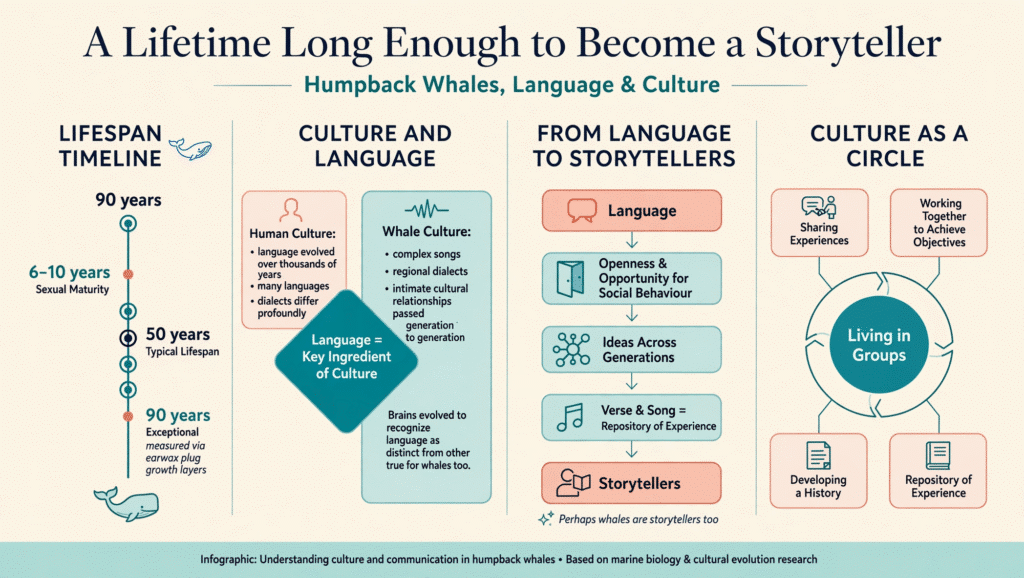
Most humpback whales live around 50 years. Exceptional individuals can reach up to 90 years of age, which scientists have measured by studying earwax plug growth layers. They reach sexual maturity between 6 and 10 years old. This lifetime is long enough to develop complex, intimate cultural relationships that whales pass from generation to generation. Language is a key ingredient of culture. In humans, language has evolved over thousands of years and in many forms.
Between 7,100 and 7,170 distinct human languages are spoken around the world today.
Are Whales Story-Tellers?
Language is culturally embedded, which is why humans have so many languages. Even within each language, local dialects can differ profoundly in word meaning. Human brains have evolved to recognise language, as distinct from other sounds. This must also be true for whales and other animals, to varying degrees. Language adds an extra layer of openness and opportunity for social behaviour. We can use it to develop ideas across generations through verse and song, creating ways to remember and pass on stories, a repository of experience. We became storytellers. Perhaps whales do something similar with their songs. Perhaps whales are storytellers too (figure3).
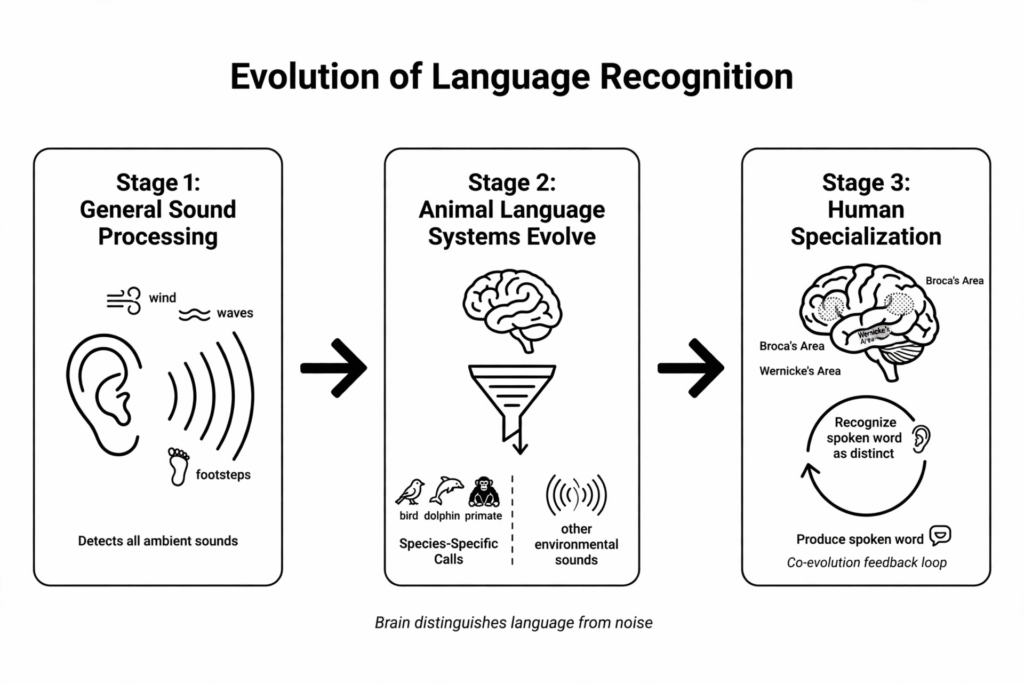
Human brains have evolved to recognise language, as distinct from other sounds. This must be true of all animal language systems. Humans have also evolved to use the spoken word. (Figure 1.)
This repository of experience is one advantage of living in groups, sharing experiences, and working together to achieve objectives. We begin to develop a history; a layer of understanding of who we are and where we came from.
What Role Does Communication Play in Whale Behaviour?
Whale cognitive function
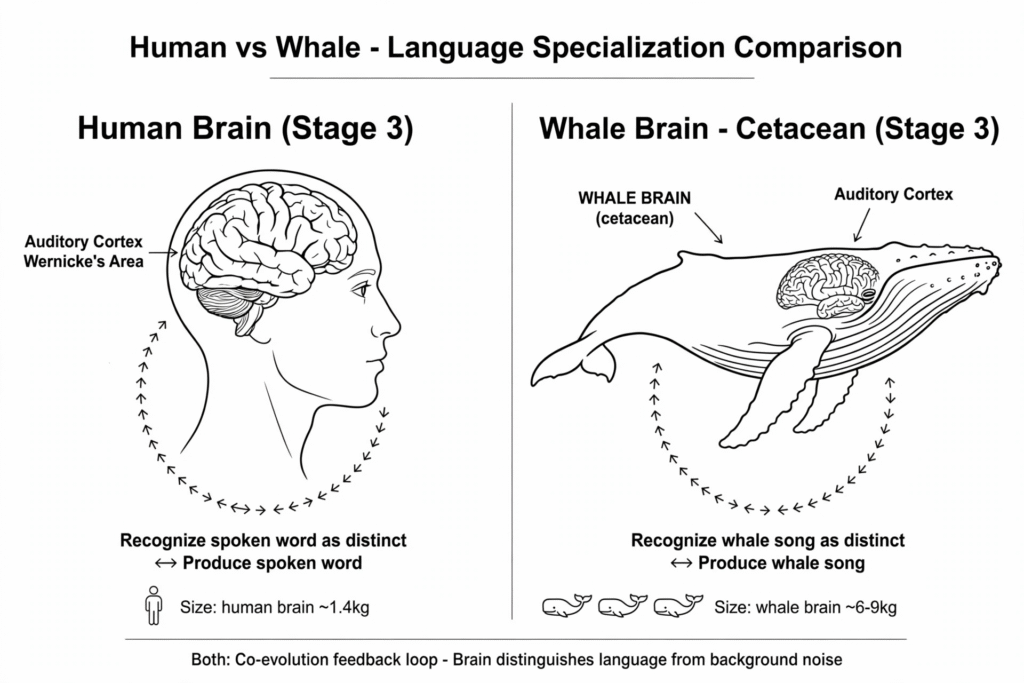
A whale brain looks like a massive, highly folded, rounded mass of grey and white tissue dominated by huge cerebral hemispheres. A sperm whale holds the record for the largest brain on Earth, weighing up to 9 kg (nearly 20 pounds) and measuring around 8,000 cubic centimetres. The cerebral hemispheres are exceptionally large and thick, completely dominating the brain stem. Killer whales and other toothed cetaceans show exceptional cortical elaboration in areas linked to processing complex social and acoustic signals. The humpback whale brain forms a massive, highly convoluted sphere that evolution has distinctly shortened from front to back, creating a globular or kidney-like shape. Its remarkable breadth displays an explosion of surface folds that surpass the complexity of a human brain.
Socially transmitted knowledge
Whales pass down knowledge across generations through social learning rather than depending solely on genetic instinct. According to research on cetacean behaviour highlighted by the Natural History Museum, “Whales are social animals that learn from each other and share behaviours. These behaviours are important for their survival, development, and sense of belonging.” This socially transmitted knowledge spans major behavioural domains, including foraging methods, migration routes, and vocal communication (see Figure 3).
According to Dr Luke Rendell, a researcher at the University of St Andrews who studies the evolution of social learning, communication systems, and culture among whales and dolphins. ‘As biologists, when we talk about culture we mean behaviour that is learned from others and shared by a group. ‘ ‘We’re not saying that whales have opera and dolphins have poetry, but some forms of shared and learned behaviour do seem to be very important to them in terms of how they make their living, survive, feed themselves and develop a sense of belonging. These animals are learning from each other in ways that are very important to their societies and their survival.’
Social Intelligence
Humpback whales possess specialised neurons called spindle cells (von Economo neurons) in the same areas of the brain as humans and great apes. These cells enable complex social behaviour, emotional processing, empathy, and communication, actively supporting the whale’s ability to compose intricate, evolving songs. These cellular networks also support memory, social intelligence, and language acquisition, giving whales the cognitive capacity to remember and develop rhyming, hours-long songs.
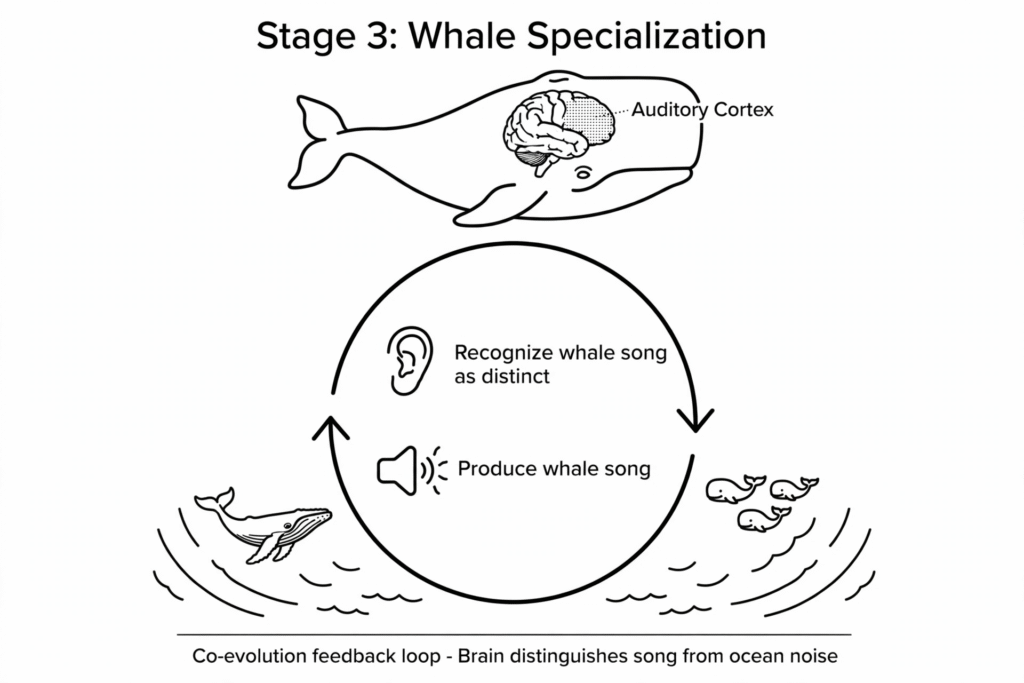
The language and speech centres in the human brain must have evolved alongside the development of speech. Similarly, the large specialised areas of the Whale’s brain for speech recognition and cognition must also have evolved alongside vocalisation faculties. This relationship would have been a mutual driver of evolution, alongside the development of cultural organisation and behaviour. In that sense, these drivers give evolution directionality in which the organisms are agents. (Figure 4).
‘Over time, some populations will radically change their songs. It can’t be explained through the loss of a single influential animal either – it’s more like a gradual cultural revolution.’ Dr Luke Kendell, University of St. Andrews.
A Brain for Navigation
Humpback whales possess an extraordinarily extensive and highly developed auditory cortex. These animals primarily perceive their world through sound. They rely entirely on acoustics to navigate, socialise, and compose complex songs, so a massive portion of their enormous cerebral cortex strictly processes sound. In humpback whales (and cetaceans in general), dramatic evolutionary expansion of the brain has pushed the auditory region upward. The primary auditory cortex sits right next to the visual cortex, allowing them to rapidly integrate sensory data. Read more here.
Coordinated pod behaviour
We often describe a pod as a clearly defined group in size and social structure. Yet, different species show varied pod sizes and structures, so not all species build similar cultural structures. Toothed whales form tightly-knit, lifelong family structures as highly social, complex mammals. At the extreme, pilot whales create incredibly large, stable family pods ranging from 20 to 150 whales. Orcas (Killer Whales) usually travel in pods of 5 to 30 individuals, with a matriarch leading the group. Baleen whales rarely form permanent pods, instead creating variable pods as needed.
Bubble-Net Feeding
In bubble-net feeding, a group of 15 or more humpback whales will spot a school of prey (like herring or krill) and dive deep beneath them. From the darkness below, they carry out a highly coordinated four-step strategy. First, a designated team of whales swims deep below and around the school of fish. They use their massive bodies to herd fish upward toward the ocean’s surface, packing them into a dense ball.
First, one primary leader—sometimes supported by a few other “bubblers”—begins swimming in a perfectly tight, upward spiral. Exhaling continuously through their blowhole, they create a cylindrical curtain of circular bubbles. Then, a single “caller” whale emits an incredibly loud, high-pitched, trumpeting vocalisation underwater. As a result, the call stuns the fish, leaving them helpless at the centre of the ring and synchronising the attack.
Navigation and Map Building
Whales use sound communication and echolocation to navigate. They build mental maps of their environment, and coordinate their movements across vast ocean expanses. Baleen whales (like blue and humpback whales) emit low-frequency calls that travel immense distances. They “listen to the echoes of their calls bouncing off distant ocean shelves and coastlines”, creating large-scale acoustic maps. Toothed whales (like sperm whales and killer whales) use high-frequency clicking sounds for biological sonar, or echolocation.
Key Takeaways
- Whales use a variety of sounds, including clicks and whistles, to communicate with their pods, showing cultural and contextual language traits.
- Humpback whales create complex songs with unique phrases and distinct dialects, indicating a structured form of communication akin to human language.
- Recent studies reveal sperm whales use a system resembling human vowels in their clicks, demonstrating depth in whale communication.
- Language plays a vital role in whale culture, passed down through generations, enhancing social ties and storytelling.
- Whales navigate and build mental maps primarily through sound communication and echolocation, showcasing their advanced cognitive abilities in social behaviour.