
Pine Martens could help Red Squirrels
Pine Martens as Red Squirrel Niche Protectors
Estimated reading time: 7 minutes
Pine Martens could help red squirrels. Grey squirrels (Sciurus carolinensis, introduced to the UK in 1876 by a wealthy landowner) now occupy nearly all of England and Wales. They are also found in large parts of Northern Ireland and central Scotland. Native red squirrels (Sciurus vulgaris), by contrast, survive mainly in isolated strongholds. About 75% of their remaining population is found in Scotland. Grey squirrels have displaced reds because they reach higher densities and are larger. Additionally, they transmit diseases like squirrel pox virus, to which they are immune, but red squirrels are not. Efforts to control grey squirrels, such as culling, have met with limited success and often face public opposition. However, recent research suggests that Pine Martens could help red squirrels because they primarily prey on grey squirrels.
Not only are red squirrels not immune to squirrel pox virus, but it is also typically lethal for red squirrels within a single week of transmission. Up to 70% of the grey squirrel population in the UK may carry the virus. Grey squirrels are also behaviourally aggressive towards red squirrels, acting as a strong constraint on the red squirrel niche.
Predator Naivety
Grey squirrels, which evolved in North America, do not recognise the danger posed by native predators like the pine marten. Research from Queen’s University Belfast shows that greys fail to detect pine marten scent, making them easy ambush targets.
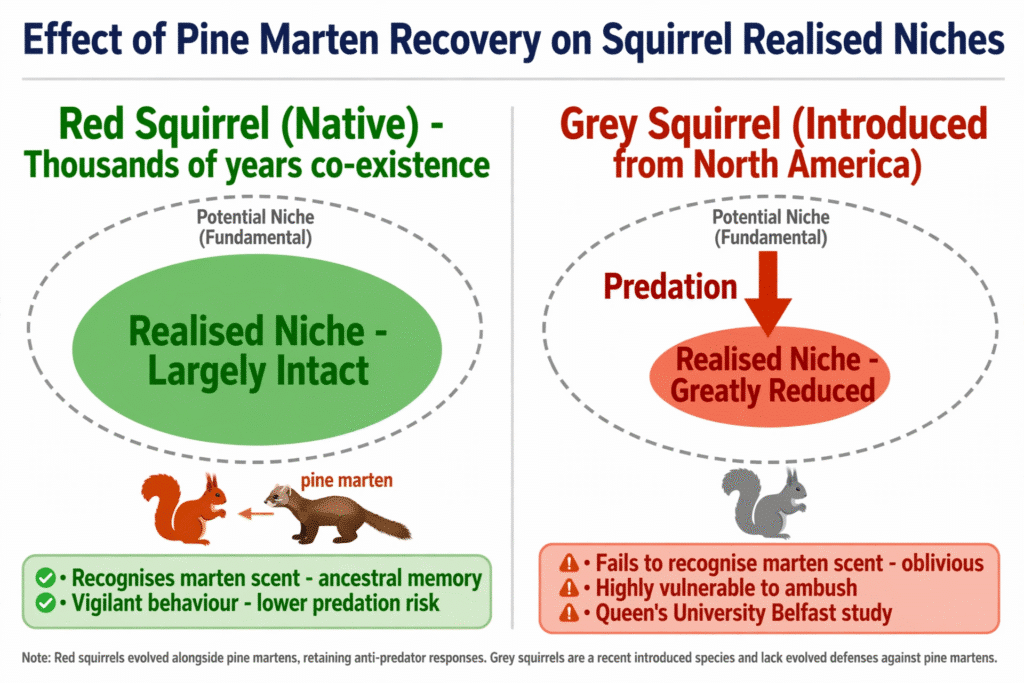
In contrast, Red squirrels and pine martens have coexisted in the UK for thousands of years. This long relationship has given red squirrels an innate wariness of pine martens. They become immediately vigilant when they sense a marten nearby. As pine marten populations recover, they naturally control squirrel numbers. Greys are especially vulnerable. These findings have important implications for red squirrel conservation policy (Figure 1). Pine martens could act indirectly as red squirrel niche protectors,
Niche constraint
The diagram (Figure 1) shows how the potential niche of a species is reduced or constrained by the presence of other species. Thus, a major factor constraining the spread of red squirrels is the presence of the grey squirrel. Reducing the population of grey squirrels would remove that constraint. As a result, the red squirrel’s realisable niche would be more extensive. The figure also shows the effect of fostering the pine marten population as a predatory constraint on grey squirrels. This action shrinks their realisable niche.
Pine Martens
Pine martens get their name from their habitat, living mostly in woodland and preferring to spend most of their time in pine trees. However, they also live in scrub, rocky areas, and crags. In the UK, they are mostly restricted to northern and central Scotland, with some populations in southern Scotland and low numbers in northern England and Wales. This distribution perhaps supports the contention that they prey more on grey than red squirrels. In turn, we should see more red squirrels where pine marten populations are high.
Support Pine Marten Recovery
In the model presented, pine martens act as natural biocontrol agents for invasive grey squirrels. They reduce grey squirrel numbers and ease competition and disease pressure on red squirrels. Robi Watkinson recently critically appraised this strategy in BioShorts (2026). The strategy also has the following key components.
Promote Habitat Management
Because pine martens are woodland specialists, restoring and maintaining complex, connected woodlands will benefit both pine martens and red squirrels. It will also make habitats less suitable for greys.
Reduce Reliance on Culling
Culling and poisoning grey squirrels has been costly, controversial, and often ineffective. Encouraging pine marten recovery offers a more sustainable, ecosystem-based solution.
Monitor and Manage Adaptively
Managers should monitor squirrel and pine marten populations. This ensures pine marten predation does not harm red squirrels, especially in areas with high red densities or few alternative prey.
Engage and Educate the Public
Raising awareness of the ecological benefits of pine martens can build support for their protection and for woodland restoration.
In summary, red squirrel conservation policies should prioritise pine marten recovery and woodland habitat management. Natural predation can help control invasive grey squirrels and secure the future of native red squirrels. One place where this is happening is the Forest of Dean.
Forest of Dean project
Between 2019 and 2021, a team from the Gloucestershire Wildlife Trust trapped 35 wild pine martens in the Scottish Highlands, fitted each one with a radio collar, drove them 600 miles south, and released them into the Forest of Dean, an ancient woodland on the English-Welsh border that had not seen a pine marten in over 160 years.
Recent studies
Recently published in Landscape Ecology, the study is the first to draw on pine marten records from across Europe. Using species distribution modelling, it provides important new evidence of the recovery of this once-widespread native species, following successful reintroduction efforts in areas such as Devon, Somerset, Wales, and the Lake District. The predator’s presence has triggered immediate behavioural shifts. Grey squirrels have dramatically expanded their home ranges and altered their activity patterns, indicating high levels of stress and fear that disrupt feeding and breeding. Whether this will enable a return of the red squirrel remains to be seen.
Although removing grey squirrels sounds simple enough, it is a complex, resource- and human-effort-intensive task that often requires large numbers of dedicated volunteers and political engagement and support from local people. Furthermore, grey squirrels are established in both rural and urban landscapes. If the Pine marten strategy has a role to play, it is unlikely to have a major effect on red squirrels as a stand-alone strategy.
The Landscape Ecology paper proposed that more research was needed to determine sites suitable for pine marten release. Not all locations will be suitable for long-term viability,
Conclusion
Evidence from Ireland, Scotland and Wales suggests that pine martens influence grey and red squirrel populations through both direct predation and indirect behavioural mechanisms that alter grey squirrel condition and space use. However, as a recent review concluded, it is not yet clear whether these interactions can control grey squirrels at a meaningful scale in the fragmented landscapes of England and Wales. Assessing this requires both understanding the ecological factors driving grey squirrel decline in the presence of martens and examining whether martens’ ecology meets the requirements of a species that can act as a biological control.
Given the now-fragmented red squirrel habitat, this strategy may not encourage red squirrels to repopulate the chosen areas. This raises the question of when it would be suitable to reintroduce them. However, we should not assume that the red squirrel goal is the primary conservation priority. Other reasons for controlling the grey squirrel population in woodland include their reported damage to trees. Even a small grey squirrel population can cause problems.
The larger size of grey squirrels enables them to process food resources such as acorns more efficiently, and they can strip hazel trees of developing fruit before it is ripe enough for red squirrels to consume. When introduced in Wales in 2015, Pine martens had no detectable effect on apparent grey squirrel survival, but home range size and daily distances travelled were positively correlated with marten exposure. As Watkinson concludes in his detailed review
“Whilst pine martens are not a panacea for Britain’s squirrel crisis, they may be a valuable part of the solution.”
Key Takeaways
- Pine martens could help Red Squirrels by preying on invasive grey squirrels that threaten their survival.
- Grey squirrels are larger and disease carriers, and they are often aggressive towards Red Squirrels, which limits their niche.
- Grey squirrels lack recognition of pine martens as predators, making them vulnerable to ambush.
- Promoting pine marten recovery and habitat management offers a sustainable solution to controlling grey squirrel populations.
- Recent studies show pine martens influence grey squirrel behaviour and distribution, but the effectiveness as a sole strategy remains unclear.